
How Long to Wait to Stain Pressure-Treated Wood: Test the Fence, Not the Calendar
New treated fence lumber may need weeks or months before staining. Learn the water test, moisture-meter check, and exception for KDAT wood.
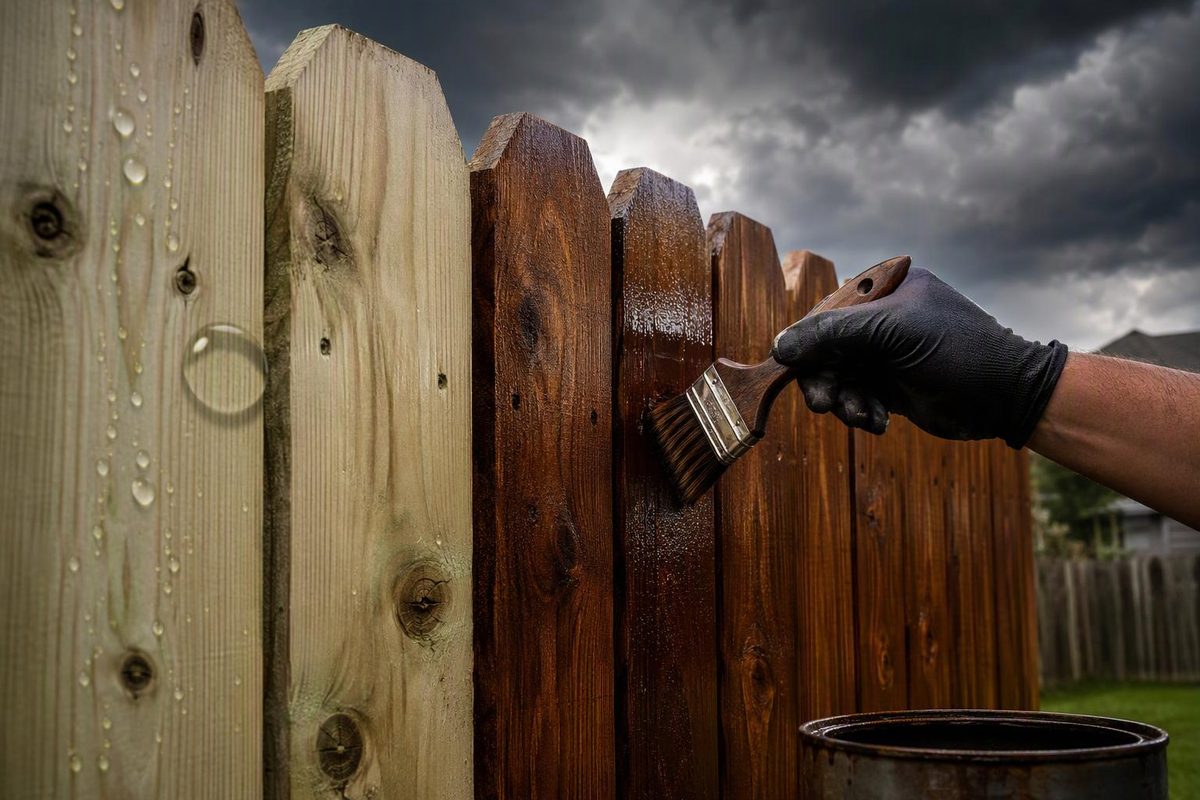
Wait until the wood is dry enough for your chosen stain—not a fixed number of months. Freshly pressure-treated fence lumber may need weeks or months to dry. Lumber marked KDAT (kiln-dried after treatment) can be finished immediately if it has stayed dry and meets the stain’s preparation requirements. YellaWood explains the difference.
A blanket “wait six months” rule can delay a fence that is already ready. Conversely, reaching a date on the calendar does not make wet boards suitable for staining.
What waiting time should you plan for?
Use the lumber’s condition to set the schedule:
| Fence lumber condition | What to do |
|---|---|
| Fresh, wet pressure-treated lumber | Allow drying time, then test. Expect weeks or potentially months—not a guaranteed deadline. |
| KDAT lumber that has stayed dry | It may be ready immediately; complete the stain’s required preparation first. |
| Lumber wetted by rain or washing | Let it dry again and recheck before staining. |
| Mixed pickets, rails and posts | Check each component rather than assuming the whole fence is ready together. |
YellaWood recommends staining its treated wood ideally within six weeks after construction, provided it is sufficiently dry. That is a conditional recommendation for its products, not a universal six-week waiting period. Its guidance specifically rejects the old practice of automatically waiting six months or a year. YellaWood’s staining instructions make dryness the deciding factor.
Check the lumber tag or receipt for KDAT. “Kiln-dried after treatment” matters because the drying takes place after the pressure-treatment process. Do not assume that any reference to kiln drying means the finished treated lumber is ready to stain.
How to check whether your fence is ready
Start with a water test
Sprinkle a few drops of water onto the wood. If they absorb, the surface is accepting water; if they bead or pool, hold off and investigate. Home Depot’s guide uses absorption within 10 minutes as its readiness check. YellaWood advises waiting several days and testing again when water beads.
For a fence, sample several locations:
- Pickets on both sides, including shaded sections.
- Rails and the exposed portions of posts.
- Lower boards and corners—not just the sunniest upper picket.
Treat this as a screening test, not a substitute for the stain’s instructions. Surface preparation can also affect absorption: Ready Seal, for example, requires preparation of smooth-milled or pressure-treated lumber before application. Ready Seal’s initial-application instructions.
Use a moisture meter when the stain specifies a limit
There is no single moisture percentage to apply to every stain. Use the limit specified for the actual product you buy.
For example, Ready Seal requires a two-pronged moisture-meter reading of 12% or less and recommends checking knot holes, corners and soft spots for consistent dryness. That is a Ready Seal requirement, not a universal standard for all fence finishes. Follow your meter’s operating instructions and take readings across the fence rather than relying on one board. Ready Seal’s drying requirements.
Cleaning and weather are separate checks
A fence that has dried since installation may need another drying interval after cleaning. Ready Seal notes that wood can take days to dry fully after rain, cleaning or other liquid preparation, depending on species, temperature and environmental conditions. Do not assume that washing today guarantees staining tomorrow. Recheck against the product’s moisture requirement. Ready Seal’s preparation and drying guidance.
Before starting, also check the stain label for application temperature, surface conditions and the required rain-free period. Complete a small test patch to confirm the color and appearance before committing to the entire fence, as Home Depot recommends.
If a contractor is handling the finish, ask the quote to identify the stain, preparation method and readiness check. A useful agreement makes staining conditional on suitable wood and weather—not simply “30 days after installation.” For choosing the finish itself, see best stain for pressure-treated wood by condition.