
Which Fence Will Cost You Less for the Time You Own It?
In some contractor comparisons, vinyl falls between pressure-treated pine and cedar rather than above both materials.
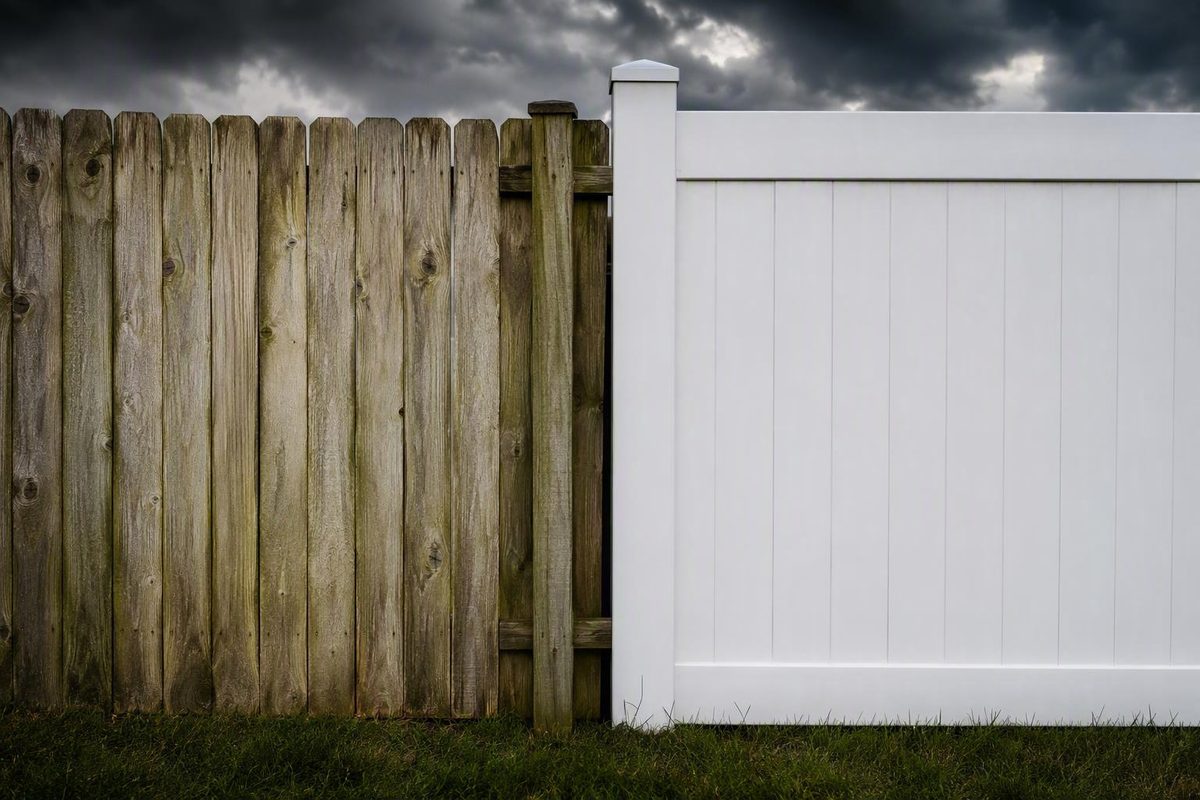
The short answer: wood usually costs less upfront, but vinyl can cost less to own
Pressure-treated wood usually has the lower initial installed price. Vinyl generally costs more at installation but requires less routine maintenance because it does not need recurring staining, painting, or sealing.
That does not make wood the cheapest choice for every project—or vinyl the automatic long-term winner. Installed-price ranges overlap, particularly when vinyl is compared with cedar, redwood, decorative wood, or premium privacy designs. In some contractor comparisons, vinyl falls between pressure-treated pine and cedar rather than above both.
The practical choice often looks like this:
| Your priority | Material that often fits |
|---|---|
| Lowest likely initial price | Pressure-treated wood |
| Natural grain or a custom stain color | Wood |
| On-site customization and localized board repairs | Wood |
| Shorter expected ownership period | Often wood |
| Less routine refinishing | Vinyl |
| More predictable routine upkeep | Vinyl |
| Longer ownership period | Often vinyl, if its premium is recovered |
| Cedar and vinyl quotes that overlap | Compare maintenance, repair, warranty, parts availability, and appearance directly |
There is no defensible universal break-even year. The result depends on the verified vinyl premium, wood species, finish, climate, maintenance method, repair history, installation quality, and how long you expect to own the fence. A seller’s model showing vinyl winning after eight, ten, or twenty years is one scenario—not a rule for your property.
Most importantly, compare equivalent fences. Hold these details constant:
- Total linear feet
- Fence height
- Picket, semi-privacy, or full-privacy design
- Gate dimensions and count
- Post material, dimensions, spacing, and depth
- Concrete and hardware
- Demolition and disposal
- Grading and site preparation
- Reinforcement
- Installation warranty
A four-foot wood picket fence and a six-foot reinforced vinyl privacy fence do not provide a useful material comparison. Neither does a materials-only retail cart compared with a fully installed contractor proposal.
Upfront installed cost per linear foot
For early budgeting, a reasonable synthesis of the supplied commercial estimates is approximately:
- Wood: $8–$30 per linear foot installed
- Vinyl: $15–$45 per linear foot installed
These are broad planning ranges, not matched national averages. A BarrierBoss retailer guide published in 2025 listed installed wood at $8–$25 per foot and vinyl at $15–$35, but did not identify a geographic market or disclose a pricing methodology. See the retailer’s 2025 cost tiers.
A separate Cool Cat Fence guide published in 2025 for Seattle- and Portland-area readers reported installed wood at $10–$30 per foot and vinyl at $25–$45, depending on wood type, vinyl style, and quality. Compare the Seattle and Portland contractor ranges.
The synthesized ranges use the lower wood and vinyl starting points from the retailer guide and the higher endpoints from the regional contractor guide. Regional, premium, or unusually difficult work can fall outside them.
Treat the figures as a screening tool. They can indicate whether a preliminary budget is plausible, but they cannot price rocky soil, a steep yard, restricted access, multiple gates, premium hardware, demolition, or local permitting requirements.
A narrower starting-price comparison
Thumbtack’s 2025 marketplace guide lists starting installed prices of $15 per linear foot for wood and $19 per linear foot for vinyl. The source does not establish that those starting examples have identical height, style, privacy level, posts, or product grade. It also says vinyl pricing changes with height, style, material quality, gates, embellishments, removal, preparation, and permits. See Thumbtack’s 2025 starting-price comparison.
That limitation matters. A low advertised price may describe a short, open picket fence, while the quote on your desk may cover a tall privacy system with reinforcement and two gates.
Wood is not one price category
Break wood quotes into at least three groups:
- Pressure-treated pine: Generally the lower-cost wood option.
- Cedar: Commonly priced above treated pine.
- Redwood or premium lumber: Often toward the higher end, subject to local supply.
Species is only the first distinction. Grade, board thickness, post material, fasteners, cap and trim details, initial finishing, and whether the design is stick-built or panelized can all alter the installed price.
This is why “wood versus vinyl” can be too broad to guide a purchase. Pressure-treated pine versus vinyl often shows a clear vinyl premium. Cedar versus vinyl may produce overlapping quotes.
In a 2024 comparison of one standard privacy design, Frederick Fence placed vinyl between pressure-treated pine and cedar. The contractor reported that vinyl was about 12% more expensive than pine, while the gap between pine and cedar was approximately 24%. The supplied comparison does not identify a broader geographic market or establish that the result applies nationally. Review Frederick Fence’s matched material example.
What “installed” should include
Ask every bidder to define “installed.” Ideally, it covers:
- Fence materials
- Delivery
- Layout
- Post-hole excavation
- Concrete
- Assembly
- Contractor labor
- Basic job-site cleanup
Removal, permits, grading, rock excavation, initial wood finishing, gates, decorative features, and haul-away may still be separate.
Do not add a published labor range to a figure already labeled installed unless the source clearly says labor is excluded. Some commercial guides state an installed price and then list labor separately without explaining whether labor is already embedded in the installed total. Adding both can double-count the same expense.
The safest comparison is the bottom-line installed amount in each local bid, followed by an itemized review of what that total includes.
What 100 and 200 feet could cost
Using the broad planning ranges above as arithmetic inputs gives these illustrations:
| Fence length | Wood at $8–$30/ft installed | Vinyl at $15–$45/ft installed |
|---|---|---|
| 100 feet | About $800–$3,000 | About $1,500–$4,500 |
| 200 feet | About $1,600–$6,000 | About $3,000–$9,000 |
These totals simply multiply fence length by the synthesized per-foot ranges. They are not matched quotes or national averages, and they do not add project-specific premiums that may be missing from the underlying estimates. The source ranges themselves vary by publisher, product, and market. Compare the underlying broad commercial estimates.
A 100-foot project can exceed the table if it is tall, decorative, reinforced, difficult to access, or gate-heavy. A simple layout in a lower-cost market may land closer to the bottom.
A localized 200-foot example
AR Fence’s Cape Fear, North Carolina, model estimated a 200-foot pressure-treated pine fence at $3,000–$5,000 installed and vinyl at $5,000–$8,000. It placed cedar and vinyl in the same $25–$40-per-foot installed range. The supplied page is dated “Jun 30” but does not display a publication year, so the currency of its pricing cannot be confirmed. See the Cape Fear 200-foot model.
This localized example is useful because it separates pressure-treated pine from cedar. It still is not a substitute for a local bid: the exact height, design, gate package, site work, and quote date may differ from yours.
Why 100 feet of vinyl can have several different prices
A Cool Cat Fence guide published in July 2025 and framed as a 2026 planning guide gives these installed estimates for Seattle- and Portland-area readers:
- Three- to four-foot picket fence: $3,000–$4,500 for 100 feet
- Six-foot privacy fence: $4,000–$6,000 for 100 feet
- Eight-foot privacy fence: $6,000–$8,500 for 100 feet
The publisher identifies them as planning ranges rather than its own project quotes. Compare the 100-foot vinyl estimates by height and style.
A short vinyl picket fence should not be compared with a tall wood privacy fence, and the reverse is equally misleading. Height changes panel area and may affect post requirements, labor, wind exposure, and reinforcement. A solid privacy design also uses more material than an open picket design.
Additions that can change either total
Before relying on a length-times-price calculation, account for:
- Walk gates and double drive gates
- Wider or reinforced gate posts
- Existing-fence demolition
- Disposal and haul-away
- Permit fees
- Property-line or survey work
- Grading and brush clearing
- Rocky, compacted, or wet soil
- Retaining walls or grade transitions
- Restricted equipment access
- Decorative caps, lattice, trim, or texture
- Stronger posts or closer post spacing
- Steel or aluminum reinforcement
- Premium hinges, latches, and hardware
- Delivery or travel charges
- Special digging requirements
Gates deserve particular attention. Two proposals with identical linear footage can differ substantially if one includes a basic walk gate and the other includes a reinforced double gate. Ask contractors to price every gate separately.
How to calculate 10-, 20-, and 30-year ownership cost
The relevant question is not simply, “Which fence costs less today?” It is:
Which fence is expected to cost less during the years I will own and maintain it?
Define total ownership cost as:
Installation + initial finishing + routine maintenance + expected repairs + replacement during the ownership period
You may also include financing expense or discount future costs to present value. For a straightforward homeowner worksheet, consistent cash-cost assumptions are usually enough to reveal what drives the result.
A reusable ownership-cost worksheet
Complete one column for pressure-treated pine, one for cedar, and one for the specific vinyl system being quoted.
| Input | Wood | Vinyl |
|---|---|---|
| Fence length | ||
| Matched installed quote | ||
| Initial staining or sealing | ||
| Cleaning cost per occurrence | ||
| Refinishing cost per occurrence | Not normally applicable | |
| Years between refinishing | Not normally applicable | |
| Refinishing cycles during ownership | ||
| Value assigned to DIY labor | ||
| Ordinary repair reserve per year | ||
| Major repair allowance | ||
| Expected replacement year, if any | ||
| Removal and disposal at replacement | ||
| Years of ownership | ||
| Total projected cash cost |
Do not automatically insert a replacement because a generic article supplies a lifespan range. Test at least two scenarios:
- The fence remains serviceable throughout your ownership.
- Major replacement occurs within the selected period.
This makes clear how strongly the answer depends on a prediction no seller can guarantee.
The simple break-even formula
When vinyl has a higher initial price, estimate its simple break-even point as:
Vinyl upfront premium ÷ annualized wood maintenance-and-repair disadvantage
Consider this invented arithmetic example:
- Wood installed: $8,000
- Vinyl installed: $10,000
- Vinyl premium: $2,000
- Assumed additional wood upkeep and repairs: $250 per year
The calculation is:
$2,000 ÷ $250 = 8 years
That is an eight-year simple break-even under the invented assumptions. It is not a market estimate or promise. It excludes financing, inflation, unexpected damage, replacement, and the time value of money.
If the annual difference is only $100, the same premium takes twenty years to recover. If professional refinishing makes the annual difference $500, it takes four. The verified premium and your maintenance method—not a generic slogan—determine the answer.
Model three wood-maintenance cases
A useful comparison should not contain only one wood scenario.
1. Professional-maintenance case
Include contractor cleaning, preparation, stain or sealer, labor, and any minimum service charge. This case may produce the strongest financial argument for vinyl because recurring professional labor can be substantial.
2. DIY-maintenance case
Include stain, cleaner, brushes or spraying equipment, protective materials, waste, and an optional value for your time. If you enjoy the work and assign no cash cost to your labor, wood may remain cheaper much longer.
3. Deferred-maintenance case
Do not model skipped maintenance as free. Reduce planned refinishing expense, but increase the repair allowance or bring forward possible board, rail, or post replacement. Deferred maintenance may conserve cash initially while increasing deterioration risk.
You can also model an “appearance-tolerant” case. Someone willing to accept fading, weathering, and cosmetic imperfections may spend less than an owner who wants a consistently finished surface.
What published long-term models actually show
The Cape Fear contractor model estimated ten-year totals of $3,900–$7,000 for maintained pressure-treated pine and $5,000–$8,200 for vinyl. Its ranges overlap, and maintained pine remains less expensive in parts of the comparison. The same source projected $7,000–$10,000 for pine when maintenance was skipped, but that result depends on its regional humidity, maintenance schedule, and repair assumptions. Review AR Fence’s Cape Fear ownership assumptions.
Seller-generated twenty- and thirty-year models may favor vinyl when they assume repeated wood staining, wood replacement, and limited vinyl repair. For example, a 2026 Kansas City contractor model projected a substantial thirty-year vinyl advantage, but it assumed cedar replacement in year 18 at an inflated future price while assigning vinyl only a small repair reserve. Its separate twenty-year ranges did not make vinyl uniformly cheaper. Review the assumptions in Kodiak Fence’s 2026 Kansas City model.
Published claims that vinyl breaks even around years eight to ten should therefore be treated as scenarios. They may be directionally useful where professional wood maintenance is frequent, but they are not independently validated rules.
Build 10-, 20-, and 30-year totals
For each ownership period:
- Start with the matched installed quote.
- Add initial wood finishing if it is not included.
- Count refinishing cycles that occur before the period ends.
- Add cleaning costs for both materials.
- Add ordinary repair reserves separately.
- Add major repairs only in scenarios where you expect them.
- Add removal and replacement if the selected scenario includes replacement.
- Compare cumulative totals and identify when modeled vinyl savings exceed its initial premium.
A ten-year comparison may favor wood, a twenty-year comparison may be close, and a thirty-year comparison may favor vinyl. That progression is not guaranteed. Owner-maintained cedar could remain economical, while impact damage or unavailable replacement components could weaken vinyl’s case.
Maintenance and repair costs that change the result
Wood and vinyl concentrate expenses differently. Wood commonly involves recurring preventive work and can permit localized repairs. Vinyl generally avoids routine refinishing, but some types of damage can require replacement of a larger component. Neither repair pattern is universal.
Common wood-fence expenses
A realistic wood budget may include:
- Periodic washing
- Mildew or dirt removal
- Inspection for loose fasteners and movement
- Staining, sealing, or painting
- Replacement of split, warped, or deteriorated boards
- Rail or post repair
- Hardware adjustment
- Vegetation control
- Disposal of removed lumber
Published refinishing recommendations vary. In the supplied commercial guidance, intervals commonly fall between every two and four years, but the appropriate schedule depends on the finish, manufacturer instructions, wood species, sun and moisture exposure, irrigation, and the appearance you expect.
BarrierBoss’s 2025 retailer guide estimated professional staining or painting at $3–$8 per linear foot every two to four years, compared with $1–$3 per foot for DIY application. It did not provide an independent methodology or geographic market, so use the figures as worksheet assumptions to test—not as guaranteed local prices.
For a 200-foot fence, even a modest per-foot refinishing cost becomes significant when repeated. Obtain a current local maintenance quote rather than extrapolating an online estimate indefinitely.
Vinyl is low-maintenance, not maintenance-free
Vinyl generally needs periodic washing rather than routine painting, staining, or sealing. Cleaning frequency depends on nearby trees, irrigation, soil splash, mildew, air pollution, color, and surface texture.
A vinyl maintenance budget should still include:
- Washing supplies or professional cleaning
- Gate-hardware adjustment
- Fastener or cap replacement
- Inspection after storms or impacts
- Panel, rail, or post repair
- Vegetation management
Calling vinyl “maintenance-free” can lead to a zero-dollar repair assumption that predetermines the lifecycle result.
Repairs follow different patterns
Wood often allows a contractor or capable homeowner to remove and replace one picket or board. If the rails and posts remain sound, the repair may remain localized. Matching an aged finish can still be difficult, although a broader section can be refinished if appearance matters.
Depending on its construction, a damaged vinyl system may require disassembly or replacement of a full rail, panel, or post. Blunt impact can crack or shatter a panel, and a later replacement may not match the aged color exactly. The Vinyl Outlet describes the possibility of full-panel replacement after impact.
Before buying vinyl, ask whether replacement pickets, rails, panels, posts, caps, and hardware are stocked locally. Also ask whether the profile and color are proprietary. A repairable system is more valuable when compatible components will remain obtainable.
Use three separate allowances
Do not combine every future expense into one vague “maintenance” number. Use:
- Routine maintenance: Washing, finish application, inspections, and adjustment.
- Ordinary repairs: Individual boards, hardware, rails, posts, or panels.
- Catastrophic damage: Fallen trees, vehicle impacts, major storms, flooding, fire, or ground movement.
Catastrophic damage is too unpredictable for a simple annual estimate in many projects. Model it as a separate scenario rather than assuming either fence will remain damage-free.
Lifespan, product quality, and climate
The supplied commercial sources generally assign longer service-life ranges to vinyl than to wood. Those estimates vary widely and are not independent guarantees, so they do not support one definitive lifespan for either material.
“Wood” can mean economical pressure-treated pine, clear cedar, redwood, or another species and grade. “Vinyl” can mean a basic unreinforced panel or a more robust system with stronger posts, rails, and reinforcement. Those product distinctions may matter more than the generic material label.
What can shorten a wood fence’s service life
Wood performance depends heavily on moisture management, installation, finishing, and timely repair. Potential concerns include:
- Persistent soil or vegetation contact
- Irrigation repeatedly wetting boards or posts
- Poor drainage around posts
- Trapped moisture
- Rot
- Wood-damaging insects
- Unsealed cut ends
- Loose or corroding fasteners
- Deferred replacement of damaged boards or rails
A wet or pest-prone setting can increase the work needed to keep wood serviceable. That does not mean vinyl automatically wins in every rainy climate. It means the wood estimate should reflect the maintenance appropriate to the property.
Pressure-treated pine, cedar, and redwood should have separate assumptions. A premium wood quote should not be judged using the lowest online wood price, just as reinforced vinyl should not be judged using the least expensive retail panel.
What can shorten a vinyl fence’s service life
Vinyl avoids wood rot and wood-boring insect damage, but it has other possible vulnerabilities:
- Blunt-impact damage
- Brittleness in severe cold, depending on the product
- Expansion and contraction with temperature changes
- Hardware stress if thermal movement is not accommodated
- UV-related aging, particularly in lower-quality products
- Loose or damaged caps, rails, and gates
- Full-panel or post replacement after some failures
These are product considerations, not forecasts for every vinyl system. Ask for product-specific documentation instead of assuming that every grade, color, and profile performs identically.
Match the material to the exposure
Use climate as an input, not a slogan:
- Frequent moisture or irrigation: Examine wood finishing, drainage, post treatment, and ground clearance.
- Pest pressure: Ask how the selected wood species and treatment are expected to perform locally.
- High UV exposure: Compare vinyl formulation, color warranty, and documented product performance.
- Extreme heat: Ask how the system accommodates expansion and how gates are reinforced.
- Severe cold: Ask about product-specific impact performance and warranty exclusions.
- Strong wind exposure: Compare engineering, post size, spacing, footing depth, panel design, and reinforcement.
- Coastal or corrosive exposure: Review fasteners, hinges, latches, reinforcement, and other hardware.
Installation quality affects both materials. Post depth and setting, drainage, alignment, concrete work, gate construction, hardware selection, reinforcement, and accommodation of grade changes can determine whether a promising product performs well.
Read the actual warranty
Do not rely on a generic phrase such as “lifetime vinyl warranty” or “naturally durable cedar.” Request the written product and installation warranties.
Check:
- Who provides each warranty
- Whether coverage transfers to a future owner
- Whether labor is included
- Whether removal and reinstallation are included
- Fading and discoloration exclusions
- Impact-damage exclusions
- Wind or storm exclusions
- Improper-installation exclusions
- Required wood-maintenance procedures
- Coverage for gates and hardware
- Whether replacement color matching is promised
- Whether replacement parts are prorated
- The claim process
Compare the coverage, not just the headline duration.
Cost is not the only difference: appearance, slopes, and DIY work
The financially cheaper fence may still be the wrong purchase if you dislike its appearance, cannot use it under neighborhood rules, or do not want its repair pattern.
Appearance and customization
Wood provides natural grain and variation. It accepts paint or stain, allowing the color to change later. Contractors can cut boards and rails on site, adjust spacing, build custom tops, and work around irregular boundaries.
Vinyl generally has a more uniform appearance. It is available in multiple factory styles and colors, but the system depends on prefabricated components. That uniformity is useful when you want clean, consistent lines. It may be limiting when a design requires unusual dimensions or extensive site-specific modification.
Consider how each material will look after several years. Wood may weather or require refinishing to preserve a selected appearance. Vinyl may retain a more uniform factory finish but can be difficult to match after an isolated replacement.
Slopes and irregular layouts
Wood is often adaptable on sloped or uneven ground because boards and rails can be cut and adjusted on site. Depending on the design, a contractor may follow the grade or step sections while controlling the gap below the fence.
Fixed-width vinyl systems may require:
- Stepped installation
- Rackable panels designed for slopes
- Custom panel adjustments
- Additional posts
- Changes in the bottom gap
- Purpose-designed transition sections
That does not make vinyl unsuitable for slopes. It means the contractor should show exactly how the proposed system will handle each grade change. Commercial guidance aimed at Bellevue homeowners likewise distinguishes field-cut wood from fixed-width prefabricated vinyl systems. Review the slope and customization comparison.
DIY installation and repair
Wood is generally the more accessible DIY option because its components can be measured, cut, fastened, and replaced using common carpentry methods. An individual board repair is also often more approachable than dismantling a proprietary vinyl section.
Commercial guides publish percentage estimates for DIY savings, but those figures should not be treated as guaranteed. Savings depend on tool ownership, delivery, spoilage, excavation, concrete work, disposal, helpers, and whether mistakes require replacement materials.
Vinyl can be installed by a capable homeowner, but prefabricated systems may be less forgiving. Exact post placement matters because rails and panels must fit fixed openings. Misplaced holes or posts that are not aligned and plumb can consume the anticipated labor savings.
A DIY budget should include:
- Material delivery
- Layout supplies
- Post-hole equipment
- Concrete
- Approved cutting or assembly tools
- Extra components for errors or damage
- Disposal
- Permit fees
- Utility marking
- Helpers or equipment rental
- The value of your time
Do not compare DIY wood with professionally installed vinyl unless that reflects your genuine choice. For an apples-to-apples financial decision, compare professional with professional or DIY with DIY, then show the alternative separately.
Apply the nonfinancial filters
Before selecting the lower projected total, ask:
- Which appearance fits the house and landscape?
- Does the HOA restrict material, color, or style?
- What privacy level is required?
- Will the fence contain children or animals?
- Are there pool or other local code requirements to confirm?
- Are you willing to wash, prepare, and refinish wood?
- Are you comfortable sourcing and replacing a vinyl panel?
- Do you expect to alter the fence later?
- Are slopes or irregular property lines important?
- How much visible weathering will you tolerate?
These filters may settle the decision before a precise lifecycle calculation does.
How to compare wood and vinyl quotes fairly
A good comparison starts with one written fence specification given to every bidder. If contractors bid different products and scopes, the lowest total may simply omit work included elsewhere.
Apples-to-apples quote checklist
Require both proposals to state:
- Total linear feet
- Fence height
- Picket, semi-privacy, or privacy style
- Board or panel dimensions
- Gate count, dimensions, and swing direction
- Gate framing and reinforcement
- Post material, dimensions, spacing, and depth
- Concrete specification
- Rail count and dimensions
- Fastener and hardware type
- Vinyl reinforcement, where applicable
- Demolition scope
- Disposal and haul-away
- Brush clearing
- Grading or slope work
- Rock or difficult-digging charges
- Delivery
- Permit responsibility and fees
- Property-line layout responsibility
- Cleanup and restoration
- Workmanship warranty
- Product warranty
- Estimated schedule
- Payment schedule
- Optional upgrades
For wood, require:
- Species
- Grade
- Whether the lumber is pressure-treated
- Board and post dimensions
- Treatment information where relevant
- Fastener material
- Initial stain, sealer, or paint
- Whether cut ends receive treatment
- The assumed future refinishing schedule
For vinyl, require:
- Named manufacturer
- Product line or system
- Panel and rail configuration
- Color and texture
- Post and rail specifications
- Reinforcement
- Gate construction
- Hardware
- Replacement-component availability
- Written warranty
“Premium vinyl” and “cedar fence” are not sufficiently detailed specifications.
Ask for itemized prices
Where possible, request separate lines for:
- Materials
- Installation labor
- Existing-fence removal
- Disposal
- Site preparation
- Gates
- Permits
- Delivery
- Finishing
- Optional upgrades
Itemization reveals whether an apparent material-price difference is actually caused by gates, demolition, or site work. It also makes later scope changes easier to evaluate.
Confirm whether initial wood finishing is included. If it is deferred, ask when the first finish should be applied and what preparation is required. Include that work in the wood total if the vinyl quote delivers a finished product.
Ask how repairs will work
For each bid, ask:
- Can one picket, rail, panel, or post be replaced independently?
- Which components are stocked locally?
- Are components proprietary?
- How long has the product line been available?
- Who performs warranty repairs?
- Is repair labor covered?
- Are freight and disposal covered?
- What happens if the original vinyl color is discontinued?
- Can a gate be adjusted without replacing major components?
- Does the contractor service fences it installed?
The lowest-maintenance material is not necessarily the easiest to repair. Your ownership-cost worksheet should reflect both patterns.
Use local bids as the final price evidence
National and regional planning ranges cannot price a specific property. Obtain multiple local bids based on the same written specification and, if possible, request pressure-treated pine, cedar, and vinyl alternatives.
Fence Report states that its coverage draws on hands-on agricultural and residential fence-building experience, identifies sources for quoted prices and specifications, and does not accept manufacturer payment for placement. Read Fence Report’s editorial and sponsorship approach. Even so, no online guide can replace an on-site assessment and current local proposal.
Final decision matrix
| Situation | Best comparison to make |
|---|---|
| Lowest initial check is the priority | Price pressure-treated wood first |
| Pine quote is far below vinyl | Test whether maintenance can recover the verified premium during your ownership |
| Cedar and vinyl quotes overlap | Compare upkeep, repairability, appearance, warranty, and parts availability |
| You will hire every wood refinishing cycle | Vinyl’s lower routine upkeep becomes more financially important |
| You will maintain wood yourself | Price supplies and decide whether to value your labor |
| You expect to sell relatively soon | Give greater weight to upfront cost and appearance |
| You expect to own the fence for decades | Run 20- and 30-year scenarios, including repair and replacement cases |
| You want natural grain or custom site work | Wood may justify its upkeep |
| You strongly dislike recurring refinishing | Vinyl may justify a verified premium |
| The yard has slopes or irregular boundaries | Compare the actual installation method |
| Repair access and local parts matter | Investigate stocked boards, panels, rails, posts, colors, and hardware |
Frequently asked questions
Is vinyl fencing always more expensive than wood?
No. Vinyl usually costs more upfront than pressure-treated pine, but installed ranges overlap. Cedar, redwood, premium lumber, decorative designs, and complex wood construction can cost as much as or more than some vinyl systems.
Compare identical height, style, privacy level, gates, posts, site work, and installation scope. A generic “wood” price is not enough because pressure-treated pine and premium cedar occupy different cost tiers.
How many years does it take for vinyl to become cheaper than wood?
There is no fixed number. Calculate:
Vinyl’s upfront premium ÷ annualized additional wood maintenance and repair cost
For an invented arithmetic example, a $2,000 premium divided by an assumed $250 annual difference produces an eight-year simple break-even. If the annual difference falls to $100, the result becomes twenty years. Those figures illustrate the formula; they are not market estimates.
Professional refinishing can shorten the modeled break-even period. DIY maintenance can lengthen it. Repairs, replacement, financing, climate, and ownership duration can change the result further. Published eight-to-ten-year claims are contractor scenarios, not a general rule.
How much does 100 feet of vinyl fencing cost compared with wood?
The broad arithmetic illustration in this article places 100 feet at approximately $800–$3,000 for wood and $1,500–$4,500 for vinyl, but those totals combine non-matched commercial ranges and should not be treated as local quotes.
Design-specific vinyl estimates can be much higher. A guide published in 2025 and framed for 2026 estimated 100 feet at $3,000–$4,500 for a three- to four-foot picket fence, $4,000–$6,000 for six-foot privacy, and $6,000–$8,500 for eight-foot privacy. See the design-specific 100-foot estimates.
Get local prices for the same height, design, gate package, posts, reinforcement, demolition, and site conditions.
Is cedar or vinyl the better value?
Cedar and vinyl can be a much closer comparison than pressure-treated pine and vinyl. When installed quotes overlap, the decision turns on maintenance, appearance, repair preferences, product quality, parts availability, and ownership period.
Cedar offers natural grain, stain flexibility, on-site customization, and often straightforward localized board repairs. Vinyl generally avoids recurring staining and sealing, but some impact damage may require replacement of a larger component or full panel.
Use the exact cedar and vinyl quotes in a lifecycle worksheet. Do not assume cedar is cheaper initially or vinyl is cheaper over time without checking the project-specific numbers.
Can DIY installation or staining make wood cheaper long term?
Yes. DIY installation and refinishing can reduce cash spending on wood, especially if you already own the tools and assign no monetary cost to your time. That can delay—or eliminate—the point at which vinyl recovers a higher initial price.
Include supplies, equipment rental, delivery, waste, helpers, cleaning, preparation, and future repair work. Also model the consequences of errors. Poor post setting, inaccurate layout, inadequate finishing, or delayed repairs can erase the apparent savings.
Compare a realistic DIY wood scenario with a realistic DIY vinyl scenario—or professional installation with professional installation—rather than mixing unlike scopes.
There is no universal winner in the vinyl fence cost vs wood decision. Pressure-treated wood usually minimizes the initial check. Vinyl can justify a higher quote when reduced routine upkeep matters and the ownership period is long enough to recover the verified premium.
Compare pressure-treated pine, cedar, and vinyl separately. Obtain matched local bids, enter your own maintenance and repair assumptions into the break-even formula, and choose the fence whose cash cost, appearance, repair pattern, and upkeep requirements fit your property.