
Budget Your Wood Fence Replacement by Length
Estimate wood fence replacement by length, then see how demolition, gates, posts, terrain, permits and finish affect a contractor’s quote.
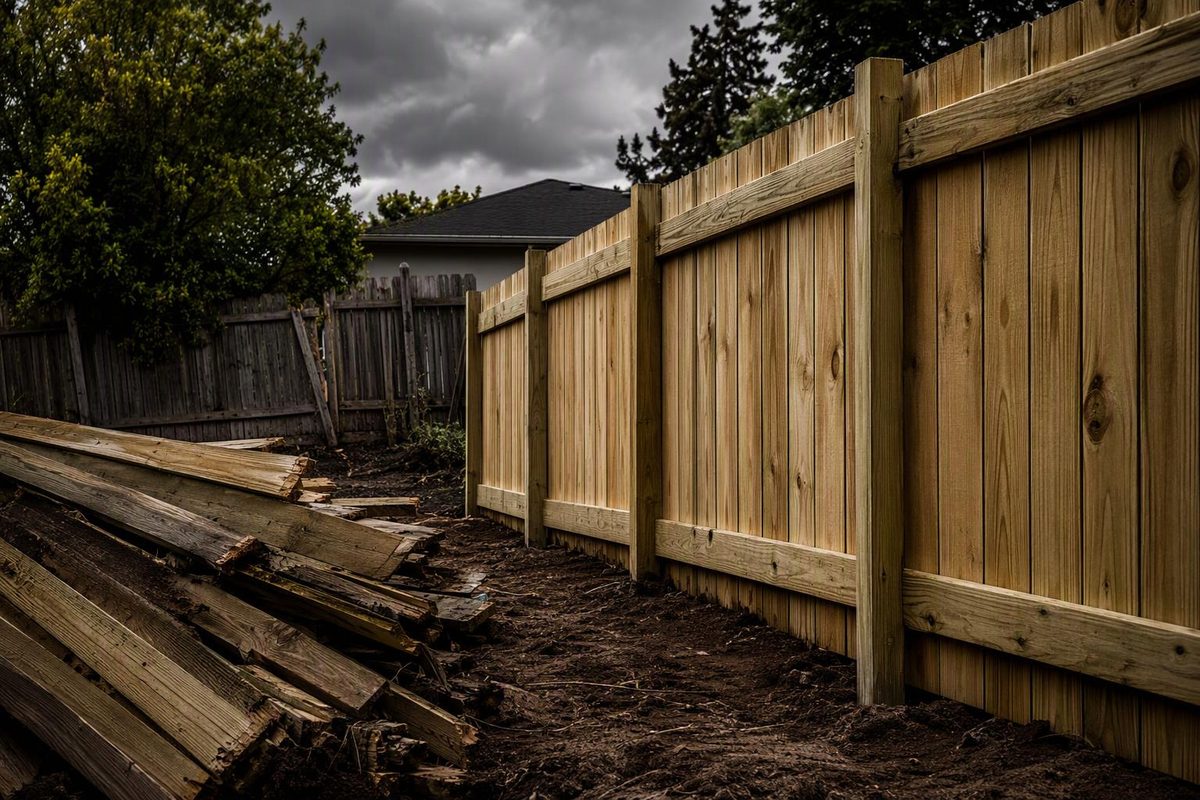
For early budgeting, expect the cost of replacing a wood fence to run roughly $28 to $70 per linear foot for a straightforward 6-foot privacy fence, including removal and disposal. At 150 linear feet, that is $4,200 to $10,500 before major grading, tree work, a survey or unusual gates.
This is a national planning range, not a quote. It combines a published $25–$50 per-foot allowance for a new 6-foot wood privacy fence with published removal allowances ranging from $3 to $20 per foot. Local labor, lumber, access and disposal costs can move a bid outside it.
Enter your fence length; adjust the per-foot rates if you have local quotes.
150 ft at $28–$70 per foot
Fence Replacement Calculator
Adjust the per-foot range
Source: planning range combines HomeGuide’s $25–$50/ft installed allowance with published removal allowances of $3–$20/ft. It excludes major grading, tree work, a survey and unusual gates.
Replacement Cost by Fence Length
| Fence length | Range at $28–$70/ft |
|---|---|
| 50 ft | $1,400–$3,500 |
| 100 ft | $2,800–$7,000 |
| 150 ft | $4,200–$10,500 |
| 200 ft | $5,600–$14,000 |
The underlying estimates do not define demolition identically. HomeGuide lists a 6-foot wood privacy fence at $25–$50 per foot installed and old-fence removal at $10–$20 per foot extra, including disposal (HomeGuide, 2026). Angi’s August 3, 2026 wood-fence guide gives a much lower $3–$7 per foot for removal (Angi).
That disagreement is a reason to require a separate demolition line in each quote. A shorter picket or open-rail fence may cost less than this range. An 8-foot, board-on-board, horizontal or decorative fence may cost considerably more.
Define What Fence Removal Includes
Replacing a fence can mean pulling every post and concrete footing, or merely dismantling panels and cutting posts at grade. Ask whether the demolition price includes:
- All panels, rails, posts and gate hardware
- Concrete-footing removal
- Loading, hauling and disposal fees
- Filling abandoned holes
- Removing vegetation attached to the fence
Cutting old posts off at grade can be acceptable if the new layout avoids them, but it should not be an undisclosed shortcut. Buried posts and concrete may conflict with the required spacing for the replacement fence.
Site access also affects demolition cost. Carrying concrete and debris through a narrow side yard takes more labor than loading beside the fence line. Heavy footings, rocky soil and roots can make removal substantially harder than knocking down deteriorated panels.
Specify the New Fence Before Comparing Bids
A quote that says only “wood fence” is not comparable with another quote. Require each contractor to price the same written specification:
- Finished height and total linear footage
- Privacy, picket, shadowbox, board-on-board or horizontal design
- Wood species and grade for posts, rails and boards
- Number and size of rails
- Post size, spacing, embedment and footing method
- Board thickness, width, overlap or gap
- Fastener material
- Trim, cap and kickboard details
- Gate dimensions and hardware
- Stain or sealer, if included
A board-on-board fence needs more boards than a single-layer design. Cedar and treated pine are not interchangeable merely because both are wood. If prefabricated cedar sections are under consideration, use these cedar panel buying checks to compare dimensions, rails, assembly and complete project cost.
Require Ground-Contact Treatment for Buried Posts
For wood posts installed in soil, specify treatment for ground contact. The American Wood Protection Association states that ground-contact applications require UC4A-treated wood or higher. It also explains that an AWPA-compliant end tag should show “AWPA U1,” the Use Category and preservative information (AWPA).
Treatment is only one part of the post specification. Height, spacing, soil, frost depth, wind exposure and gate loads also affect the structure; see fence post sizes by role.
Price Gates, Finish and Site Work Separately
Angi’s August 2026 guide puts a standard 4-foot-wide walk gate at $200–$600. It treats grading, vegetation removal, painting and staining as additional cost factors rather than part of the base fence price (Angi).
Ask the estimator to identify slopes, rocks, roots and limited access rather than burying them in an unexplained lump sum. Sloped sites may require stepped panels, racked sections or individually cut boards. Also confirm whether staining is included, excluded or delayed until the lumber is ready to accept a finish.
Repair May Cost Less When Posts Remain Sound
Full replacement becomes easier to justify when multiple posts are rotten or loose, the fence leans across several sections, rails have widespread decay, or the design no longer provides the required privacy or containment.
Partial repair may make more sense when posts remain sound and plumb and damage is confined to several boards, one rail or a gate. Gray boards alone do not establish structural failure. A typical residential wood fence can be budgeted around a 15–20-year service-life benchmark, but species, treatment, installation, exposure and upkeep can move the result well outside it; see how long a wood fence should last.
If the decision is close, request both repair and replacement prices. Note which aging components remain, what finish work is included and what each warranty covers.
Check Permits, Boundaries and Utilities Before Demolition
Rebuilding on the same line does not necessarily avoid current rules. Atlanta directs owners to obtain a permit for a new or replacement fence. San Antonio’s residential FAQ requires one when more than 25% of an existing fence is repaired or replaced (Atlanta 311; City of San Antonio). These are local examples, not nationwide thresholds. Check your municipality for permit, height, setback and corner-visibility rules, along with any HOA requirements.
Confirm the property line before demolition if its location is uncertain. Then contact 811 before digging new post holes. The national 811 information site says every digging project, regardless of depth, requires contacting 811 a few days in advance (811 Before You Dig).
Public utility locating does not establish a property boundary or necessarily mark owner-installed irrigation, septic components and other private lines. Lowe’s installation guidance likewise tells owners to identify unmarked irrigation, sprinkler and septic systems separately (Lowe’s).
Make Every Replacement Quote Auditable
A useful replacement quote should identify demolition, disposal, the new fence, gates, finish, permits and site work. It should state whether every old post and footing comes out, identify the lumber and post treatment, describe the footing method, and provide warranty terms.
Compare several quotes against one written specification. A $35-per-foot bid that excludes removal, footings, a gate and staining may ultimately cost more than a $45-per-foot bid that includes them.