
A Realistic Guide to Wood Fence Lifespan
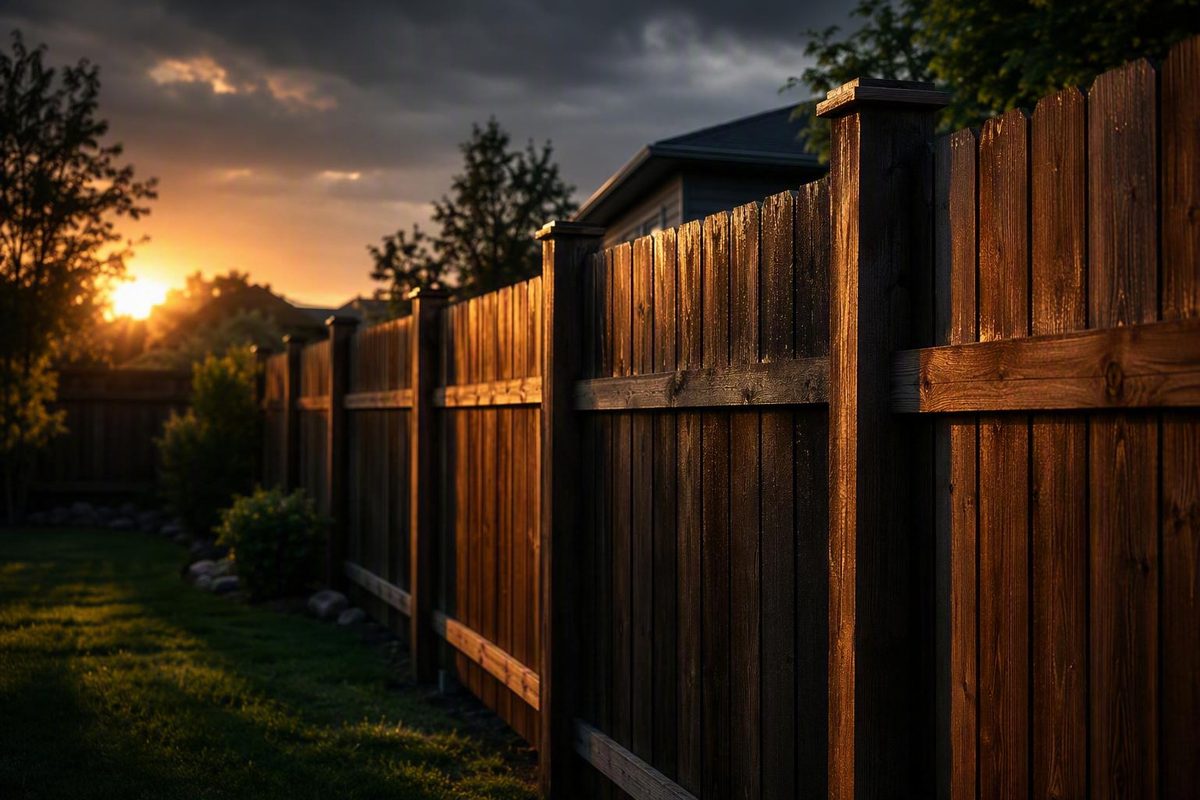
The short answer: plan on about 15–20 years
For planning purposes, a typical residential wood fence should last about 15–20 years. That is a budgeting benchmark, not an expiration date. A broader range of roughly 10–30 years is plausible once differences in lumber, treatment, installation, climate, moisture exposure, and maintenance are considered. Angi publishes a 15–30-year range while describing about 15 years as an average, and another commercial guide estimates 10–25 years (Angi’s wood-fence lifespan guide; Outdoor Living’s lifespan estimates).
At the short end, neglected fences, low-grade lumber, poor drainage, or constant wetting may produce major deterioration within approximately 5–10 years. At the long end, durable material, sound construction, favorable exposure, and timely care may carry a fence toward 25 years or longer. These are possible outcomes reported by fencing companies, not promises or warranties (Big Jerry’s Fencing lifespan overview).
A fence can also look old long before it stops working. Graying, fading, small splits, surface checking, and an uneven finish indicate weathering, but they do not prove that the posts, rails, or connections have failed. Appearance and structural condition should be evaluated separately.
The practical question is not simply, “How old is the fence?” It is, “Does the fence remain upright, firm, securely connected, and capable of doing its job?” A relatively new fence with several soft or unstable posts may be in worse condition than a much older fence on a well-drained site.
Evidence note: They are directional commercial estimates, not results from standardized independent testing. Agreement among several commercial pages does not turn a range into a warranty, engineering standard, or scientific consensus. Use the figures for planning, then use the fence’s actual condition to decide whether to maintain, repair, or replace it.
Wood fence lifespan by material
Wood species matters, but the name on the lumber is only a starting point. The following ranges reconcile the supplied commercial estimates into practical planning bands.
| Wood type | Directional planning range | Common vulnerabilities | Evidence confidence |
|---|---|---|---|
| Untreated softwood, including untreated pine and comparable low-durability softwoods | About 5–12 years (Cedar Rustic’s material comparison) | Rot, insects, warping, splitting, and rapid deterioration under persistent moisture | Low; the range is commercially reported and highly exposure-dependent |
| Pressure-treated pine | About 10–20 years (Pittsburgh Fence Company’s pine-and-cedar comparison) | Checking, shrinking, twisting, warping, coating wear, and decay where treatment or drainage is inadequate | Low; regional commercial estimates conflict substantially |
| Cedar | About 15–25 years (Cedar Rustic’s cedar lifespan guide) | Persistent moisture, decay near grade, insects, checking, and ultraviolet weathering | Low to moderate agreement among commercial estimates, but low independent-evidence confidence |
| Redwood | About 20–30 years (Frame It All’s wood-fence guide; Big Jerry’s material comparison) | Moisture exposure, end-grain wetting, checking, ultraviolet weathering, and variable lumber grade | Low; fewer supplied sources address redwood, and the estimates remain commercial claims |
The untreated-softwood range is most applicable to ordinary untreated pine and other relatively vulnerable softwoods, not every piece of every softwood species. A separate regional contractor guide places spruce and fir toward the short end of wood-fence longevity, particularly where moisture exposure is substantial (Cool Cat Fence’s wood-fence guide). Dry conditions and careful detailing may improve performance, while wet soil contact or repeated irrigation can shorten it.
For pressure-treated pine, the table’s broad planning band should be treated cautiously. Some contractors place it near the lower end, while regional accounts sometimes report substantially longer performance.
Pressure treatment improves resistance to decay and insects, but it does not prevent checking, swelling, shrinking, twisting, or warping. It also cannot compensate for unstable footings, standing water, damaged cut ends, unsuitable hardware, or construction that traps moisture.
For cedar, the table’s planning range assumes suitable installation and exposure. Cedar is commonly described as naturally resistant to decay and insects, but “resistant” does not mean immune. Wet post bases, saturated soil, dense vegetation, restricted airflow, and pest pressure can still cause deterioration. Cedar can also fade to silver-gray while remaining firm and usable.
For redwood, the range is particularly tentative. Commercial comparisons often place it above ordinary untreated pine and near or above cedar, but fewer supplied sources provide redwood-specific figures. Grade, heartwood content, availability, climate, and construction details may materially affect the result.
Do not use exceptional lifespan claims for exotic hardwoods to set expectations for an ordinary residential pine, cedar, or redwood fence. Those materials differ in cost, availability, grades, installation requirements, and typical applications, and the supplied evidence does not justify treating unusually long commercial claims as normal residential performance.
Most importantly, species cannot rescue a poor installation. A high-grade board attached with unsuitable hardware to an unstable, poorly drained post system may fail prematurely. Conversely, appropriate material selection, careful workmanship, ground clearance, drainage, and suitable hardware can help a less prestigious material remain serviceable.
A fence does not age as one piece
A quoted lifespan describes the fence as a usable system. It does not guarantee that every post, rail, picket, gate, and fastener will remain sound for the same period. Components face different loads and exposures, so remaining life should be assessed component by component.
Posts: Begin here. A post may soften or lose stability while the boards attached to it still look acceptable. Watch for leaning, movement, cracks around connections, and visible deterioration near ground level.
Rails: Rails connect the posts and support the pickets or panels. Look for sagging, failed ends, loose connections, splitting near fasteners, and areas that remain damp. One damaged rail may be a localized repair. Failed rails across several sections suggest a wider problem with moisture, connections, or supporting posts.
Pickets or panels: These are the most visible components but not always the most structurally important. An isolated warped, split, or rotted board can often be replaced while the supporting structure remains intact. Conversely, attractive pickets may conceal weakened posts or loose rail connections.
Gates: Gates are high-use assemblies. A dragging or misaligned gate may reflect loose hardware, frame distortion, soil movement, or a failing hinge post. Gate trouble does not automatically condemn the entire fence, but recurring misalignment can reveal continuing structural movement.
Hardware: Check nails, screws, brackets, hinges, and latches for corrosion, looseness, pull-through, or staining around connections. Hardware that no longer holds tightly can weaken otherwise usable wood.
An isolated failed post or damaged board can sometimes be replaced without discarding sound sections. Feasibility depends on whether the fence is stick-built or panelized, how its components are connected, whether the damaged area is accessible, and whether adjacent wood can tolerate disassembly and reattachment.
Instead of recording only the installation year, note the condition of each component. A short entry such as “two loose pickets, gate sagging, southeast post soft, north run stable” is more useful than a statement based on age alone. Photographs taken from the same locations can reveal gradual leaning, recurring moisture patterns, and repairs that continue to fail.
What moves a fence toward the short or long end of the range
Persistent moisture is the recurring threat. Pooled water, saturated soil, sprinkler overspray, vegetation pressed against boards, trapped debris, and poor airflow keep wood wet. Mold or algae may signal damp conditions, although surface growth alone does not prove that the wood has lost structural strength.
Direct contact with soil or mulch increases moisture exposure and allows organic debris to collect against the fence. Keep pickets and rails clear of the ground where the design permits. Prevent mulch, leaves, vines, and soil from accumulating around posts and boards. Correcting the source of repeated wetting is generally more important than covering the symptom with another coat of finish.
Climate changes the dominant stress:
- Frequent rain and high humidity slow drying and prolong damp conditions.
- Freeze-thaw cycles can compound soil movement and the effects of existing cracks or moisture exposure.
- Intense sunlight and ultraviolet exposure fade wood and contribute to surface deterioration.
- Severe wind loads posts, rails, panels, gates, and connections.
- Moving or poorly compacted soil can pull sections out of alignment.
- Termites and wood-boring insects can damage vulnerable material.
Ultraviolet exposure can dull and crack wood, creating additional paths for moisture. Excessive moisture can contribute to warping, rot, mold, and algae, while some insects consume or bore into wood fibers (Lowe’s wood-fence protection guide).
Consider two contrasting fences. A cedar fence with stable posts, open airflow, no sprinkler contact, and fast drainage may approach the upper part of its planning range. A pressure-treated fence in saturated soil and daily irrigation may fall below its nominal range despite the preservative treatment.
Regional estimates require similar caution. Advice from the rainy Pacific Northwest, humid Georgia, freeze-thaw conditions around Pittsburgh or the Midwest, or a contractor working in St. Louis may be useful locally but should not be applied nationwide without adjustment. A source’s estimate can reflect regional lumber, treatment practices, soil, pests, and construction methods as much as the species itself.
No responsible rule can say exactly how many years one sprinkler, shaded corner, harsh winter, or windstorm removes from a fence’s life. Look instead for patterns: sections that stay wet, posts that repeatedly move, hardware that continually loosens, or repairs that fail in the same exposure.
Installation details that influence service life
Durable lumber cannot compensate for every installation flaw. Post placement, foundations, drainage, ground clearance, spacing, hardware, and management of exposed end grain all influence how a fence ages.
Posts and foundations should suit the property’s soil, drainage, frost conditions, expected wind, fence height, gate loads, and applicable local requirements. There is no responsible universal post depth or footing design for every yard. A short, open fence in stable, well-drained soil and a tall privacy fence in frost-susceptible ground present different demands.
The objective at the base is to support the fence without creating persistent wet pockets around vulnerable wood. Keep rails and pickets out of soil and mulch. Grade or drain the area so rain and irrigation move away rather than collecting around each post.
Use rust-resistant fasteners and outdoor connectors appropriate for the lumber and exposure. Corroded, loose, or undersized hardware can permit movement, and repeated movement can enlarge holes or split wood around connections. Commercial installation guidance consistently treats sound spacing, firmly supported posts, and rust-resistant fasteners as basic durability considerations (Bryant Fence’s installation and maintenance guide).
Post caps and other details that cover exposed end grain may help shed water. Their benefit depends on fit, design, exposure, and maintenance, so they should not be treated as a guaranteed way to add a particular number of years.
Where wood-post decay has repeatedly limited fence life, steel posts behind wood panels are an option worth evaluating. Steel posts do not make the wood rails and boards maintenance-free, nor do they guarantee a fixed service life.
Commercial advice conflicts on footings. Some contractors favor concrete-set posts, while another supplied source favors dry-set footings on the theory that they drain better. Neither method is universally superior in every soil, climate, and fence design. Concrete geometry, drainage, post treatment, frost behavior, wind loads, local requirements, and established regional practice all matter. Base the decision on site conditions, material instructions, applicable requirements, and qualified local installation guidance rather than one contractor’s nationwide rule.
A condition-based maintenance schedule
A useful maintenance program follows the fence’s exposure and condition rather than treating every task as a rigid calendar event.
Ongoing moisture control
Whenever a problem appears:
- Redirect sprinklers that repeatedly wet the fence.
- Correct pooling water and obvious drainage problems.
- Remove leaves and debris trapped around post bases.
- Prevent soil or mulch from building up against boards.
- Trim vines, shrubs, and groundcover touching the fence.
- Restore airflow around shaded, slow-drying sections.
These actions address conditions that contribute to decay and distortion. They take priority over cosmetic work.
Annual inspection
Walk both sides of the fence at least once a year and inspect it again after weather that appears to have caused damage. Annual inspection is a recurring recommendation in commercial maintenance guidance (Reddi Fence’s wood-fence maintenance guide). Check:
- Post bases and visible ground-level zones
- Leaning, racking, or movement
- Rail ends and post-to-rail connections
- Loose, missing, or corroded fasteners
- Split, warped, broken, or missing boards
- Gate alignment, hinges, latch, frame, and supporting posts
- Visible insect activity or damage
- Drainage and pooled water
- Vegetation and debris contact
- Sprinkler overspray
- Peeling, worn, or uneven finish
Mark affected locations and photograph them. Comparing the same section over time makes gradual movement and recurring failures easier to detect.
Periodic cleaning
Clean when dirt, algae, mildew, or other buildup warrants it. Begin with the gentlest method appropriate for the wood and existing finish. Excessive pressure washing can roughen or gouge weathered fibers, so follow the equipment and cleaning-product instructions and test an inconspicuous area first (Bryant Fence’s cleaning guidance).
Allow the wood to dry as required before applying a finish. Cleaning should not substitute for correcting irrigation, drainage, vegetation contact, or structural movement.
Prompt repair
Tighten or replace suitable fasteners, correct gate problems, replace failed boards, and address loose rails before movement damages adjacent components. If a section leans or a post is unstable, address the structural cause before cleaning or staining it.
A repair should also address the source of the damage. Replacing a repeatedly soaked board without redirecting the sprinkler may simply restart the same deterioration cycle.
Finish renewal
As a broad planning range, evaluate stain or sealer renewal approximately every 2–4 years, while recognizing that some coatings may call for shorter or longer intervals (Cool Cat Fence’s maintenance guidance). The actual schedule should depend on:
- Coating type and opacity
- Manufacturer instructions
- Sun, rain, humidity, and irrigation exposure
- Visible peeling, fading, or uneven wear
- Whether water beads or readily absorbs
- Wood moisture at application
- Surface preparation and compatibility with previous coatings
Stain can preserve or change color, while suitable exterior coatings may also reduce exposure to moisture and ultraviolet light. The supplied evidence does not establish that staining adds a precise number of structural years to every fence. A cedar fence allowed to turn silver-gray may remain sound; appearance preference and structural condition are separate questions.
For new pressure-treated lumber, allow the wood to dry sufficiently for the selected coating. Commercial recommendations vary with the lumber and conditions, so follow the coating manufacturer’s moisture, preparation, weather, and application requirements rather than relying on one universal waiting period (Pittsburgh Fence Company’s treated-pine guidance).
If you must choose between correcting pooled water and applying fresh stain, correct the water. Drainage, stable posts, sound connections, and timely repairs come before cosmetic refinishing.
How to estimate the remaining life of an existing fence
Do not estimate remaining life by subtracting the fence’s age from a standard lifespan. Use a walk-around assessment instead.
- Start with the posts. Look for visible softness or rot, cracking, leaning, and movement. Pay particular attention to wet, shaded, irrigated, and low-lying areas.
- Follow the rails. Identify sagging, failed ends, broken members, and loose connections.
- Scan the pickets or panels. Separate isolated damage from deterioration spread across an entire run.
- Operate every gate. Note dragging, racking, failed latches, loose hinges, and movement in the supporting posts.
- Inspect the hardware. Look for corrosion, missing fasteners, loose brackets, and connections pulling through the wood.
- Compare exposures. Examine sunny and shaded runs, high and low ground, sprinkler zones, windy corners, and sections beside dense landscaping.
- Document the pattern. Record which components are affected, how widely the damage is distributed, and whether earlier repairs have failed again.
Fading, silver-gray weathering, and minor surface checking may be cosmetic when the wood remains firm, upright, securely connected, and functional. Color alone does not reveal structural capacity.
Stronger warning signs include:
- Soft or visibly rotted posts
- Significant leaning or movement
- Failed or sagging rails
- Widespread board decay
- Insect damage
- Unstable or repeatedly misaligned gates
- Loose structural connections
- Repeated breakage or failed repairs
A gray but stable cedar fence may need only cleaning or optional appearance treatment. Multiple soft posts combined with failed rails indicate a more serious loss of function.
Gather whatever history is available:
- Approximate installation date
- Wood species and grade, if known
- Whether posts or boards were pressure-treated
- Stain, paint, or sealer history
- Previous post, rail, board, or gate repairs
- Drainage changes
- Irrigation exposure
- Areas of recurring failure
Treat a severely leaning or unstable section cautiously rather than dismantling it as routine maintenance. When structural stability or safe repair is uncertain, obtain a qualified assessment; commercial inspection guidance identifies soft posts, serious leaning, widespread decay, and irreparable gates as major warning signs (Economy Fence Center’s condition guidance).
The result should be a condition profile, not a falsely precise number. For example: “Most boards are weathered but firm; one gate post moves; two rails have failed on the irrigated side; all other runs remain upright.” That description supports a better decision than assigning an exact number of remaining years.
Repair individual components or replace the whole fence?
Choose among four outcomes: maintain, repair localized damage, replace failed structural components, or replace the complete fence.
1. Maintain
Maintenance is appropriate when the fence remains stable and functional and the main concerns are:
- Dirt or biological buildup
- Worn finish
- Vegetation contact
- Minor hardware looseness
- Cosmetic fading or graying
- A few superficial checks
Correct moisture sources, clean as needed, service hardware, and renew the finish according to its condition and product directions.
2. Repair localized damage
Localized repair makes sense when one or a few pickets, fasteners, rail ends, hinges, latch parts, or gate components have failed but the adjacent structure is sound. The repair should address the cause as well as the visible damage.
Before replacing a component, check what supports it. A new picket attached to a sound rail can be a durable repair. A new picket attached to a decaying rail merely conceals the larger problem.
3. Replace failed posts or structural components
A post or rail may be replaceable while nearby panels and boards are retained. This is most practical when the surrounding wood is firm enough to disconnect and reconnect, the design permits access, and deterioration is genuinely limited.
If each post repair reveals another weak rail or damaged connection, the project is no longer localized. Component replacement makes sense only when the retained material can reliably support the repaired section.
4. Replace the complete fence
Full replacement deserves serious consideration when:
- Rot is widespread
- Multiple posts are soft or unstable
- Long sections lean severely
- Rails repeatedly fail
- Gates cannot stay aligned because their supports move
- Many boards are decayed rather than merely weathered
- Repairs recur without restoring stability
- Sound new components would depend on broadly deteriorated material
Age provides context but should not decide the outcome by itself. A well-situated older fence may remain serviceable, while a much newer fence can fail because of saturated soil, unsuitable materials, poor construction, or severe exposure.
Some commercial guides propose replacing a fence after a fixed percentage is damaged or when repair costs cross a set share of replacement cost. Treat those figures only as informal sales or budgeting heuristics, not engineering standards. A small amount of damage concentrated in critical posts may matter more than a larger area of cosmetic picket damage.
Compare the scope, recurrence, and likely durability of repairs with complete replacement options. A useful quote should identify which posts, rails, panels, gates, and hardware will be retained; what hidden deterioration could change the scope; and whether repaired sections will depend on aging adjacent material. National cost averages are of limited value without project length, height, location, access, terrain, lumber grade, gates, disposal, and labor details.
The central rule is simple: repair isolated defects when the surrounding structure is sound; consider replacement when failures are widespread, structural, and recurring.
Frequently asked questions
Does a 20-year-old wood fence automatically need to be replaced?
No. Age is a planning clue, not a mandatory replacement trigger. Inspect the posts, rails, connections, gates, and extent of decay. A fence that remains firm, upright, and functional may need only maintenance or limited repair. Multiple soft posts, failed rails, severe leaning, or recurring structural problems support replacement regardless of the installation date.
How often should a wood fence be stained or sealed?
Use approximately every 2–4 years as a general planning range, not a rigid rule. Coating type, exposure, visible wear, water absorption, wood moisture, previous finishes, and manufacturer instructions should determine the actual timing. Correct drainage and structural problems before refinishing.
Can a rotted fence post be replaced without replacing the panels?
Feasibility depends on the fence design, access, connections, and condition of neighboring components. If several posts or surrounding rails are decayed, replacing one post may not restore dependable stability.
Which lasts longer: cedar or pressure-treated pine fencing?
There is no universal winner. Commercial estimates often place cedar higher, but some regional contractors report longer performance for pressure-treated pine. Cedar’s natural decay resistance, pine treatment quality, lumber grade, drainage, ground contact, pest pressure, workmanship, and climate can reverse the expected result on a particular property. Compare the complete material and installation specification, not just the species name.
Does a gray wood fence need to be replaced?
No. Gray color commonly results from surface weathering, especially with cedar. If the fence remains firm, upright, securely connected, and functional, cleaning or an optional appearance treatment may be sufficient. Replacement becomes more likely when weathering accompanies soft rot, unstable posts, widespread decay, failed rails, or severe leaning.
The practical planning benchmark remains useful, but observable condition should control the final decision. Identify the wood if possible, inspect posts and connections first, eliminate persistent moisture, renew finishes according to condition and product directions, and repair localized problems early. Weathering can be cosmetic; widespread rot, multiple unstable posts, failed rails, and recurring structural trouble are stronger reasons to replace a fence.