
Which Fence Will Give You the Least Work Without Sacrificing What You Need?
For full privacy, solid-panel vinyl is often the first option to compare because it generally needs washing rather than painting, staining or sealing.
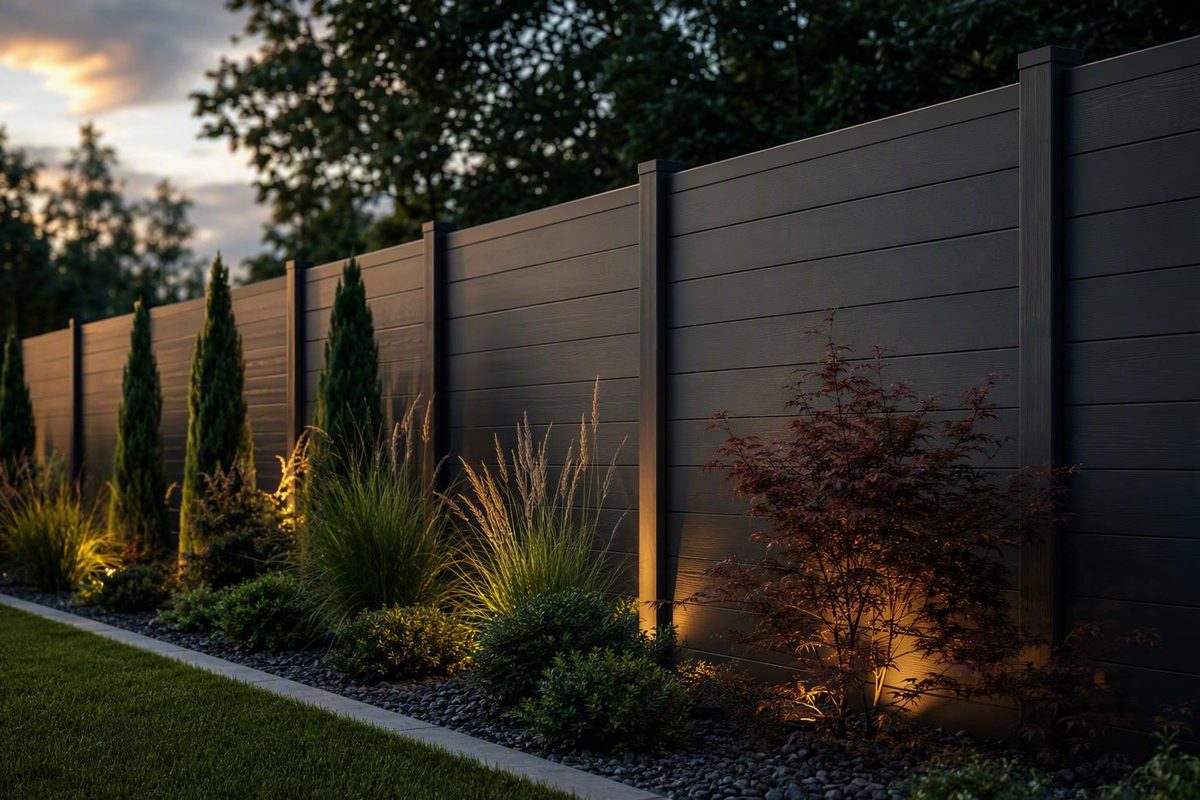
A low maintenance fence should eliminate chores you dislike without compromising the reason you need a fence. That may mean solid privacy, pet containment, an open view, a decorative boundary, or a barrier whose design can be reviewed against local pool requirements.
No material wins every comparison. Solid vinyl and composite are strong privacy candidates that generally avoid recurring staining. Aluminum suits open, decorative applications. Galvanized or coated chain-link provides practical containment and visibility, commonly at a more accessible initial price. Cedar offers natural character but remains wood, while wrought iron can require corrosion treatment and refinishing.
The useful question is not “Which fence is maintenance-free?” It is:
Which complete fence system performs the required job while leaving me with maintenance tasks I am willing to do?
What “Low Maintenance” Actually Means
Low maintenance usually means avoiding frequent painting, staining, sealing, or corrosion treatment. It does not mean installing a fence and ignoring it indefinitely.
Every fence is a system made from multiple components:
- Posts and footings
- Rails or frames
- Boards, panels, pickets, or mesh
- Fasteners, brackets, fittings, and ties
- Hinges, latches, stops, and gate frames
- Galvanized, painted, powder-coated, or polymer finishes
- Reinforcement inside posts, rails, panels, or gates
A washable panel attached to unstable posts is not a low-maintenance fence. Neither is a corrosion-resistant frame fitted with unsuitable hardware or a heavy gate that repeatedly falls out of alignment.
It helps to divide maintenance into two categories.
Cosmetic upkeep concerns appearance. It includes washing dirt from vinyl, removing biological growth from composite, addressing discoloration, preserving cedar’s original color, or touching up a damaged finish.
Structural maintenance concerns continued function. It includes correcting leaning posts, tightening permitted connections, replacing cracked components, restoring chain-link tension, adjusting gates, repairing coating damage, and dealing with drainage or vegetation around the fence.
Retail guidance commonly classifies vinyl, chain-link, and decorative metal as relatively low-maintenance choices while still recommending cleaning and inspection. It distinguishes them from wood, which generally brings recurring painting or staining into the ownership cycle. The Lowe’s overview of fence materials and care illustrates why “low maintenance” is more accurate than “maintenance-free.”
Compare actual tasks rather than promotional labels. Ask:
- Does the material need painting, staining, sealing, or rust treatment?
- How should it be cleaned?
- What damage is plausible at this site?
- Can one damaged component be replaced?
- What care do the gates, hardware, coatings, and posts require?
- What happens when irrigation, vegetation, salt, standing water, wind, or impact affects the system?
- Are care instructions and replacement parts likely to remain available?
Whatever material you choose, expect some combination of cleaning, vegetation control, inspection, gate adjustment, and repair after impact or severe weather.
Low-Maintenance Fence Materials Compared
Material names are only the beginning. A solid vinyl privacy panel and an open vinyl picket fence perform different jobs. So do an aluminum picket fence and a solid coated-steel system.
Metal terminology also requires care. “Ornamental metal” may mean aluminum or coated steel, while wrought iron is a separate material and maintenance category. Ask what the substrate actually is instead of accepting “metal” as a complete specification.
| Material | Routine care | Periodic treatment | Inherent privacy | Visibility and airflow | Likely concerns | Repairability questions | Relative initial cost tendency* |
|---|---|---|---|---|---|---|---|
| Vinyl | Wash with water and mild soap as needed; inspect alignment and damage | Usually no routine painting, staining, or sealing | High in solid-panel designs; low in picket designs | Configuration-dependent | Impact cracks, movement, color change, brittle components, gate sag | Can one panel, rail, picket, or post be replaced? Will matching parts remain available? | Often above basic chain-link |
| Composite | Clean gently; inspect boards, connections, and surface growth | Usually avoids wood-style refinishing, subject to product instructions | High in solid-board systems | Usually limited in solid designs | Staining, fading, moisture response, board damage, proprietary parts | Can one board be removed, or must a section be dismantled? | Commonly higher-priced |
| Aluminum | Rinse or wash; inspect finish, hardware, and gates | Local touch-up may be needed where permitted | Usually low because common residential designs are open | High | Finish damage, impact distortion, loose hardware, unsuitable exposure specification | Can a picket, rail, bracket, or panel be replaced? | Often above basic chain-link |
| Galvanized or coated steel | Clean and inspect coatings, joints, and hardware | Coating damage may require repair; some systems may eventually need refinishing | Low in open ornamental designs; potentially high with solid infill | Design-dependent | Corrosion at damaged areas or connections, weight, impact damage | Are sections welded or mechanically assembled? Can the finish be repaired locally? | Broad range |
| Galvanized or polymer-coated chain-link | Remove debris and vegetation; inspect tension, ties, gates, posts, and corrosion | Local coating or component repairs may be needed | Low without additions | High without slats or screens | Sagging fabric, bent rails, loose ties, coating damage, corrosion, gate misalignment | Can fabric, rails, ties, tension bars, posts, and gate parts be replaced separately? | Commonly among the more affordable permanent choices |
| Cedar | Clean as needed; inspect boards, posts, gates, fasteners, insects, and decay | Finish may be applied periodically to preserve color | High in solid-board designs | Depends on spacing and style | Weathering, checking, loose boards, decay, insects, failed fasteners | Can individual boards and rails be replaced? | Highly dependent on grade, dimensions, and local supply |
| Wrought iron | Clean and inspect for rust and coating failure | Rust treatment, coating repair, and refinishing may be required | Usually low | High | Corrosion, finish failure, heavy or specialized repairs | Can a local section be repaired and finish-matched? Is welding required? | Commonly premium |
*These are broad market-positioning tendencies, not price estimates. Height, design, grade, gates, terrain, removal, labor, and installation scope can reverse the apparent ranking. Commercial comparisons consistently position chain-link as relatively affordable and composite toward the higher end, but local like-for-like quotes are necessary for a financial decision.
Vinyl
Vinyl is a common candidate for low-maintenance privacy because solid panels can block sightlines while avoiding routine painting, staining, and sealing. Washing generally replaces refinishing as the recurring cosmetic task.
Not every vinyl product is equivalent. Formulation, color, UV protection, component dimensions, reinforcement, spans, gate construction, installation clearances, and exposure all matter. Open-picket vinyl also provides little privacy, so the material name alone does not establish performance.
Vinyl should not be described as incapable of fading, cracking, movement, or impact damage. The practical comparison is between documented products, not between idealized material categories.
Composite
Composite fencing generally combines plastic with wood fiber or another engineered core. It can provide a wood-like appearance without a traditional staining schedule and is commonly available as solid boards or panels for privacy.
Performance varies by product. Evaluate composite by product line rather than treating it as one uniform material.
Aluminum
Aluminum commonly avoids the rot and recurring staining associated with wood. Routine care generally consists of washing, checking the finish, and maintaining gate hardware.
Most residential aluminum fences use open pickets. They preserve visibility and airflow but do not provide full visual privacy. Aluminum therefore tends to fit decorative boundaries, gardens, front yards, and potentially qualifying pool enclosures better than secluded backyards.
Commercial comparisons also distinguish aluminum from wrought iron, which can require rust prevention and refinishing. That distinction is useful even though individual contractor preferences should not be treated as an independent ranking.
Galvanized or Coated Steel
Steel should not be collapsed into the same category as aluminum. Galvanization, pretreatment, paint, powder coating, and other finish systems can reduce exposure of the substrate, but scratches, cuts, failed coatings, and unsuitable connections can still affect upkeep.
Steel may appear as ornamental pickets, chain-link fabric and framework, welded panels, posts, frames, or solid privacy systems. Maintenance varies accordingly. Ask for the substrate and complete coating specification rather than relying on terms such as “metal” or “weather-resistant.”
Chain-Link
Galvanized or polymer-coated chain-link is practical when containment, visibility, and initial affordability matter more than complete screening. It avoids wood-style refinishing, but it still needs inspection for corrosion, loose ties, sagging fabric, damaged rails, vegetation, and gate problems.
“Galvanized” is not a complete specification. Wire gauge, coating class, whether galvanization occurred before or after weaving, post and rail construction, fabric tensioning, gates, and terrain can distinguish two otherwise similar bids. The guide to galvanized chain-link gauges, coatings, and quote details explains why buyers should request those specifications explicitly.
Cedar
Cedar is often described as a lower-maintenance wood because its natural oils provide some resistance to decay and insects. It is still wood. Boards can weather, check, loosen, and change color, while posts, rails, gates, and fasteners remain subject to local conditions and installation quality.
If natural weathering is acceptable, you can avoid some cosmetic treatment. If you want cedar to retain a fresh and consistent color, plan for cleaning and periodic finishing. Color change is not necessarily structural failure, but it may be unacceptable when appearance is a priority.
Wrought Iron
Wrought iron belongs in a separate category from aluminum. Its appearance may justify the upkeep for some owners, but rust detection, surface preparation, coating repair, and eventual refinishing can make it a poor match when the main goal is minimal recurring work.
What Maintenance Each Fence Actually Requires
A useful maintenance plan can be part of a normal property walk-through. Inspect the fence after severe weather, construction activity, falling branches, vehicle contact, or other impact. When product documentation provides specific care instructions, follow it instead of relying on generic advice.
Vinyl Checklist
- Rinse away loose dirt.
- Use mild soap and a soft cloth or brush when water is insufficient.
- Avoid harsh cleaners unless the manufacturer permits them.
- Look for cracks, impact damage, displaced caps, or loose components.
- Check that panels remain seated and aligned.
- Open and close each gate and look for sag, hinge movement, or latch misalignment.
- Inspect reinforced posts, rails, and gates where accessible.
- Limit repeated strikes from trimmers, mowers, sprinklers, and other equipment.
General vinyl guidance recommends soap-and-water cleaning, crack inspection, prompt attention to damaged panels, and avoiding unnecessarily harsh chemicals. These tasks are modest, but they are still maintenance.
Composite Checklist
- Remove loose dirt before scrubbing.
- Use cleaners and tools approved for the exact product.
- Do not assume pressure washing is permitted.
- Inspect boards for damage, movement, open joints, swelling, or surface deterioration.
- Check clips, brackets, rails, posts, and other connections.
- Address algae, mildew, or other growth as directed by the manufacturer.
- Maintain required clearance from soil, mulch, or persistent vegetation.
- Confirm that replacement boards and matching finishes remain available.
Keep the care instructions and product identification with your property records.
Aluminum Checklist
- Rinse away dust, pollen, salts, and irrigation residue.
- Use mild soap when necessary.
- Inspect finishes at joints, fasteners, cuts, and impact areas.
- Look for bent pickets, distorted rails, loose brackets, or moving posts.
- Check hinges, latches, stops, and any self-closing hardware.
- Follow the manufacturer’s approved touch-up procedure for coating damage.
“Does not need staining” should never be interpreted as “does not need inspection.” Finish condition, connections, posts, and gates remain part of the maintenance burden.
Galvanized or Coated Steel and Chain-Link Checklist
- Remove vines, leaves, soil, and debris that conceal damage or retain moisture.
- Check for corrosion at scratches, cut ends, welds, ties, fittings, and ground-adjacent areas.
- Examine chain-link fabric for sagging, distortion, damaged edges, or loss of tension.
- Confirm that ties, tension bands, brace bands, and tension bars remain secure.
- Inspect top rails, braces, terminal posts, line posts, and caps.
- Open gates fully and check that hinges and latches operate without dragging.
- Repair damaged coatings only by an approved method.
Commercial maintenance guidance pairs chain-link’s “low maintenance” description with continued rust, wear, and debris checks. It also identifies separate corrosion-related care for ornamental iron, reinforcing why the two should not be treated as equivalent systems.
Cedar Checklist
Structural care
- Look for soft or decayed wood.
- Check for insect activity.
- Inspect posts at and near grade.
- Look for leaning, twisting, split rails, or loose boards.
- Check fasteners for failure or corrosion.
- Address persistent soil, mulch, vegetation, or standing-water contact where practical.
- Check gates for sag and hinge movement.
Optional cosmetic care
- Clean dirt and biological growth using methods suitable for the wood and existing finish.
- Apply a compatible stain, sealer, or finish when retaining the original color matters.
- Test cleaning and finishing products in an inconspicuous area.
- Expect natural color change when choosing not to refinish.
The important distinction is between preserving appearance and preserving function. Letting cedar weather can reduce cosmetic work, but it does not eliminate structural inspection or repair.
Wrought-Iron Checklist
- Inspect joints, decorative details, fasteners, and low points for rust.
- Address affected areas before corrosion spreads beneath the coating.
- Repair damaged finishes with a compatible system.
- Monitor welds, hinges, and latches.
- Consider broader surface preparation and refinishing when local touch-ups no longer provide adequate coverage.
Warning Signs That Deserve Attention
Investigate these conditions before they develop into larger repairs:
- Leaning or moving posts
- Loose, missing, or corroded fasteners
- Sagging or distorted chain-link fabric
- Misaligned, dragging, or unreliable gates
- Cracked panels, rails, boards, or brackets
- Visible corrosion or unexplained surface deposits
- Peeling, bubbling, chalking, or otherwise failed coatings
- Vegetation wrapped through or pressing against the fence
- Soil, mulch, or debris accumulated against components
- Standing water near posts
- Repeated sprinkler exposure
- Gaps that have changed enough to affect containment
Choose by Function: Privacy, Pets, Pools, and Appearance
The lowest-upkeep material is irrelevant if its configuration cannot perform the required job. Start with function, then compare products capable of delivering it.
For Full Visual Privacy
Prioritize solid-panel or tightly assembled board configurations. Solid vinyl and composite are common candidates because they combine screening with no routine wood-style staining. Solid coated-metal and hybrid systems may also qualify, but their upkeep depends on the frame, infill, finish, connections, and repair process.
Do not assume that vinyl, composite, or metal automatically means private. Each is available in open designs. Evaluate the actual sightlines, gaps at grade, gate edges, panel joints, and changes in elevation.
Because solid and open fences interact differently with exposed sites, use the selected product’s documented installation limitations and obtain qualified local review where wind exposure is a concern. Avoid applying one generic post, footing, or reinforcement detail to every property.
For Pets or Children When Visibility Is Useful
Chain-link can create a physical boundary while preserving visibility through the fence.
Containment still requires project-specific judgment. Consider:
- Fence height
- Mesh opening
- Gaps below the fabric
- Space around gates and posts
- Latch placement and reliability
- Climbable features
- Digging, squeezing, or jumping behavior
- Fabric, tie, post, and gate strength
- Changes in grade
A fence that contains one animal may not contain another. General product descriptions also cannot establish whether a fence is suitable for a particular child or setting.
For an Open Decorative Boundary or Pool Area
Powder-coated aluminum is a common low-upkeep candidate when you want an open view and a finished residential appearance. Typical picket designs preserve airflow and visibility while avoiding wood-style refinishing.
For a pool application, do not infer acceptability from the material name or a seller’s “pool fence” label. Ask the relevant local authority which rules apply, then have the proposed layout, openings, gates, latches, access points, and installation reviewed before ordering. Requirements are jurisdiction-specific, so general retailer or contractor guidance cannot establish compliance.
For a Tight Initial Budget
Galvanized chain-link is commonly positioned as an affordable permanent option. It provides containment with relatively limited routine care when full privacy is unnecessary.
The quote can change materially with height, wire gauge, coating, terminal-post construction, top rail, tension wire, gates, corners, demolition, rock, slopes, and site access. A low headline price may describe lighter fabric, smaller framework, fewer accessories, or an incomplete installation scope.
For a Wood-Like Appearance Without Recurring Staining
Compare wood-grain vinyl with composite. Both can reproduce aspects of stained or painted wood without a conventional refinishing cycle. Vinyl is available in multiple colors, simulated grains, privacy styles, semi-private layouts, and stepped configurations, as shown in these vinyl design examples.
The materials can look and feel different at close range. Request samples and, if possible, inspect an older installation of the exact product.
For Chain-Link Privacy
Standard chain-link does not provide full visual privacy. Slats, screens, artificial foliage, or landscaping can increase screening without replacing the framework.
Those additions may also:
- Reduce airflow
- Create more surfaces to clean
- Conceal ties, coatings, and fabric during inspection
- Fade or become damaged
- Change how the fence behaves at an exposed site
- Complicate access for repairs
Before modifying an existing fence, ask the product supplier or a qualified local professional whether the installed framework and connections are suitable for the proposed addition. Do not assume every chain-link fence can accept every privacy accessory.
For Cedar Buyers
The central question is whether natural weathering is acceptable.
If it is, cedar may require less cosmetic work than a homeowner expects from a stained wood fence. It will still need inspection and occasional repair as a wood system.
If it is not—if you want a fresh, consistent color—include cleaning and finishing in the ownership plan. Cedar can still be the right choice, but it should not be purchased on the assumption that natural decay resistance eliminates maintenance.
Climate, Exposure, and Fence Design Can Change the Answer
A fence that performs well in one location may be troublesome in another. Consider the microclimate around the fence rather than relying only on broad regional weather.
Relevant exposures include:
- Persistent rain and humidity
- Coastal or roadside salt
- Pool splash and chemicals
- Ultraviolet exposure
- High surface temperatures
- Extreme cold and temperature cycling
- Freeze-thaw conditions
- Open or turbulent sites
- Irrigation overspray
- Dense vegetation
- Lawn equipment, vehicles, sports, and falling branches
- Poor drainage and standing water
Rainy and Humid Locations
In wet conditions, compare drainage details, post installation, fastener materials, cleanability, and access for inspection. Control vegetation and irrigation that keep surfaces continuously damp, and watch shaded areas for biological growth.
It is too simple to declare one material universally superior in rain. Vinyl avoids wood-style refinishing, but its system still includes posts, rails, reinforcement, gates, and hardware. Composite products differ in core and cap construction. Metal performance depends on the substrate, pretreatment, coating, cuts, and connections. Cedar performance depends heavily on detailing and drying conditions.
A Seattle-area contractor favors vinyl over composite for persistent rain but acknowledges that composite behavior varies with product quality and construction. That is climate-specific vendor guidance, not a universal result. The contractor’s rainy-climate comparison is best used to identify questions for the manufacturers of the exact products being considered.
Salt, Pools, Roads, and Irrigation
For coastal sites, pool surroundings, roads exposed to deicing salts, or heavily irrigated areas, avoid relying on generic terms such as “rust-proof” or “weather-resistant.”
Ask for documented information about:
- Metal substrate
- Galvanization method and coating class
- Pretreatment
- Powder-coat or paint system
- Fastener and bracket materials
- Protection of cuts and field modifications
- Approved touch-up procedure
- Suitability for the stated exposure
- Cleaning instructions following salt or chemical contact
The goal is not simply to choose metal or nonmetal. It is to select a documented system intended for the relevant environment.
Vinyl in Heat, Cold, and Sun
Vinyl performance can depend on formulation, UV package, color, reinforcement, component span, temperature exposure, and installation clearances. It should not be described as incapable of fading, cracking, moving, or becoming brittle.
Vinyl expands and contracts with temperature. Darker products may require additional attention to formulation and system design, while gates and exposed privacy sections may rely on reinforcement. A vendor comparison discussing commercial applications emphasizes that performance depends on reinforcement, span, and installation details; use those concerns as specification questions rather than as proof that one material universally outperforms another.
Composite Variation
When comparing composite, ask about:
- Wood-fiber or other organic content
- Capped versus uncapped construction
- Which faces and edges are protected
- Core composition
- Required moisture clearances
- Fastening and expansion details
- Permitted cleaning methods
- Replacement procedures
- Warranty treatment of fading, staining, and biological growth
Do not transfer claims from one composite formulation to another.
Wind and Solid Panels
Solid privacy panels and open fences are different systems and may have different documented installation limitations. Before selecting a solid panel for an open field, hilltop, exposed corner, or corridor between buildings, obtain the product’s relevant specifications and ask whether site-specific professional review is appropriate.
The same caution applies when screens or slats are added later. Avoid improvising post spacing, footing dimensions, or reinforcement from generic online advice.
Slopes and Changing Grades
Some component fences can rack so the fence line follows the terrain while maintaining relatively consistent clearance below. Rigid panels may have limited racking capacity and may need to be stepped instead.
That matters for privacy, containment, mowing, appearance, and gate placement. Confirm the product’s permitted installation method and slope limitations before buying.
Compare Total Ownership Cost Without Trusting a Generic Price Table
A national price per foot is rarely useful unless every bidder is pricing the same fence. Height, grade, region, labor scope, terrain, demolition, gates, access, permits, rock, disposal, and site preparation can all change the result.
Even two fences made from the same material may not be comparable. A basic chain-link run with light residential fabric and one walk gate is not equivalent to heavier fabric, more substantial framework, several corners, and a vehicle gate. A vinyl picket fence is not equivalent to a reinforced full-height privacy system.
Use a locally adaptable ownership-cost worksheet instead.
| Cost category | Quote or estimate | When incurred | Assumptions to record |
|---|---|---|---|
| Primary fence materials | Initially | Product line, grade, height, style, color | |
| Posts, rails, reinforcement, and hardware | Initially | Sizes, spacing, materials, finish | |
| Installation labor | Initially | Layout, access, soil, slope, cleanup | |
| Old-fence removal and disposal | Initially | Included area and disposal terms | |
| Gates | Initially | Quantity, width, frame, hinges, latches | |
| Permits, surveys, or reviews | Initially | Applicable process and responsible party | |
| Grading, rock work, drainage, or vegetation removal | Initially or as needed | Allowances and change-order terms | |
| Cleaning supplies or hired cleaning | Recurring | Method and assumed frequency | |
| Staining, sealing, painting, or coating repair | Recurring or conditional | Materials and labor | |
| Gate and hardware repairs | Conditional | Parts availability and labor | |
| Panel, board, fabric, rail, or post replacement | Conditional | Unit cost and installation access | |
| Warranty-related labor, shipping, and reinstallation | Conditional | Covered, limited, or excluded | |
| Eventual removal and disposal | End of ownership | Access and disposal assumptions |
A higher initial price may be reasonable if it eliminates work you would otherwise pay someone to perform. That does not automatically make it the lower-cost option. Cleaning, hardware, repairs, storm or impact damage, replacement components, and eventual removal still cost money.
Conversely, a less expensive fence may remain the sensible choice if it performs the job and likely repairs are straightforward. Upfront affordability and total ownership cost are related but separate decisions.
Request Like-for-Like Quotes
Give each bidder the same scope:
- Total measured layout
- Fence height
- Exact style and privacy level
- Number, width, and type of gates
- Manufacturer, product line, and grade
- Post and rail specifications
- Reinforcement requirements
- Fastener and hardware materials
- Finish or coating system
- Removal and disposal
- Grading, vegetation, rock, and access assumptions
- Permit responsibility
- Cleanup and restoration
- Warranty documents
- Unit prices for plausible change orders
For chain-link, require the wire gauge, mesh size, coating, framework, tensioning, and gate specifications. Published prices are otherwise difficult to compare because “galvanized chain-link” can describe materially different products and installation scopes.
Treat lifespan and savings figures from vendors as conditional estimates rather than established service lives. A warranty period is also not a lifespan prediction. Cosmetic aging, excluded damage, labor coverage, component availability, and the owner’s standards for appearance can all change the practical outcome.
Specifications, Repairability, and Warranties to Check Before Buying
The better low-maintenance fence is often the one with clearer specifications, suitable installation details, replaceable parts, and an understandable warranty—not the one with the strongest advertising adjective.
Use this checklist for each quote:
- Exact manufacturer and product line
- Material composition or substrate
- Panel, board, picket, mesh, or component construction
- Post and rail dimensions or series
- Reinforcement locations and materials
- Fastener, bracket, hinge, and latch materials
- Pretreatment, galvanization, paint, powder coat, or cap construction
- Gate frame and hardware specifications
- Installation method
- Slope-accommodation method
- Exposure documentation where relevant
- Approved cleaning and repair procedures
- Replacement-part availability
- Written warranty and claim procedure
Chain-Link Questions
Ask for:
- Wire gauge
- Mesh size
- Galvanization or polymer-coating details
- Coating class where applicable
- Galvanized-before-weaving or galvanized-after-weaving, where relevant
- Line-, terminal-, corner-, and gate-post specifications
- Top rail, tension wire, and brace details
- Fabric-tensioning method
- Tie and fitting specifications
- Gate frame, hinge, and latch details
Do not accept “standard galvanized” as a complete specification.
Vinyl Questions
Ask:
- What is the formulation, and how is UV exposure addressed?
- Does color affect installation or exposure limitations?
- Which posts, rails, and gates require reinforcement?
- Are there documented wind or site limitations?
- How are temperature movement and installation clearances handled?
- Can one panel, rail, or picket be replaced?
- What impact or low-temperature failures are excluded?
- Will matching profiles and colors remain available?
- Which cleaners and tools are approved?
Composite Questions
Ask:
- Are the boards capped?
- Which faces and edges are capped?
- What is the core composition?
- What clearances are required from soil, mulch, or standing water?
- How are expansion and drainage handled?
- Can one damaged board be removed?
- Which cleaning products and methods are permitted?
- Is pressure washing allowed?
- How does the warranty treat fading, staining, scratching, swelling, and biological growth?
- How should cut ends and field modifications be treated?
Aluminum and Coated-Steel Questions
Ask:
- Is the substrate aluminum, galvanized steel, another steel product, or a combination?
- What pretreatment is used?
- What is the complete finish system?
- What materials are used for fasteners, brackets, hinges, and latches?
- How should scratches, cuts, and damaged coatings be repaired?
- Is suitability for the intended site exposure documented?
- Are panels welded or mechanically assembled?
- Can individual pickets, rails, or panels be replaced?
- What installation or exposure limitations apply?
Evaluate Component-Level Repairability
Imagine one part is damaged by a branch, vehicle, mower, animal, or gate failure. Determine whether you can replace:
- One board
- One slat or picket
- One rail
- One panel
- One post
- One length of chain-link fabric
- One hinge
- One latch
- One gate-frame component
Some proprietary systems allow infill to be accessed without reconstructing a full section. That can reduce repair disruption, but it remains a product-specific claim. Verify the procedure, required tools, replacement availability, and warranty consequences before purchase.
Read Warranty Coverage and Exclusions
Warranty duration does not prove how long a fence will remain structurally sound or cosmetically acceptable. Read the definitions, remedies, transfer rules, maintenance obligations, and exclusions.
Determine whether each relevant condition is covered, limited, or excluded:
- Labor
- Shipping
- Removal and disposal
- Reinstallation
- Fading or color variation
- Staining
- Cracking
- Corrosion
- Coating damage
- Biological growth
- Wind
- Impact
- Ground movement
- Improper cleaning
- Improper installation
- Unauthorized modifications
- Residential versus commercial use
Do not assume a useful warranty must cover every item. The purpose of this review is to discover what the contract actually does.
Find out whether the remedy is a replacement component, repair, or prorated credit. Ask who documents the claim and who pays to remove and reinstall the affected section.
Finally, consider proprietary-system risk. Are compatible parts stocked locally? Can you order them directly? What happens if the installer closes or the product line is discontinued? A long warranty has limited practical value if no one can supply a matching component or administer the claim.
Plan the Site Before You Commit to a Material
Material selection should follow basic site planning, not precede it.
First, define the primary purpose:
- Full privacy or partial screening
- Pet or child containment
- Pool-area application
- Decorative boundary
- Security or access control
- View preservation
- Airflow preferences
- Gate and vehicle access
- Acceptable cleaning and repair tasks
Then identify the project constraints.
Ask the relevant local government, association, or other authority which height, placement, setback, permit, easement, and pool-related rules apply to the property. Requirements are location-specific; a neighboring fence or contractor’s general statement is not confirmation that a proposed design is acceptable.
Confirm the property boundary rather than assuming an old fence, hedge, curb, or mowing line is accurate. If the boundary is uncertain or consequential, seek the appropriate local professional assistance.
Before digging, use the official utility-location process that applies where the project is located and follow the instructions provided by that service and the affected utility owners. Do not begin excavation based only on visual assumptions about where services run.
Walk the site and document:
- Standing water and drainage paths
- Downspouts and irrigation
- Soil conditions and fill
- Rock and excavation access
- Local frost considerations
- Slopes and abrupt grade changes
- Trees, roots, hedges, and vines
- Existing concrete or retaining walls
- Gate approaches and turning space
- Access for excavation and material delivery
- Exposure to vehicles, mowers, sports, or falling limbs
- Open or otherwise exposed locations
Where exposure or site conditions may affect structural design, use the product’s technical documentation and qualified local professionals rather than adopting generic post spacing, reinforcement, or footing details.
A disciplined decision sequence keeps the project focused:
- Choose the function.
- Shortlist designs that perform it.
- Account for climate and site exposure.
- Compare exact material and installation specifications.
- Evaluate component-level repairability.
- Read warranty coverage and exclusions.
- Obtain like-for-like local quotes.
The best low maintenance fence is not a universal winning material. It is a well-specified, properly installed system whose privacy, containment, appearance, exposure limits, likely repairs, and remaining care requirements match your expectations.
What is the lowest-maintenance fence for full privacy?
Solid-panel vinyl is often the first option to compare because it generally needs washing rather than routine painting, staining, or sealing. Solid composite is another strong candidate when a wood-like appearance matters.
Neither is automatically the lowest-maintenance choice at every property. Compare formulation, reinforcement, gate construction, exposure documentation, cleaning instructions, component replacement, and warranty exclusions. Privacy comes from the solid configuration, not merely the material name.
Is chain-link fencing low maintenance, and can it provide privacy?
Galvanized or coated chain-link is relatively low maintenance because it avoids a wood-style refinishing schedule. It still needs vegetation removal and inspection for corrosion, fabric tension, loose ties, damaged rails, moving posts, and gate alignment.
Standard chain-link provides visibility rather than privacy. Slats, screens, inserts, and landscaping can increase screening, but they also change cleaning and inspection needs. Confirm that any accessory is suitable for the existing system and site.
Is cedar a low-maintenance fence if I let it weather naturally?
Allowing cedar to weather can eliminate much of the cosmetic work associated with preserving a fresh wood color. Its natural resistance to decay and insects may make it less demanding than some other wood choices, but it remains a wood fence.
You still need to inspect posts, boards, rails, gates, and fasteners for decay, insect damage, movement, loose components, and moisture problems. If natural weathering is acceptable, cedar may fit your maintenance tolerance; if you want a like-new color, plan for recurring treatment.
Is aluminum lower maintenance than vinyl or composite?
Not in every application. Aluminum commonly needs washing, finish inspection, and hardware care while avoiding wood-style staining. It is especially well suited to open decorative fencing.
Vinyl and composite are generally stronger candidates for full privacy because solid panels are widely available. Their upkeep centers on cleaning and damage inspection, but formulation, moisture exposure, reinforcement, and repair methods vary. The better choice depends on whether you need an open boundary or solid screen and whether the documented product suits the site.
What should a low-maintenance fence warranty cover?
Do not begin with the assumption that every relevant condition will be covered. Determine whether the warranty covers, limits, or excludes structural defects, component failure, finish problems, corrosion, cracking, fading, staining, impact, wind, and environmental exposure.
Check the remedy and claim process, along with responsibility for labor, shipping, removal, disposal, and reinstallation. Confirm transfer rules and replacement-part availability.
Most importantly, do not treat warranty duration as proof of service life. A warranty is a contract with definitions, conditions, remedies, and exclusions—not a prediction that the entire fence will remain unchanged for that period.