
Choose an Aluminum Fence by Its Gaps, Frame and Post System
Compare aluminum fence picket spacing, wall thickness, slope limits, posts and finish warranties before choosing panels or accepting a quote.
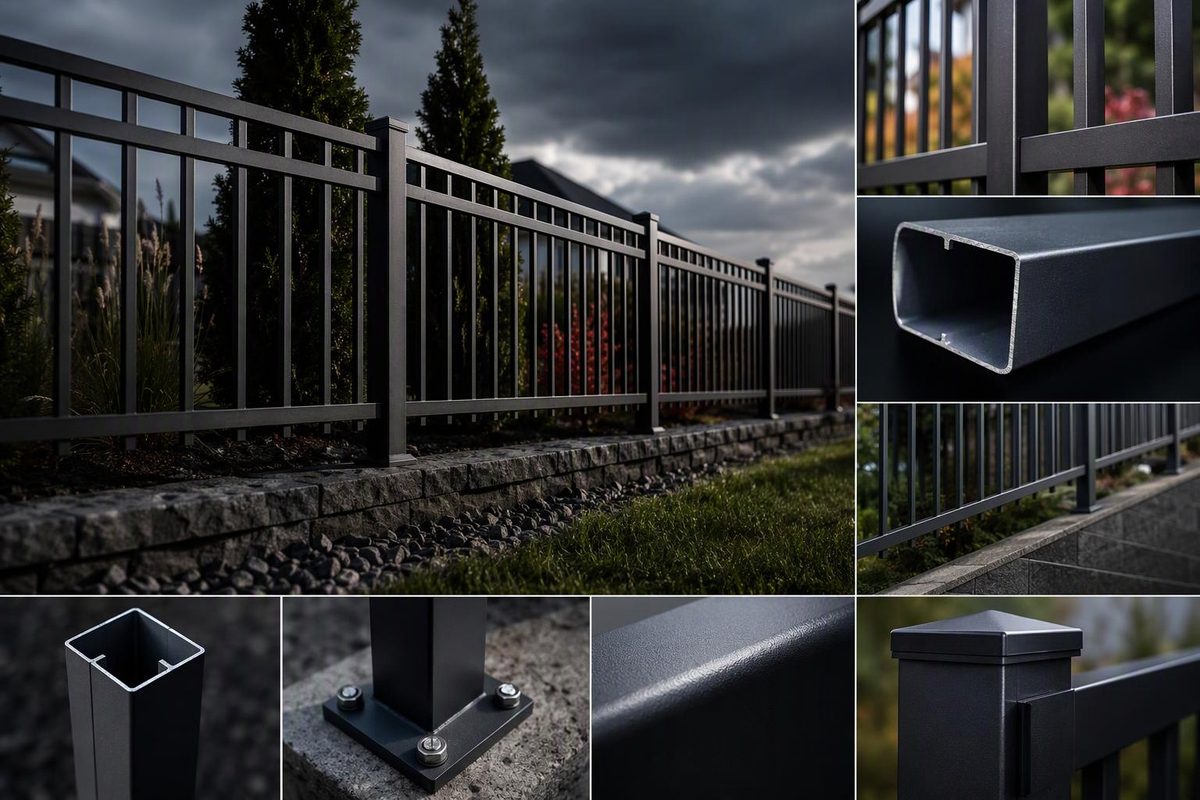
An open-picket aluminum fence suits a visible boundary where you want to preserve views. It can also serve as a pet enclosure or pool barrier—but only when its openings, height, gates and installation fit that job. It does not provide privacy just because it is tall.
Choose the panel-and-post system, not just the material. Start with openings and terrain, then compare frame dimensions, support and finish.
Match the openings to the job
For a decorative boundary, picket spacing is largely an appearance choice. For containment, it is a functional specification. Ask for the clear opening between pickets, not just their center-to-center spacing, and check the gaps below panels, beside posts and around gates.
Ultra Aluminum, for example, lists residential spacing between pickets of 3-13/16 inches as standard, with a narrower 1-5/8-inch option. It also offers short additional pickets at the bottom for “puppy protection.” Those are product options, not a guarantee that any particular dog will stay inside. Match the largest opening and fence height to your animal, including its ability to jump or dig. Sources: Ultra fence specifications, Ultra pet options
For screening a patio or neighboring yard, compare a purpose-built aluminum privacy fence instead. Do not assume that attaching screening to an open-picket fence leaves its support requirements unchanged; ask the manufacturer to approve the modified assembly.
A pool fence needs more than a “pool-safe” label
Get the exact panel style and gate hardware checked against your local pool-barrier rules before ordering. Height alone does not establish compliance: rail placement, openings, ground clearance, latch access and gate operation also matter.
The U.S. Consumer Product Safety Commission recommends a barrier at least 48 inches above grade, measured on the side facing away from the pool, and pedestrian gates that open away from the pool and self-close and self-latch. Its guidance also links allowable picket spacing to the distance between horizontal rails. These are safety recommendations, not a nationwide building code; local requirements govern your installation. A barrier does not replace adult supervision. Source: CPSC pool-barrier guidelines
Plan posts, footings and slopes before pricing panels
A nominal six-foot panel does not necessarily mean posts go six feet apart.
Ultra’s installation guide specifies 72-1/2 inches on center for its six-foot residential or commercial panels with two-inch posts. Williams specifies 72 inches on center for its nominal six-foot panels with three-inch posts; the actual panel width is 69.43 inches. Those dimensions belong to different assemblies and are not interchangeable. Sources: Ultra installation guide, Williams installation instructions
Before digging, confirm the boundary and check local height, placement and permit requirements. In the U.S., contact 811 and follow your state’s waiting period before excavation. Also account for private buried lines, such as pool plumbing, which utilities typically do not mark. Sources: 811 digging guidance, Williams installation instructions
The footing plan should identify hole diameter, concrete depth, post embedment and gate-post support. Do not copy one generic hole depth across every climate and soil condition: Williams explicitly directs installers to check local frost-depth requirements.
On sloping ground, distinguish two methods:
- Racking: the panel follows the slope while its pickets remain upright.
- Stepping: adjacent panels sit at different heights, requiring attention to the resulting bottom gaps.
Ask for the selected panel’s racking limit and how it is measured. Ultra says its standard fencing racks up to four inches, with other options for steeper grades. Williams allows up to an eight-degree slope for the covered panels and warns that racking reduces horizontal post spacing. Test-fit a panel at the intended slope before fixing post locations. Sources: Ultra slope options, Williams installation instructions
Lay out gates early, including their full swing over the ground. Confirm whether the advertised width means the gate leaf or the opening between posts. See the aluminum gate buying guide for a separate support and hardware checklist.
Compare dimensions, not grade names alone
“Residential,” “commercial” and “heavy duty” are not enough to compare two quotes. Request a drawing or specification sheet showing:
| Component | What to compare |
|---|---|
| Pickets | Outside dimensions, wall thickness and clear spacing |
| Rails | Cross-section, wall thickness and number of rails |
| Posts | Outside dimensions, wall thickness, length and intended role |
| Connections | Rail-to-post attachment, fasteners and required brackets |
| Gates | Frame dimensions, joint construction and specified supporting posts |
A small-looking specification difference can be real. Ultra lists residential pickets at 5/8 inch square × .050-inch wall, versus commercial pickets at 5/8 inch square × .055-inch wall. That is an example from one manufacturer—not proof that all commercial fences share those dimensions or that picket thickness alone determines system strength. Source: Ultra grade specifications
For coated tubular-picket aluminum systems, the relevant ASTM specification is F2957, listed as F2957-13(2025) as of October 2026. It covers materials, structural testing, dimensions, workmanship, finish testing and certification. F2408 covers galvanized-steel tubular-picket systems, not aluminum. If a seller claims standards compliance, request documentation tied to the quoted product rather than accepting a logo or an unexplained standard number. Sources: ASTM F2957, ASTM F2408
Do not substitute ornamental fence panels for a deck or balcony guard. Ultra expressly rejects that use of its fencing. Source: Ultra fence-use guidance
Treat the finish warranty as a contract, not a lifespan
Aluminum avoids iron rust, but “won’t rust” should not be read as “needs no attention.” Follow the selected manufacturer’s cleaning instructions and check coating damage, connections and gate operation. Ultra says a garden-hose spray is sufficient for cleaning in most cases. Source: Ultra maintenance guidance
Read the actual warranty for the product. Iron World’s aluminum-fence warranty covers specified coating failures but excludes normal weathering, slight discoloration and chalking. Its residential lifetime coverage applies to the original owner while that person owns and resides at the installation property; it is nontransferable and excludes removal and installation labor. A lifetime material warranty therefore does not establish a maintenance-free lifespan or promise a free installed replacement. Source: Iron World aluminum warranty
What an acceptable quote should identify
Before comparing totals, require the same scope: manufacturer and series, panel height and spacing, frame dimensions, post types, footing plan, slope treatment, gate openings and hardware, finish and warranty. Have the contractor list delivery, demolition, disposal, permits and site work as included or excluded.
For price ranges and a material-budget example, use the aluminum fence cost guide. The better-value quote is the one that specifies the fence you need and the installation it requires—not simply the lowest price attached to the word “aluminum.”