
Choose Aluminum Privacy Fencing by Gaps, Support and Full Cost
Compare closed and spaced aluminum privacy panels, calculate listed panel-and-post costs, and check wind support, finish warranties and repair options.
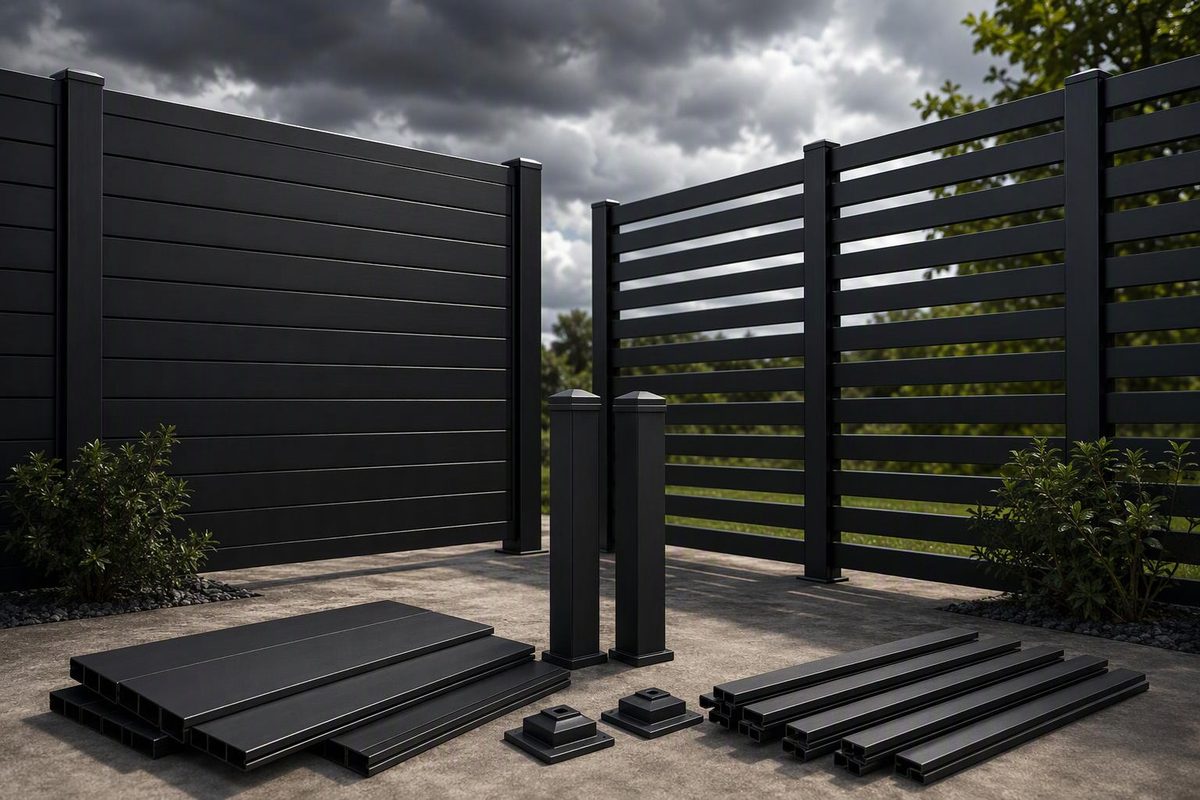
An aluminum privacy fence is a good fit if you want a metal enclosure without a recurring wood-staining routine. For direct visual privacy, choose closed or interlocking infill—not spaced slats—and require a support plan for that panel design. The panel price alone is not the finished cost: posts, foundations, freight, assembly and installation must be priced separately.
Choose the panel style and enter panel and post quantities to calculate a materials-only subtotal.
Panel-and-Post Subtotal
10 panels × $565 = $5,650; 11 posts × $139 = $1,529.
Post price: $139 each for the listed 2.56-inch × 95-inch post with cap. Quantities must be whole numbers; zero is allowed.
Excludes gates, freight, tax, foundations, hardware, assembly, installation, demolition and custom work. This is not a post-design check or a finished-length calculation.
Source: Aluminum Fences Direct, standard solid-color prices checked October 3, 2026. Panels arrive unassembled; privacy materials do not qualify for free shipping.
Closed Infill Provides More Privacy Than Spaced Slats
Products sold as aluminum privacy fencing can provide very different levels of screening:
| Design | What to Check Before Buying |
|---|---|
| Solid or interlocking panels | Whether joints close the sightline; gaps at edges, gates and ground level |
| Spaced horizontal slats | Actual gap width; these provide partial screening |
| Louvered panels | Visibility at different angles; documented airflow or screening requirements |
| Aluminum-framed hybrid panels | Infill material, its upkeep and its separate warranty |
SLEEKFENCE’s Lineara Full Privacy uses 6-inch interlocking horizontal slats with no spacing. My Private Patio’s horizontal slat system comes with 1/2-inch spacers, with other gaps available. Those are different privacy products, even though both use aluminum. SLEEKFENCE’s product page and My Private Patio’s product page describe the respective designs.
Also check what “aluminum fence” includes. Ultra Aluminum offers both all-aluminum privacy fencing and a hybrid with extruded aluminum rails and vinyl inserts, along with louvered screening. A metal frame does not necessarily mean metal infill. Ultra Aluminum’s privacy fencing range distinguishes these options.
For direct visual privacy, specify closed infill rather than relying on a “privacy” label. Ask for a sample or close-up showing the joints, then inspect the view from the street and neighboring seating areas. Include gate-edge gaps and clearance under the fence in that assessment: closed slats do not close those openings.
Posts and Foundations Must Match the Privacy Panel
A solid privacy panel needs a support design for that panel—not instructions borrowed from an open ornamental aluminum fence.
SLEEKFENCE’s wind guidance makes its performance conditional on the complete system: panel-to-post screw spacing, post spacing, secure mounting and suitable foundations. Its in-ground guidance assumes footings to the local frost-line depth. Surface-mounted installations require a structurally sufficient concrete host and appropriate anchors. The manufacturer also requires site-specific review rather than treating its general guidance as a project design.
Get these specifications in writing before ordering:
| Component | Required Detail |
|---|---|
| Posts | Profile and wall thickness for lines, corners, ends and gates |
| Panel spacing | Whether width means clear opening or post-center spacing |
| Footings | Diameter and depth suited to soil, frost conditions and wind exposure |
| Surface mounts | Slab suitability, anchors, embedment and edge distances |
| Connections | Specified fasteners and their spacing |
A baseplate does not make any patio slab suitable for a tall privacy fence. An advertised wind-speed rating is also incomplete without the height, panel style, spacing and mounting assumptions behind it.
Walk the entire route before buying panels. Ask whether the selected system can follow the slope, must be stepped, or needs custom sections. Have the installer show the resulting bottom gaps on the layout. Confirm cutting permissions, corner details and gate swing clearance before posts are set.
Check local height, placement, permit and HOA requirements. For a U.S. installation involving excavation, contact 811 and follow the state-specific waiting period before digging. The national 811 Before You Dig guidance explicitly includes fence installation.
Listed Panel and Post Prices Are Not Installed Costs
Compare prices for the same height and privacy design. Open-picket aluminum prices are not a useful budget for solid aluminum screening.
As checked on October 3, 2026, Aluminum Fences Direct listed these prices in its standard solid-color range:
| Component | Listed Price |
|---|---|
| 6-foot-wide × 6-foot-high tongue-and-groove privacy panel | $565 |
| 6-foot-wide × 6-foot-high semi-privacy panel | $435 |
| 2.56-inch × 95-inch post with cap, listed for the 6-foot system | $139 |
| 48-inch-wide × 6-foot-high privacy gate | $795 |
| Double-sided Lokklatch, sold separately | $88 |
The supplier says panels and gates arrive unassembled, gates include self-closing hinges, and privacy materials do not qualify for free shipping. These prices and conditions come from the Aluminum Fences Direct price list.
An illustrative shopping list for a straight run without gates—ten full-privacy panels and eleven listed posts—totals $7,179: (10 × $565) + (11 × $139). The same quantities with semi-privacy panels total $5,879.
These are panel-and-post subtotals, not installed quotes or an engineered post selection. Ten nominal 6-foot panels also do not establish the exact finished run length; that depends on the system’s spacing convention. Use the calculator with quantities from the proposed layout, not a presumed panel count derived from nominal width alone.
Add freight, tax, concrete or mounting hardware, assembly, installation, gates, demolition and any custom work. No figures for those additional costs are supplied here. Require the contractor’s quote to identify those items rather than hiding them inside one price per foot.
If cost is the deciding factor, compare that complete scope with other low-maintenance fence options, using the same finished height, privacy level and gate openings.
Finish Documentation and Replacement Parts Complete the Specification
Ask for the coating specification, applicable edition and written warranty—not simply “powder coated.” AAMA 2604 concerns coating performance on aluminum extrusions and panels; it is not a structural wind rating. As of October 3, 2026, FGIA lists AAMA 2604-26 as the active edition. A supplier claiming compliance should identify the documentation for the actual finish being supplied. FGIA’s AAMA 2604-26 listing identifies that edition.
Low maintenance still means following the care instructions. SLEEKFENCE, for example, requires documented cleaning at six-month intervals, recommends more frequent care in demanding environments, and prohibits power washing in its cleaning guidance. Those are product-specific requirements, not universal aluminum-fence rules.
Before paying a deposit, ask whether individual damaged slats can be replaced, whether replacements require panel removal, and how matching parts and finishes are supplied. For full visual privacy, the buying specification should include closed infill, a site-suitable support plan, an itemized delivered-and-installed price, and a documented route to future repairs.