
What an Aluminum Fence Costs Before Gates and Extras
Budget an open-picket aluminum fence with installed cost ranges, a panel-and-post example, and clear checks for gates, shipping, footings and quote exclusions.
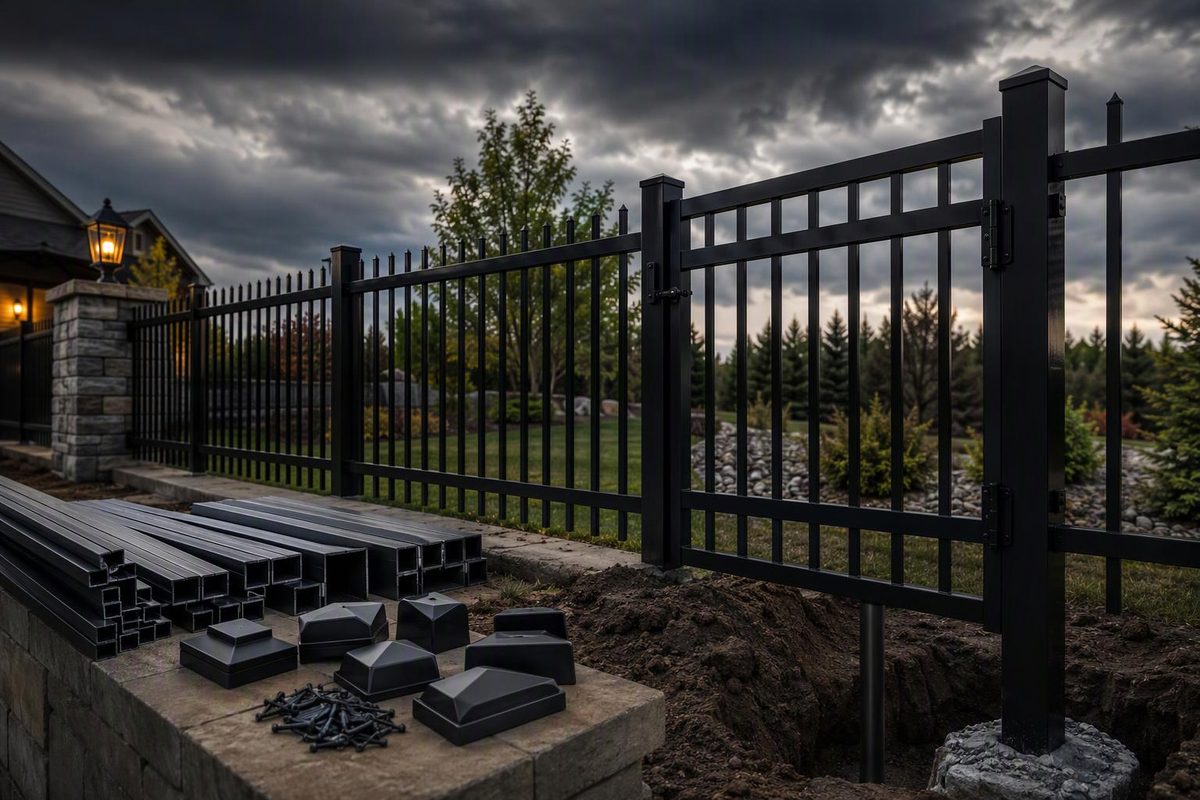
For a residential open-picket aluminum fence up to 6 feet tall, budget $25–$75 per linear foot installed as an initial U.S. planning range. That puts 200 feet at roughly $5,000–$15,000, subject to the quote’s gate and site-work allowances. HomeGuide publishes that range for picket, pool and ornamental fencing; New England contractor Brentwood Fence publishes a narrower $25–$65 per foot for ornamental aluminum in its September 2026 guide. Neither replaces an itemized site quote. All prices below are in USD.
Enter your planned fence length to calculate an initial installed allowance.
Installed Fence Allowance
Use the same footage basis as your installer.
Estimated installed range
200 feet × $25–$75 per foot.
For U.S. residential open-picket aluminum up to 6 feet tall. Gate and site-work inclusions must be confirmed; this is not a delivered materials or site quote.
Source: HomeGuide aluminum fence cost guide; USD. Range is a planning estimate.
Ordinary aluminum pickets preserve views rather than screen them. If you want a closed slat system, use a different price comparison—see our aluminum privacy fence guide.
Installed Budgets by Fence Length
These figures multiply the $25–$75 installed range by the proposed fence length. They are starting allowances, not a promise that every contractor includes gates, demolition, permits or difficult digging.
| Fence Length | Initial Installed Budget |
|---|---|
| 100 feet | $2,500–$7,500 |
| 150 feet | $3,750–$11,250 |
| 200 feet | $5,000–$15,000 |
Within the same scope—open-picket, pool and ornamental fences no taller than 6 feet—HomeGuide separately lists $15–$50 per foot for materials and $10–$25 for labor. Do not add that labor allowance to the installed price: labor is already included.
Start with a route drawing showing each run, corner and gate opening. Ask whether the contractor’s footage includes gate openings, then have gates priced separately so competing bids use the same measurement basis.
A Panel-and-Post Budget Is Not a Complete Materials Price
Posts, gate supports, caps, fasteners, concrete, delivery and tax all need checking before a panel price becomes a usable materials budget.
One retail example shows the difference. Fencing Direct’s Bradford listing gives a sale price of $145.96 for a 4-foot-high, 6-foot-wide black panel, with matching line and end posts at $41.18 each. Posts are sold separately.
For an illustrative 16-panel straight run with no gate, the panel-and-post calculation is:
| Component | Quantity | Unit Price | Subtotal |
|---|---|---|---|
| Bradford panels | 16 | $145.96 | $2,335.36 |
| Line posts | 15 | $41.18 | $617.70 |
| End posts | 2 | $41.18 | $82.36 |
| Total | $3,035.42 |
Sixteen nominal 6-foot panels represent approximately 96 feet of panel width. Lay out the fence using the system’s specified post spacing, rather than simply placing holes every 6 feet. Lowe’s installation guide says spacing varies by panel length and recommends dry-fitting before digging line-post holes.
The $3,035.42 example excludes concrete, any separately required caps or hardware, freight, tax, tools and labor. Fencing Direct states that items 6 feet or longer require common-carrier shipping. Obtain a delivered total before comparing its online price with a local supplier’s package.
This is a priced example, not the lowest possible aluminum-fence budget. Height, construction and sale pricing differ across product lines.
Posts, Gates and Ground Conditions Change the Bill
Post Types and Footings Need Their Own Specification
A quote should identify line, end, corner and gate posts—not just give a total post count. Gate posts support the gate’s weight and movement; Lowe’s advises mounting gates to gate posts rather than standard end posts.
Its guide also calls for footing depth and diameter to follow the fence manufacturer and local code, including applicable frost-depth requirements. Ask for the proposed hole dimensions and concrete allowance. A cheaper panel does not compensate for footings that do not suit the site.
Gate Prices Need Hardware and Support Allowances
On the same Bradford listing, a 4-foot-high, 4-foot-wide straight gate costs $464.60, while a heavy-duty gate post costs $72.11, compared with $41.18 for a standard post. Those are listed product prices, not installed gate totals.
Check the required hinges, latch, post count and footing details before adding a gate allowance. The draft’s source prices do not establish a complete installed gate cost.
Choose the opening around what must pass through it: people, a mower, a trailer or service equipment. Our aluminum gate buying guide covers sizing and support checks.
Slope Treatment Is Product-Specific
Racking angles a panel to follow the ground; stepping keeps panels level at different elevations. Fencing Direct advertises up to 33 inches of racking per 6-foot Bradford panel. Do not assume another panel offers the same adjustment.
Have the installer explain the resulting bottom gaps, especially for pet containment. Establish how rock, roots, old concrete footings and restricted equipment access will be charged rather than accepting an undefined “site conditions” extra.
Finish Specifications Do Not Establish Service Life
Ask for the coating specification and written warranty, not merely “black aluminum.” For Bradford, the seller states an AAMA 2604 powder-coated finish and a limited lifetime warranty, but says hardware has separate warranty coverage.
That is useful purchasing detail—not proof of a universal service life or a maintenance-free gate.
Compare Quotes on the Same Installed Scope
Each bidder should specify the manufacturer, style, height, panel width, picket spacing and rail/post dimensions, including wall thickness. The quote should also identify post types, footing dimensions and slope treatment. Otherwise, the same price per foot can describe materially different fences.
For gates, require opening widths, hardware and support details. For the rest of the job, request separate prices or explicit inclusions for delivery, removal, disposal, permits, tax and site restoration. Unexpected digging conditions need a written charging method, and product and workmanship warranties should be stated separately.
Check boundaries, easements, zoning and HOA restrictions before ordering, as Lowe’s planning guidance recommends. For a pool barrier, confirm the exact panel design, spacing, ground clearance and gate hardware against local requirements before buying. A general ornamental-fence price or a nominal 4-foot height does not establish compliance; CPSC’s pool-barrier guidance advises checking with local authorities.
Before digging, confirm who will contact 811 and follow your state’s waiting period, using the 811 before-you-dig guidance.
Compare the complete installed scope first, then the price per foot. A panel-only offer is not comparable to a bid that includes posts, gates and ground work.