
What You Will Really Pay to Fence a Pool
Compare installed costs by material and route length; mesh runs $17–$35 per foot, with a separate $480–$800 gate allowance plus other extras.
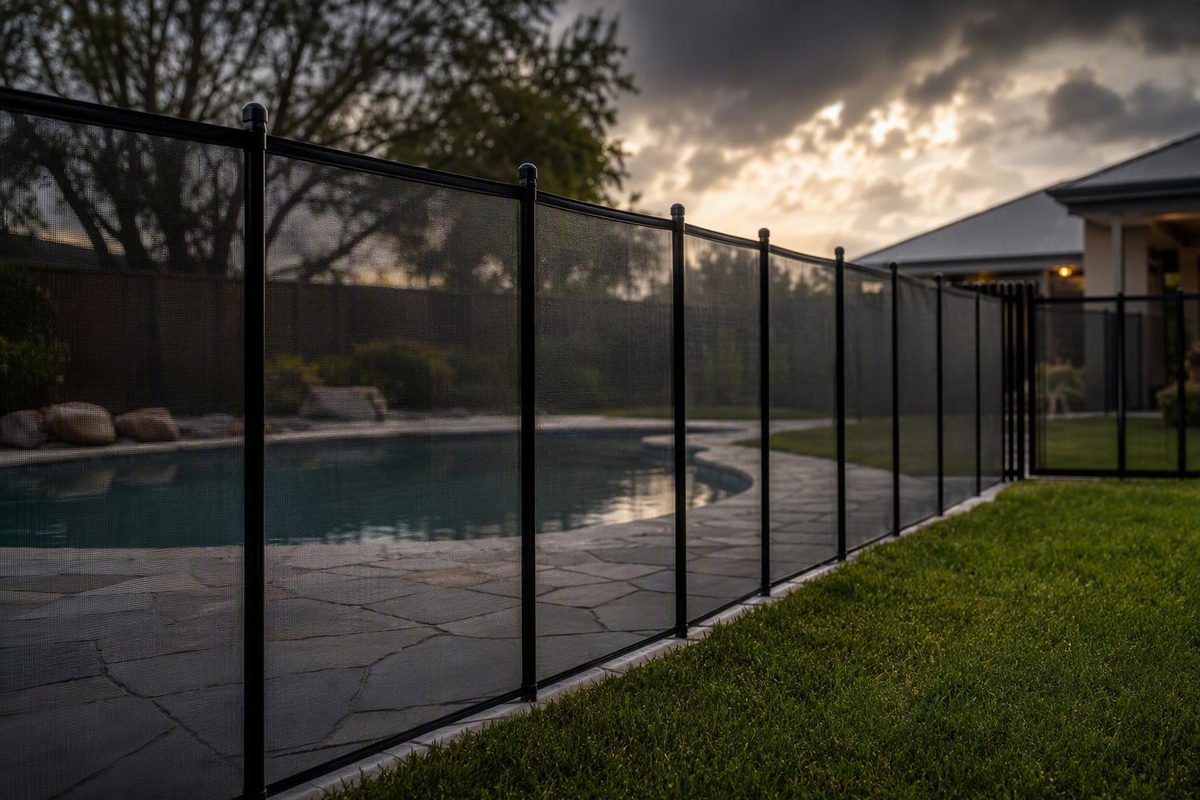
Swimming pool fence cost at a glance
A realistic starting budget depends on what “pool fence” means in your project:
- Basic projects may begin around $1,500–$3,000
- Many professionally installed projects are quoted around $3,000–$10,000
- Premium glass barriers or structurally difficult installations can cost substantially more
These are planning bands assembled from commercial cost guides, not an independently verified national average. A contractor-authored guide published in January 2026 places many projects between $1,500 and $10,000, depending on material and project size. Review the contractor’s project ranges and cost variables. Separately, a fence-installation company updated its guide in May 2025 and estimated a typical total of $3,000–$10,000 while acknowledging that projects can fall well outside that range. See the second company’s stated total-cost range.
One “average” is misleading because published estimates mix different materials, locations, route lengths, heights, gate counts, surfaces, and installation scopes. A panel-only price is not comparable with an installed barrier. A simple mesh route drilled into sound concrete is also not comparable with frameless glass requiring structural support and restoration of surrounding finishes.
The clearest pool-specific benchmark is removable mesh at approximately $17–$35 per installed linear foot. Multiple mesh sellers and installers publish figures around that range, although lower commercial outliers exist. Use $17–$35 as a preliminary planning range rather than blending conflicting figures into a false national average. See the mesh manufacturer’s pricing range and listed variables.
Use this formula for an initial estimate:
Measured barrier-route length × applicable installed rate + gates + permits + taxes + delivery + preparation + structural work + demolition + cleanup + restoration
For example, 100 feet of mesh at $17–$35 per foot produces a base estimate of $1,700–$3,500. That is not necessarily the contract total. A gate, difficult deck, permit, sales tax, old-fence removal, or minimum-job charge can materially change the final price.
How to interpret the prices in this guide
Unless otherwise stated, the figures below were published, updated, or observed in 2024–2026. They are planning figures rather than guaranteed bids. Most come from installers, manufacturers, sellers, contractors, and estimating services with a commercial interest in the subject.
That does not make the numbers unusable, but it makes context essential. For every estimate, consider:
- Publication or observation date
- Geographic market
- Material and fence height
- Product-only, DIY, or installed scope
- Whether gates and hardware are included
- Substrate and structural assumptions
- Taxes, permits, delivery, demolition, and restoration exclusions
Fence Report covers fence materials, installation, costs, and repair. It states that it identifies the sources behind quoted prices, specifications, and products and that manufacturers do not pay for placement. Read Fence Report’s editorial description.
Installed cost per linear foot by pool-fence material
The primary table is limited to categories for which reasonably defensible installed planning ranges can be assembled. “Installed” still does not mean every possible expense is included. Gates, permits, taxes, demolition, structural modifications, and finish restoration are commonly separate.
| Material | Defensible planning range | Date, geography, and scope | Evidence confidence | Major caveats |
|---|---|---|---|---|
| Removable mesh | $17–$35/ft | Pool-specific professional installation; vendor figures available in 2025–2026 | Higher | Gates and specialty surfaces may be extra; lower outliers exist |
| Aluminum | About $30–$110/ft | Roughly $30–$55 in a March 2026 general installed-fence guide; $65–$110 in an Arizona pool-fence guide | Moderate | Product grade, height, finish, substrate, geography, and footing scope differ |
| Ornamental steel or wrought iron | About $35–$140+/ft | $35–$75 in a March 2026 general installed-fence guide; Arizona pool-fence pricing starts around $140 | Moderate | Custom fabrication, finish, footings, access, and restoration can dominate |
| Glass | About $90–$325+/ft | Pool-specific commercial figures published or available in 2026; includes both broad and Arizona-specific evidence | Moderate to low | No dependable national average; specialty systems and structural work can push prices much higher |
The general 2026 guide lists standard installed ornamental aluminum at $30–$55 per foot and steel or wrought iron at $35–$75, excluding gates, permits, removal, and unusual conditions. Review its pricing scope and exclusions.
Removable mesh
Removable mesh has the most consistent pool-specific cost evidence. Professional installation is commonly quoted at $17–$35 per linear foot, with route design, fence height, surface, gate selection, and custom work affecting the result.
A Katchakid pricing page takes a different approach, estimating many complete removable-mesh installations at $2,000–$5,000 before tax, with self-closing, self-latching gates at $480–$560 each. Those project totals cannot be compared directly with a per-foot estimate unless the route length is known. Review Katchakid’s installed totals, route lengths, and gate pricing.
Some sources place mesh below $17 per foot. Those estimates may reflect another product, year, market, or installation scope. They are better treated as outliers than averaged into a supposedly precise national figure.
Mesh is usually removable and maintains sightlines through the barrier, although not as completely as transparent glass. Installation cost changes when the route crosses pavers, stone, turf, grass, stairs, slopes, or other nonstandard conditions.
Aluminum
Use approximately $30–$110 per foot installed as a broad planning range rather than a national average.
The lower portion comes from general or national-style guides that place ornamental aluminum around $30–$57 per foot. The upper portion reflects an Arizona contractor’s pool-specific estimate of $65–$110 for powder-coated tubular aluminum. Geography, product specification, local labor, substrate, footing requirements, and restoration scope may all contribute to the difference.
Aluminum is generally a permanent barrier with open sightlines between pickets. But “aluminum” is not a complete specification. Finished height, picket spacing, rail arrangement, post size, finish, gate hardware, and footing design all affect suitability and price.
Ornamental steel or wrought iron
Use approximately $35–$140 or more per foot as a wide planning band. Standard-condition general fencing estimates can begin around $35–$75 per installed foot, while one Arizona pool-fence contractor starts wrought iron around $140 per foot.
Custom fabrication, corrosion-control finishes, heavier posts, difficult access, demolition, footings, and deck or landscape restoration can widen the range. Permanent metal fencing preserves views through its openings, but the completed design—not the material name—determines whether it is viable for a particular property.
Glass
Glass is best treated as a highly variable premium category, not as a material with one reliable national average. Several commercial sources support a planning range of roughly $90–$325 or more per foot. Other published estimates extend to $600 or $800-plus per foot, potentially reflecting premium markets, upgraded glass, specialty hardware, difficult handling, structural work, or different labor assumptions. A 2026 vendor comparison illustrates how wide commercial glass estimates can become. Review the published mesh and glass cost comparison.
Glass is permanent and preserves open sightlines, but transparent panels do not make the installation structurally simple. Substrate evaluation, engineering, hardware, gates, panel handling, and finish restoration can be as important to the budget as the glass itself.
Vinyl, wood, and chain link
Evidence for vinyl, wood, and chain-link pool barriers is less consistent. These figures should therefore remain source-specific rather than being blended into installed national ranges.
| Material | Source-specific examples | Scope and confidence |
|---|---|---|
| Vinyl | $15–$40/ft in 2025 commercial pool-fence guides | Installation inclusion varies; low confidence |
| Wood | $3–$30/ft in one 2025 broad guide; $25–$50/ft in a 2025 Orlando contractor guide | Different geographies and scopes; low confidence |
| Chain link | $5–$12/ft in one 2025 pool-fence guide; $15–$35/ft in a March 2026 general installed-fence guide | Pool design and installation assumptions differ; low confidence |
The Orlando contractor’s guide, for example, quotes vinyl at $20–$40 and wood at $25–$50 per foot but does not fully establish consistent installation inclusions for every material. See the dated, source-specific material figures.
A low general-fence price does not prove that a particular configuration is suitable as a pool barrier. The complete proposal must address height, openings, climbable features, bottom clearance, gates, latches, attachments, substrate, and local requirements. Compare materials on cost scope and practical characteristics such as permanence, removability, and sightlines—not unsupported claims that one is universally safest, strongest, or best.
Sample budgets for 50, 75, 100, and 150 feet
Mesh provides the strongest basis for transparent sample arithmetic. The examples below use $17–$35 per installed foot and add one separate $480–$800 installed mesh-compatible gate allowance.
These are planning examples, not quotes.
| Barrier route | Base mesh arithmetic | Base installed mesh | One gate allowance | Planning total with one gate |
|---|---|---|---|---|
| 50 ft | 50 × $17–$35 | $850–$1,750 | $480–$800 | $1,330–$2,550 |
| 75 ft | 75 × $17–$35 | $1,275–$2,625 | $480–$800 | $1,755–$3,425 |
| 100 ft | 100 × $17–$35 | $1,700–$3,500 | $480–$800 | $2,180–$4,300 |
| 150 ft | 150 × $17–$35 | $2,550–$5,250 | $480–$800 | $3,030–$6,050 |
The gate allowance reconciles two pool-specific seller estimates: Katchakid lists $480–$560, while Life Saver lists $500–$800. Lower advertisements may describe a basic walk gate, hardware-only purchase, manual opening, or another system rather than the same installed self-closing, self-latching assembly.
A 75-foot cross-check
Homewyse’s January 2026 example estimates $1,613.38–$2,968.10 for 75 feet of four-foot contractor-grade fencing under stated basic conditions. It includes 79 feet of purchased material with overage, labor, supplies, tools, setup, certain preparation, cleanup, and local delivery. It excludes sales tax, permits and inspection fees, disposal, structural modifications, remediation, unspecified repairs, and general-contractor supervision. Inspect the Homewyse assumptions and exclusions.
That range overlaps the 75-foot mesh example, but it should not be called a mesh quote because Homewyse does not identify the precise material used in the displayed example. Its main value is demonstrating how assumptions and exclusions shape an online estimate.
An 80-to-100-foot material comparison
Fantastic Fence’s January 2026 guide, which labels its figures as 2025 estimates, gives the following planning totals for an 80-to-100-foot pool perimeter:
- Mesh: approximately $1,500–$3,500
- Aluminum: approximately $2,800–$5,500
- Glass: approximately $7,500–$15,000
These are one California contractor’s planning estimates, not national prices. A glass project requiring structural work could cost more, while a straightforward route might cost less.
Small projects also do not always scale neatly. A 25-foot route may not cost exactly one-quarter of a 100-foot route because sellers can impose minimum footage, fixed ordering increments, mobilization charges, or minimum labor hours.
Measure the fence route, not just the pool perimeter
Linear footage is the length of the planned barrier route. It is not automatically the pool’s waterline, coping perimeter, or deck edge. Depending on the property, the route may tightly isolate the pool, run between existing structures, or incorporate part of a larger yard barrier.
A-to-B route versus full isolation
An A-to-B route runs between two proposed endpoints and incorporates existing structures into the overall barrier. One mesh installer reports that these routes commonly require about 40–60 feet plus a gate, while a full-isolation route encircling the pool commonly requires 60–120 feet with a gate.
Using a house wall, garage, or perimeter fence does not automatically make the shorter route permissible. Existing barriers, windows, doors, gates, access points, openings, height, and condition may affect whether the complete design is acceptable. Confirm the route locally before treating reduced footage as a valid budget saving.
A practical measurement workflow
- Sketch the property and proposed route. Include the pool, house, garage, existing fences, deck edges, landscaping, and access paths.
- Mark the endpoints. For full isolation, choose a starting point and trace the complete closed route.
- Divide the route into straight segments. Mark each corner and direction change.
- Measure every segment. Add the straight-line measurements instead of estimating from pool dimensions.
- Mark gate positions and widths. Account for routine access, maintenance equipment, and unobstructed operation.
- Record elevation changes. Note steps, slopes, raised decks, retaining walls, and transitions.
- Identify every crossed surface. Distinguish concrete, pavers, stone, turf, grass, soil, and wood decking.
- Photograph obstacles. Spas, planters, drains, utilities, walls, and narrow passages may alter the layout.
- Ask how the system counts gates. Do not assume every seller treats gate openings the same way.
- Confirm the route before ordering. Have the installer and applicable local authority review it where required.
Irregular routes may consume more material than a simple perimeter calculation suggests. Pool Guard estimates that curves, landscaping, spas, planters, or retaining walls can require roughly 10%–15% more fencing than the measured perimeter. Treat that as a vendor estimating allowance rather than a universal rule. See the vendor’s layout and overage guidance.
Gates and ordering increments can change the footage
One system may treat the gate opening as part of the measured route, while another may price the gate in addition to all fence footage. Ask:
- Does the stated footage include the gate opening?
- Does the gate replace a section of fence?
- Is cutting allowance or material overage included?
- Will unused modular sections remain with the homeowner?
Some proprietary products use fixed ordering increments and minimum orders. A measured 58-foot requirement might therefore have to be rounded upward. Verify the seller’s rules before turning a field measurement into an order quantity.
The costs commonly left out of the per-foot price
A per-foot rate is useful only when you know what it includes. Eight broad categories commonly push the final bill upward.
Gates and hardware
A complete gate can include the frame or panel, posts, hinges, latch, lock, closer or tension mechanism, installation, alignment, and reinforcement. For removable mesh, a self-closing, self-latching compatible gate is commonly quoted around $480–$800 installed.
Optional alarms and upgraded latches may be separate. For example, the No Holes configurator lists a $125 battery-operated gate alarm. That is a proprietary product price, not a market average. Review the configurator’s gate and alarm listings.
Permits and inspections
Permit and inspection requirements vary by jurisdiction. Even when a permit fee is modest, design changes required for approval may be expensive. A different route, height, gate operation, latch, footing, or attachment method can invalidate an early estimate.
Ask whether the contractor:
- Confirms applicable permit requirements
- Prepares drawings or documentation
- Submits and pays for the permit
- Schedules inspections
- Includes ordinary correction work
- Charges separately for redesign or resubmission
Taxes and delivery
Sales tax, freight, residential delivery fees, fuel surcharges, and remote-area charges may be excluded. Product-only sellers may impose minimum purchases or shipping thresholds. Do not assume an online panel price includes delivery to the property.
Site preparation
Preparation may include moving furniture, clearing plants, trimming landscaping, creating equipment access, locating sleeves, cleaning the work area, or exposing structural concrete.
Cost-sensitive conditions include:
- Pavers and natural stone
- Artificial turf or grass
- Slopes, stairs, and elevation changes
- Tight side yards
- Retaining walls and planters
- Unusual concrete thickness or reinforcement
- Rock or hidden obstructions
- Drainage lines and utilities
Pool Guard estimates that specialty surfaces or custom mesh configurations can add $1–$15 per foot. For 150 feet, its example places the addition for pavers, stone, or uneven terrain at $150–$2,250. These are vendor-specific planning figures, not universal surcharges.
Structural work
The support system must be appropriate for the proposed fence and substrate. An Arizona contractor states that glass spigots require a structural slab, bond beam, or engineered footing rather than attachment to pavers, bedding sand, or compacted aggregate alone. It also says iron and aluminum posts need a structural slab or suitable footing.
For geographic context, the same contractor estimates footing work at $75–$100 per foot in open or new areas and $110–$125 per foot where pavers, turf, or similar finishes must be removed and restored. These are Arizona-specific planning figures and should not be transferred directly to another market. Review the Arizona structural and footing guidance.
If a quote says “attach to existing deck,” ask whether the contractor has verified that the deck is structurally suitable—not merely that it looks solid from above.
Removal and disposal
Replacement work may require demolition, old-post extraction, concrete cutting, hauling, dump fees, and repair of holes or damaged finishes. Clarify whether removal includes:
- Existing fence and gates
- Concrete footings or sleeves
- Hauling and dump charges
- Hazardous-material handling, if relevant
- Temporary protection during construction
- Final cleanup
Finish restoration
Drilling and structural work can affect concrete coatings, tile, pavers, stone, turf, lawn, irrigation, and landscaping. “Patch included” may mean a practical repair rather than a close visual match.
Ask who restores each surface, what matching standard is promised, and whether spare pavers or tiles are needed. If another trade will perform the restoration, add that separate quote to the budget.
Contractor overhead and project management
Engineering, design coordination, mobilization, supervision, and change-order administration may fall outside the base installation rate. Homewyse’s displayed estimate, for example, includes defined labor and supplies but excludes general-contractor supervision along with taxes, permits, disposal, remediation, and structural modifications.
Pool-fence quote inclusions checklist
Mark each item as included, excluded, allowance, or not applicable:
- [ ] Fence posts, sleeves, or bases
- [ ] Rails, mesh, pickets, or glass panels
- [ ] Fasteners, fittings, and hardware
- [ ] Gate frame or panel
- [ ] Hinges, closer, latch, and lock
- [ ] Alarm or optional equipment
- [ ] Material overage
- [ ] Freight and delivery
- [ ] Layout and installation labor
- [ ] Drilling, coring, or excavation
- [ ] Concrete, bond beam, or footings
- [ ] Engineering or structural details
- [ ] Permit and inspection fees
- [ ] Demolition and disposal
- [ ] Cleanup
- [ ] Concrete, paver, turf, or landscape repair
- [ ] Sales tax
- [ ] Warranty terms and service-call charges
Product-only, DIY, and professional installation prices
Three numbers that look similar online may represent very different purchases:
- Product-only price: Panels, sections, or a proprietary product, often without installation or complete hardware.
- Homeowner-installed kit: A packaged DIY system, while tools, shipping, tax, and site work remain separate.
- Professionally installed barrier: Materials and labor for a defined route, potentially excluding permits, structural work, restoration, and tax.
Do not compare them as if they describe the same scope.
DIY mesh-kit pricing
Pool Guard estimates DIY mesh kits at $12–$22 per foot, compared with its professional-installation range of $17–$35. That is a seller estimate rather than a market-wide average.
A complete DIY budget should also include:
- Measurement and layout
- Drill or core-drill rental
- Bits, templates, anchors, epoxy, and consumables
- Personal protective equipment
- Freight, tax, and minimum orders
- Extra sections or waste
- Cleanup and surface repair
- Correction of alignment, tension, or gate problems
- Inspection-related rework
No-drill product-only case study
The No Holes freestanding system lists $32 per foot at four feet high and $33 per foot at 4.5 feet. Compatible gates are listed at approximately $577–$588, with a $125 optional alarm. The package includes fence and water-filled bases, but professional installation, shipping, taxes, permits, and preparation are not confirmed as included.
Its listed purchasing and installation constraints include:
- Minimum order: 24 feet
- Ordering increment: 3 feet
- Listed maximum order: 300 feet
- Required surface: flat and level
- Gate footprint: approximately 3 feet
- End attachment: wall attachment may still require drilling
This is why “no drilling” should not be interpreted as “works everywhere” or “requires no site evaluation.” Slopes, steps, endpoints, available deck width, and local approval can affect feasibility.
Panel prices are not project prices
Iron Fence Shop lists wrought-iron pool panels starting at $273.71 for a 50-inch-by-eight-foot panel and aluminum panels starting at $133.98 for a 54-inch-by-six-foot panel. Those are starting product prices, not complete barrier totals. See the listed panel dimensions and starting prices.
Posts, gates, hinges, latches, brackets, labor, shipping, tax, permits, footings, and restoration may all remain outstanding. Dividing the panel price by its nominal width also ignores intermediate posts, corner and terminal conditions, cutoffs, gates, and installation.
When DIY is more or less plausible
DIY is more plausible when:
- The system is designed for homeowner installation
- The surface and route match the instructions
- The layout is level and straightforward
- Gate installation is standardized
- The purchaser can verify local requirements
- Suitable tools and installation skills are available
Professional or engineered work becomes more important when:
- Posts or glass require structural anchoring
- The route crosses pavers, stone, turf, slopes, or steps
- Elevations change
- Gate geometry is complex
- Existing slabs may be inadequate
- Demolition or finish restoration is needed
- Local requirements are uncertain
- Drawings, permits, or structural details are required
Neither route guarantees approval, durability, or a particular level of protection. Compare the complete scope rather than assuming DIY always saves a fixed percentage or professional installation automatically includes everything.
Local barrier rules can change the design and budget
Pool-barrier requirements vary by jurisdiction. Generic online diagrams, seller statements, and regional code summaries are not proof that a design complies at a particular property.
Before choosing a material or ordering sections, verify:
- Minimum barrier height
- Maximum openings within the fence
- Maximum clearance beneath it
- Restrictions on climbable features
- Required distance from structures or objects
- Gate-opening direction
- Self-closing operation
- Self-latching operation
- Latch position, release arrangement, and shielding
- Lock requirements
- Door, window, or pool-alarm requirements
- Permit requirements
- Inspection stages
- Treatment of existing buildings, walls, or yard fences
- HOA, insurer, or other property-specific conditions
Compliance depends on the complete installed barrier—fence, gates, hardware, attachments, surfaces, openings, clearances, and access points—not merely the material name. Regional guidance from a Las Vegas vendor illustrates how height, openings, and gate details can vary locally and repeatedly advises checking the governing authority. Review the regional guidance and its local-code caveats.
Check the municipal or county building department first. Where applicable, also review HOA documents, insurer requirements, easements, and other approval conditions before ordering.
These checks have direct budget consequences. A taller barrier may require different panels or posts. A different gate direction can alter the route. An upgraded latch can change gate cost. A permit may require drawings, and an inadequate slab may trigger footing work.
A fence is one layer of protection around water. It does not replace active, attentive adult supervision. The Arizona contractor guidance cited above makes the same limitation while emphasizing that municipal, HOA, insurer, permit, and inspection approval must be evaluated for the specific project.
How to compare pool-fence quotes on equal terms
Online calculators and per-foot ranges are useful for preliminary budgeting, but the purchasing decision should rest on written, itemized local assessments. Every bidder should price the same route and specification.
Build a normalization worksheet
| Quote variable | Required common basis |
|---|---|
| Route | Same drawing, endpoints, corners, and measured footage |
| Material | Same category, product line, grade, and finish |
| Height | Same finished barrier height |
| Gates | Same quantity, clear width, location, and opening direction |
| Gate hardware | Same hinges, closer, latch, lock, and alarm requirements |
| Surface | Same description of concrete, pavers, stone, turf, soil, or decking |
| Footings | Same structural scope and engineering responsibility |
| Existing work | Same demolition and disposal requirement |
| Restoration | Same patching or finish-replacement standard |
| Permits | Same responsibility for research, application, fees, and inspections |
| Tax and delivery | Clearly included or clearly excluded |
| Warranty | Same breakdown of product, finish, labor, and gate coverage |
Ask whether quoted footage includes or excludes gate openings. Also ask whether material quantities include overage, modular rounding, waste, or spare replacement sections.
Require itemized line items
Request separate figures for:
- Fence materials
- Posts, sleeves, bases, and hardware
- Installation labor
- Gates and gate hardware
- Locks, alarms, and optional equipment
- Drilling, coring, excavation, concrete, or footings
- Engineering
- Demolition and disposal
- Delivery or freight
- Permit and inspection fees
- Sales tax
- Cleanup
- Surface and landscape restoration
Related tasks can reasonably be combined, but the proposal should still make the inclusions and exclusions clear.
Clarify responsibility before signing
Ask each bidder:
- Who verifies municipal or county requirements?
- Who confirms that the route is acceptable?
- Who obtains the permit and schedules inspections?
- Are ordinary inspection corrections included?
- What remains the homeowner’s responsibility?
- Who determines whether the existing slab is adequate?
- Who repairs damaged or removed finishes?
- Are utility-marking or private-line-locating services needed?
- Who coordinates engineers or other trades?
Also request written exclusions, payment schedule, expected duration, warranty terms, and change-order rates. Unforeseen-condition clauses may cover rock, hidden concrete, buried obstructions, inadequate slabs, unexpected reinforcement, restricted access, or unavailable matching finishes.
Compare complete totals, not headline rates
The lowest per-foot rate may not produce the lowest final price. Consider two hypothetical bids:
- Bid A: $24 per foot, with gate, permit, and restoration extra
- Bid B: $29 per foot, including specified gate hardware, permit handling, and ordinary surface repair
Bid A looks cheaper until its exclusions are priced. Conversely, an “all-inclusive” proposal may contain allowances too small for the actual work.
The practical sequence is:
- Verify the route and local requirements.
- Choose the material and product-only, DIY, or professional scope.
- Collect written quotes using the same route and specification.
- Add every exclusion and compare complete itemized totals.
- Revise the budget before ordering or signing.
A credible swimming pool fence cost estimate starts with the actual barrier route and a defined installation scope, not a generic national average. Mesh offers the clearest preliminary benchmark at roughly $17–$35 per installed foot, but gates, difficult surfaces, structural support, permits, taxes, demolition, and restoration can change the total sharply.
Frequently asked questions
How much does a 100-foot swimming pool fence cost?
At the commonly published installed mesh range of $17–$35 per foot, 100 feet calculates to $1,700–$3,500 for the base fence. Adding one mesh-compatible gate at approximately $480–$800 produces a planning total of $2,180–$4,300. The supporting manufacturer pricing page quotes the mesh range, the 100-foot base calculation, and a $500–$800 gate estimate. Review the underlying mesh and gate figures.
That total remains before permits, taxes, specialty surfaces, delivery surcharges, alarms, demolition, restoration, and minimum-job charges. Aluminum, iron, and glass can cost substantially more.
What is the cheapest pool-fence material based on upfront installed cost?
Among the pool-specific installed estimates with the clearest support, removable mesh commonly has the lowest upfront range at about $17–$35 per foot. Some sources publish lower chain-link, wood, or mesh figures, but their installation scope and pool-specific assumptions are inconsistent.
Do not choose a barrier solely from the lowest material rate. The complete design—including gates, openings, clearances, attachments, substrate, and local requirements—determines whether it is viable.
How much does a self-closing, self-latching pool gate add?
For a professionally installed mesh-compatible gate, use approximately $480–$800 as a planning allowance. Katchakid lists $480–$560, while another manufacturer lists $500–$800. Lower prices may describe hardware only, a basic gate, a manual opening, or another system rather than an equivalent installed assembly.
Upgraded latches, locks, alarms, unusual widths, structural posts, difficult surfaces, and restoration can add more.
Do pool-fence prices include permits, taxes, delivery, and site preparation?
Sometimes, but never assume they do. Published estimates and contractor bids may include materials and installation while excluding sales tax, permits, inspections, delivery upcharges, demolition, disposal, structural modifications, remediation, or finish restoration.
Request a written inclusions-and-exclusions list covering delivery, tax, drilling or footings, permits, inspections, cleanup, and repair of concrete, pavers, turf, or landscaping.
Is a DIY pool fence cheaper than professional installation?
DIY can reduce direct labor expense for a standardized kit on a compatible, straightforward surface. One commercial seller estimates DIY mesh kits at $12–$22 per foot, but that is a vendor figure rather than a market-wide benchmark.
The true DIY total includes tools, bits, consumables, shipping, tax, minimum orders, material overage, cleanup, mistakes, and possible inspection-related rework. Professional or engineered work becomes more important when the route involves structural anchoring, slopes, elevation changes, difficult finishes, complex gates, or uncertain local requirements. Neither method guarantees approval or a fixed percentage of savings.