
The Best Backyard Fence Material Depends on Privacy, Pets and Upkeep
Compare wood, vinyl, chain link, aluminum and composite backyard fences, with practical checks for posts, slopes, gates, maintenance and quotes.
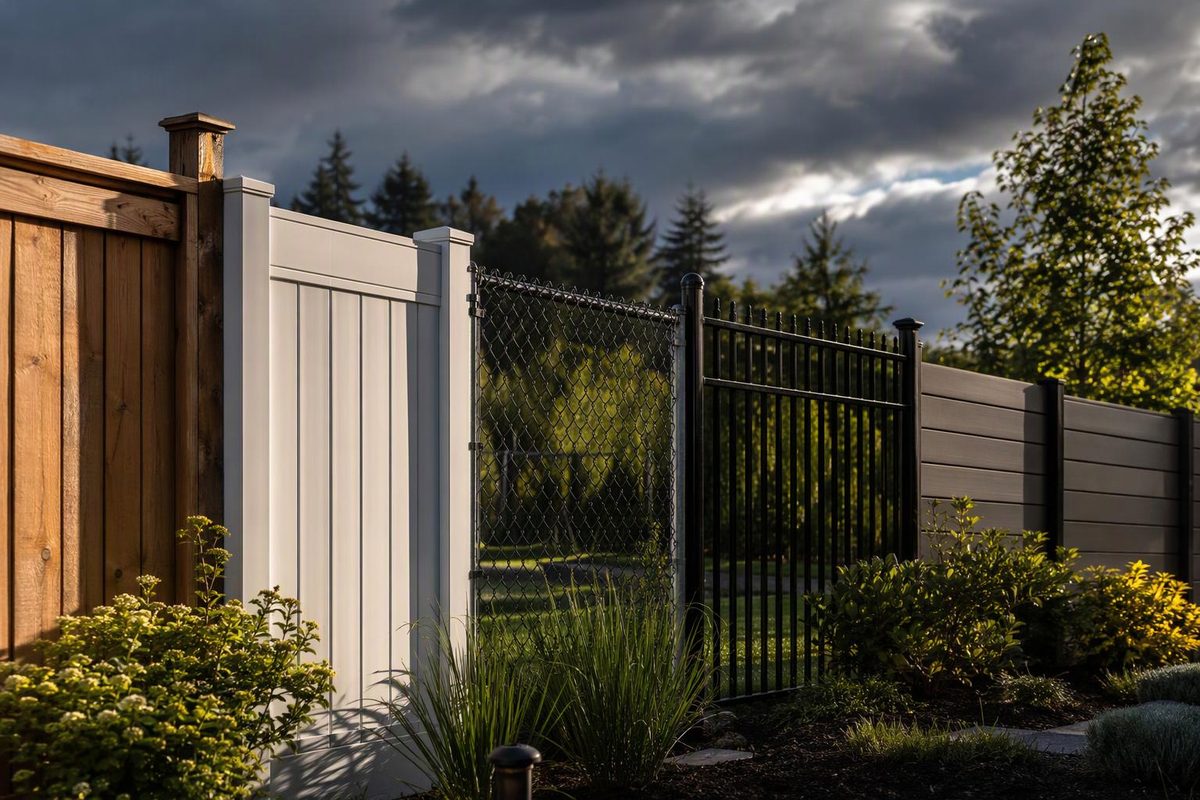
For full backyard privacy with little finish maintenance, start with solid-panel vinyl. For a natural appearance and a fence you can repair board by board, start with wood. If screening is unnecessary, compare chain link for economical containment and open-picket aluminum for appearance. Composite belongs on the shortlist when you want a wood-like privacy fence without routine staining and can justify its quoted price.
Those are starting recommendations, not universal winners. The best fence material for a backyard depends on what must stay in, what you want to screen out, and how the complete fence fits your ground and exposure.
Check the site before choosing the material
A panel is only part of the purchase. Before comparing prices, settle these points:
- Boundary and rules: Verify the property line, easements, permitted height and any HOA restrictions. If the yard contains a pool, check the applicable barrier and gate requirements before selecting a style.
- Posts and footings: Ask for post dimensions, spacing, embedment, footing details and any gate-post reinforcement. Match these to the selected system, soil, frost conditions and exposure—not a generic post-hole rule.
- Terrain: Decide whether panels will rack, meaning follow the slope, or step with level sections. Ask the installer to show the resulting bottom gaps, particularly where pets could escape.
- Upkeep and repairs: Decide whether you will renew a wood finish, accept weathered wood, or pay for a system maintained mainly by cleaning. Ask how damaged components are replaced.
Installation details genuinely differ. For example, an older Bufftech vinyl installation guide specifies reinforcement for gate posts and warns that its concrete-and-rebar post-filling method can cause cracking in freeze-thaw climates. Use the current instructions for the exact product you buy, rather than borrowing another system’s details.
In the United States, contact 811 before digging fence-post holes, and follow your state’s waiting period and safe-digging requirements. Confirm who will arrange the locate if a contractor handles installation.
Match the material to the backyard’s main job
| Your priority | First material to compare | Main trade-off | Specification to request |
|---|---|---|---|
| Full privacy with little finish work | Solid-panel vinyl | Repairs depend on compatible system parts | Panel construction, rail reinforcement and gate-post support |
| Natural appearance and individual-board repairs | Cedar or pressure-treated wood | Finish renewal if you want to preserve a particular color | Species, grade, board thickness and post treatment |
| Economical enclosure without privacy | Chain link | Open mesh does not screen neighbors | Wire gauge, mesh size, coatings and post dimensions |
| An attractive boundary that preserves views | Open-picket aluminum | Picket and bottom gaps may not suit small pets | Clear openings, rail and picket dimensions, finish and slope limits |
| Wood-like privacy without routine staining | Composite fencing | Price and construction vary by system | Complete component list, reinforcement and installation requirements |
Wood: the flexible choice for a natural privacy fence
Choose wood when appearance, custom layout and straightforward board replacement matter more than avoiding finish work. Compare cedar and pressure-treated lumber as separate specifications—not simply two versions of a “wood fence.”
Western red cedar can be left to weather rather than repeatedly coated. The Western Red Cedar Lumber Association describes weathering to silver-gray as a low-maintenance option; retaining or changing the color requires a finish that will eventually need renewal. Its outdoor finishing guidance also explains why surface preparation affects finish performance.
For pressure-treated posts buried in soil, check the end tag. AWPA’s homeowner guidance identifies UC4A as general-use ground contact and says ground-contact applications require UC4A or higher. “Pressure treated” alone does not establish suitability for burial.
Privacy also depends on board arrangement. Ask whether the design will preserve screening if boards develop gaps; overlap is a different proposition from boards installed edge to edge. For the lumber decision, see pressure-treated lumber versus cedar.
Vinyl: the first comparison for low-upkeep privacy
Solid-panel vinyl is a sensible starting point when you want screening but do not want recurring staining or painting. Choose the actual panel design carefully: vinyl also comes in open-picket and semi-private styles.
Cleaning remains part of ownership. ActiveYards recommends a garden-hose rinse and mild dish soap with water for routine cleaning of its vinyl and aluminum fences. The same manufacturer says most of its vinyl and aluminum systems can rack to follow a slope, but that is not a promise about every panel on sale.
Before buying, ask about allowable slope, rail reinforcement, gate supports and replacement-part availability. A low-upkeep material is less useful if a damaged rail requires replacing an entire unavailable section.
Chain link: start here when containment matters more than screening
Chain link deserves an early quote for a backyard enclosure that does not need privacy. The Chain Link Fence Manufacturers Institute’s residential guidance describes metallic-coated and color-coated options and recommends combining chain link with other fence materials where appearance and budget have different priorities.
Specify wire gauge, mesh opening, protective coating, posts and gates. Do not accept “galvanized chain link” as a complete description. Our chain-link specification guide explains the buying checks.
For dogs, examine the complete enclosure: height, mesh openings, bottom restraint and gate clearances. Material alone cannot address jumping, climbing or digging. If you plan to add privacy slats or screening, have the supplier check post, footing and wind-support requirements first. California contractor All American Fence Erectors warns against adding slats to a fence not designed for the resulting wind load; its reinforcement advice should not be treated as a universal specification.
Aluminum: choose open pickets for views, not privacy
Open-picket aluminum is worth comparing when you want a defined boundary without hiding the garden. Powder-coated products offer a low-upkeep alternative with an ornamental iron appearance; Ultra Aluminum describes its products as low-maintenance, powder-coated aluminum.
Check the actual clear distance between pickets and beneath the panel against your pet’s size. Ask for the panel’s slope limit, component dimensions and finish warranty. If you want screening, compare a dedicated aluminum privacy fence system, not open ornamental panels.
Composite: compare the complete system, not the label
Composite is a candidate for wood-like privacy without routine staining. Construction varies, so request the exact installation guide and component schedule.
For example, Trex describes its fencing as recycled wood fibers and plastic film, with interlocking privacy pickets. It also notes that colors weather lighter and that reinforcement and spans depend on the system. Judge samples with that expected weathering in mind, and get a complete installed quote rather than assuming all composites perform alike.
Make the final choice with comparable quotes
Request two shortlisted options using the same route, height, gate openings and site-work assumptions. Each quote should identify posts, footings, reinforcement, hardware, demolition, haul-away and exclusions—not just a price per foot.
Then add the upkeep you actually intend to do. A wood fence allowed to weather has a different maintenance budget from one kept freshly stained. A vinyl or composite fence still needs cleaning, inspections and occasional repairs; a warranty is not a guaranteed service life.
Use our new-fence cost and quote checklist to compare the totals. You can also mix materials: privacy fencing beside a patio and an open enclosure elsewhere may serve the backyard better than paying for full screening along every boundary.