
Buy a Vinyl Fence by the System, Not Just the Panel
Compare vinyl fence profiles, ASTM F964 claims, post support, slope fit, gates and warranty terms before choosing a panel or contractor quote.
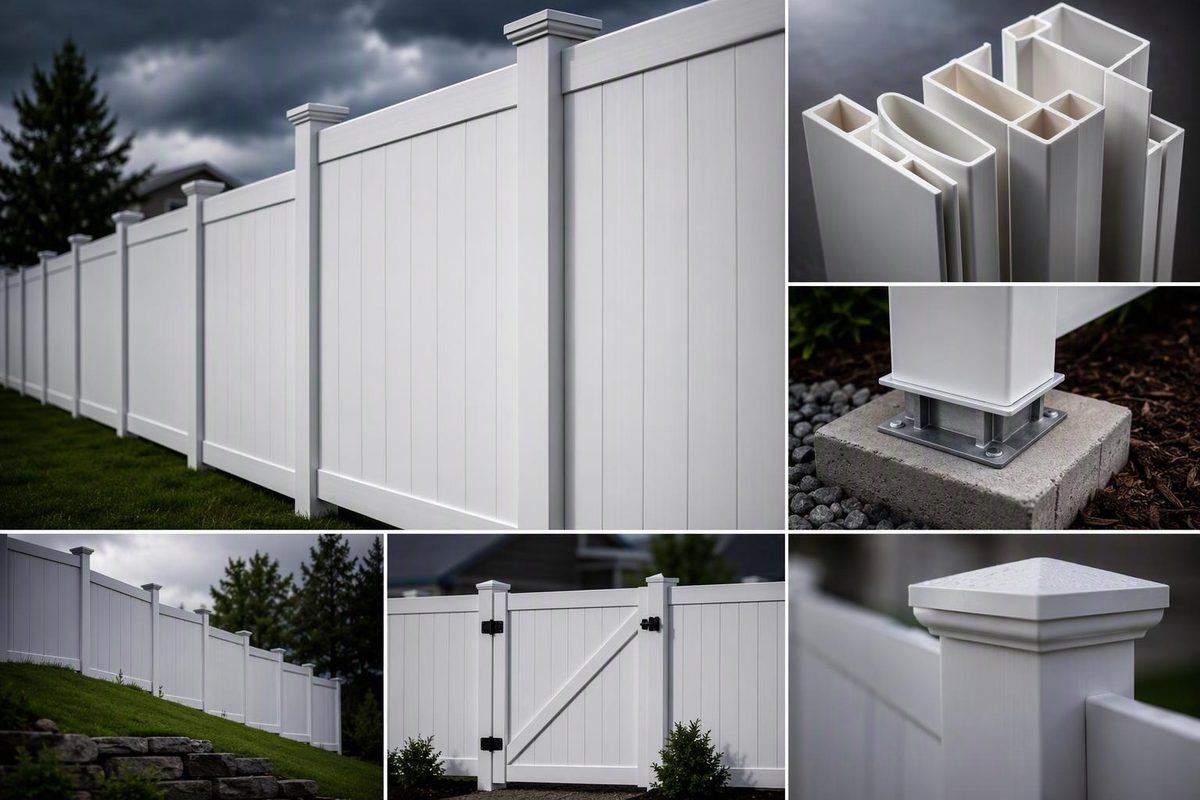
A vinyl fence is worth comparing when you want a finished appearance without a recurring painting or staining job. But “vinyl,” “heavy duty” and “lifetime warranty” do not tell you enough to buy one. The useful comparison is between complete systems: panels, posts, reinforcement, connections, gates and footings.
This guide covers rigid PVC fencing, not vinyl-coated chain link. Start with the fence’s job, then ask the supplier to identify the exact product and provide its specification sheet and installation instructions. Those documents should explain what supports the fence—not just what the surface looks like.
Match the design to the job
| Your priority | What to check before choosing |
|---|---|
| Full privacy | Solid infill, board joints, decorative-top openings and the planned gap beneath the fence |
| A visible boundary | Picket or post-and-rail design, finished height and sightlines |
| Dog containment | Height, picket openings, bottom clearance, slope transitions and gate gaps matched to your dog’s jumping and digging behavior |
| A sloping yard | Whether the exact system can rack with the slope or must step in level sections |
| An exposed site | Documentation for the complete assembly’s wind performance and required installation |
Do not assume an attractive residential panel is suitable for livestock containment or a pool barrier. Have the supplier confirm its intended use, and check applicable local requirements before selecting the style.
What ASTM F964 does—and does not—tell you
ASTM F964 is a useful material specification, not a wind rating. ASTM F964-13(2024) covers rigid PVC exterior profiles used in fencing and railing. It addresses material and physical properties, dimensional tolerances, extrusion quality and weatherability, with testing that includes impact resistance and dimensional stability. It expressly does not address the loadbearing characteristics of complete assemblies, including wind loads. Accessories such as hinges, latches and brackets are outside its scope. Source: ASTM
Ask which profiles in the quoted product meet F964 and request supporting manufacturer documentation. A general statement about a brand is less useful than a statement tied to the fence series you will receive.
The standard permits both a single homogeneous PVC extrusion and coextrusion with distinct PVC layers. That means “coextruded” is not, by itself, a reason to reject a fence. Compare documented properties and construction rather than treating a manufacturing label as a quality grade. Source: ASTM
Read dimensions component by component
Ask for the outside dimensions and wall thickness of the posts, rails and infill, plus details of any internal ribs or metal reinforcement. A thickness quoted for one component does not describe the entire fence.
Use those dimensions to compare equivalent parts, not to declare a universal winner. Also check:
- Which rails contain metal support, and whether it is included in the price.
- How rails are retained in posts or brackets.
- How cut sections retain their connections and infill.
- Whether replacement boards, rails and matching posts can be ordered separately.
For example, Illusions’ installation guide identifies heavy-wall post options for gates and heightened wind locations, and shows metal U-channel placement within rails. Those are product-specific construction details—not features to assume every vinyl panel includes. Source: Illusions installation instructions
Settle posts, footings and terrain before price
A panel cannot compensate for unsuitable post support. Have the quote state post size and length, footing diameter and depth, reinforcement and the installation method required for your site.
Follow the exact system’s guide rather than copying a footing recipe from another fence. Illusions, for instance, directs installers to account for local ordinances and expected frost depth and to use the style-specific sheet for post centers. Bufftech’s guide requires reinforcement at hinge and latch posts for its extruded systems; it also warns that its concrete-and-rebar fill method can cause post cracking in freeze-thaw climates. Illusions guide · Bufftech guide
On a slope, stepping keeps rails level, while racking lets them follow the grade. Bufftech’s extruded-fence instructions show that racking may require field modifications and reduced post spacing, depending on slope and style. Confirm the allowed method before posts are set. Source: Bufftech guide
Ask the installer to show the largest expected bottom gap and the gate’s swing clearance. For layout details, see our guide to installing a vinyl fence.
Before digging, verify the boundary, applicable height and placement rules, easements and utility locations. In the United States, arrange an 811 locate and follow your state’s waiting and response requirements before excavation. If a contractor is digging, confirm who will make the request. Source: 811 before you dig
Compare the complete installed price
Request separate amounts for:
- Panels, posts, caps and required reinforcement.
- Gates, gate-post support, hinges and latches.
- Excavation, concrete and installation labor.
- Slope adjustments, shortened sections and difficult access.
- Old-fence removal, disposal, delivery and permit work where applicable.
Compare quotes at the same height, style, color, footage and gate openings. A low panel price is not a low project price if posts and support are excluded. For a material comparison, use our vinyl fence cost versus wood guide.
Low maintenance still needs a repair plan
Routine upkeep is principally cleaning rather than refinishing. Catalyst says soap and water are usually sufficient for its vinyl fences; use your product’s care instructions before choosing stronger cleaners. Source: Catalyst material guide
Keep the invoice, product series, color name and installation documents. Ask how a damaged rail or board is removed and whether replacement parts remain available. Our vinyl fence repair guide explains when replacing a component makes more sense than patching it.
Finally, read the warranty itself. Illusions’ published warranty excludes removal and installation labor, ends coverage when the property is sold or the last purchaser dies, and excludes events including object impacts and wind storms. Its Grand Illusions coverage is prorated over 20 years for a qualifying homeowner purchase. These are examples of why a warranty headline is not a promised service life or an all-damage guarantee. Source: Illusions warranty
Choose the system whose documents and quote resolve these details. Leave “heavy duty” as a description until the supplier shows you what it means.