
Choose a Chain Link Fence by Its Wire, Posts and Coating
Compare chain-link wire gauge, mesh, coatings, posts and gates, then build a complete project budget instead of pricing fabric alone.
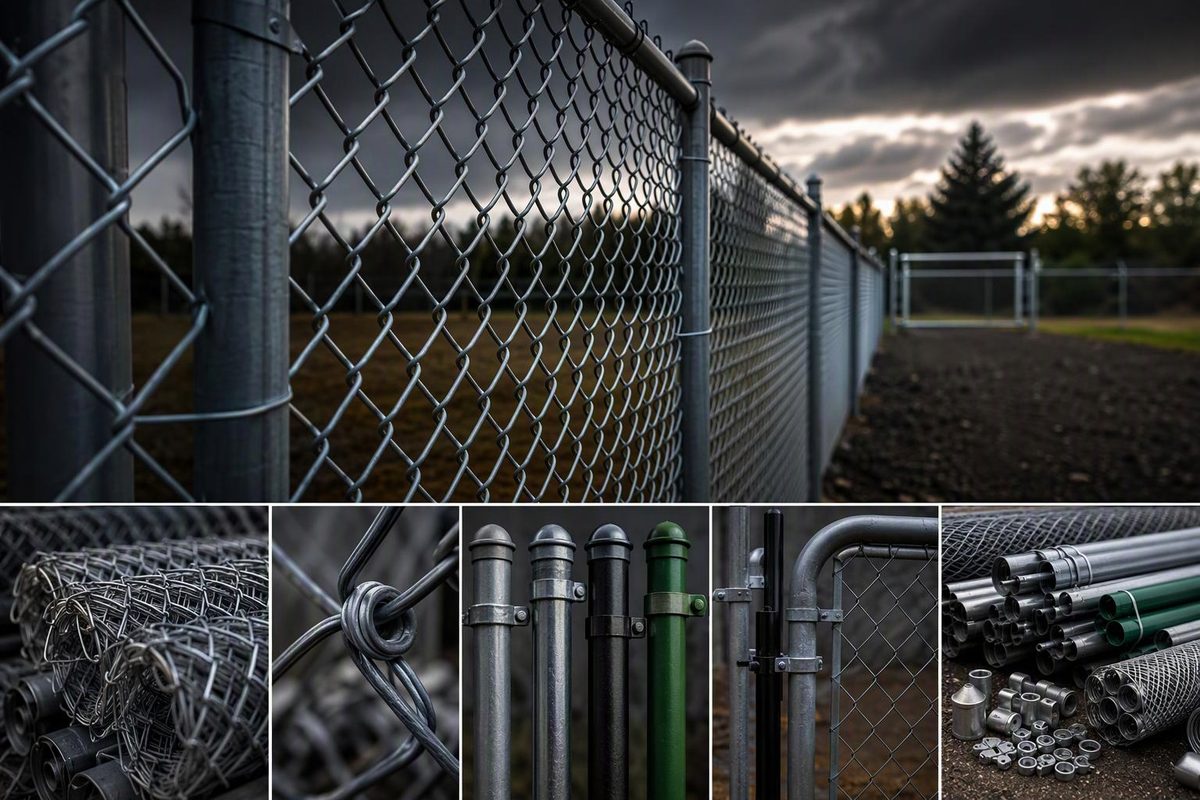
A chain link fence is a good candidate when you want an open boundary or enclosure without a solid wall. But “6-foot chain link” is not a complete specification. Two fences with the same height can have different wire thicknesses, mesh openings, post strength and corrosion protection.
Choose the enclosure and supporting framework first; compare prices only after the specifications match. That matters especially for gates, sloping ground and fences that will carry privacy screening.
Match the fence to its job
For a boundary fence, decide how much visibility you want to preserve. Galvanized chain link has the familiar metallic appearance; colored polymer-coated systems offer a different look without closing the mesh. Both are available from manufacturers such as Master Halco.
For dog containment, look beyond height. Check the proposed mesh opening, clearance beneath the fabric, gaps beside gates and connections to buildings. Choose those details for the particular animal rather than assuming that any residential chain-link package will contain it.
If privacy is the main objective, compare a purpose-built privacy fence against chain link with its screening and support upgrades included. Slats and screens increase wind load. Hoover Fence’s installation manual recommends considering closer post spacing, larger diameters and thicker-wall framework when adding them—not simply attaching screening to an ordinary open fence. See our privacy-screen comparison for the different options. (Installation guidance)
Settle posts, footings and terrain before ordering fabric
Chain-link posts have different roles:
- Line posts support the fence between its ends and corners.
- Terminal posts anchor the fabric at ends, corners, gates and certain changes in grade or long runs.
- Gate posts are terminal posts that also support the moving gate and its hardware.
The Chain Link Fence Manufacturers Institute’s product manual defines line posts as intermediate supports spaced no more than 10 feet on center. Treat that as a ceiling, not a promise that 10-foot spacing suits every site.
Ask for outside diameter, wall thickness and steel grade, or a manufacturer’s framework designation that identifies those properties, for each post role and the rail. Diameter alone leaves an important part of the specification unstated. Our chain-link post-size guide explains how to compare the roles.
Footing depth and diameter need to account for the location, fence height and materials; gate footings commonly require additional depth and diameter. Hoover’s manual also explains that sloping terrain changes post-height planning and the fabric’s clearance above ground. Avoid accepting one standard hole depth without checking local frost conditions and the proposed installation. (Post and terrain guidance)
Before digging in the United States, contact 811 in advance and follow your state’s locate procedure. Separately, verify the property boundary, easements, setbacks, allowed height and any permit or deed restrictions before fixing the fence line.
Read wire gauge and mesh size separately
Wire gauge describes thickness; mesh size describes the clear opening between parallel wires. A smaller gauge number means thicker wire.
These are useful comparisons from the CLFMI manual’s March 2017 edition—not a complete design prescription:
| Wire gauge | Nominal wire diameter | CLFMI listed use with 2-inch mesh |
|---|---|---|
| 11 | 0.120 inch | Residential/light commercial |
| 9 | 0.148 inch | Residential/commercial/industrial |
| 6 | 0.192 inch | Commercial/industrial/security |
The manual defines mesh size as the minimum clear distance between the wires forming parallel sides of the opening. It also specifies polymer-coated fabric gauge by the metallic-coated core wire, not the outside diameter including plastic. (CLFMI definitions and tables)
That distinction can change a buying decision. Master Halco’s catalog lists one extruded product with a 13-gauge core and 9-gauge finish, while another product has a 9-gauge core and 8-gauge finish. “9 gauge” without saying which measurement is being quoted can therefore conceal a substantial difference in steel thickness. Ask for both the core gauge and nominal core diameter on colored-fabric quotes. (Manufacturer’s core/finish table)
Also specify the edge finish, called the selvage. Knuckle-knuckle fabric has folded edges at the top and bottom; knuckle-twist has a twisted, barbed edge at one end. For a yard where people regularly contact the fence, request folded edges rather than leaving the choice implicit. CLFMI specifically recommends knuckle-knuckle edges for added safety in playfield and park applications. (Selvage definitions and guidance)
Specify the coating—not just the color
“Galvanized” and “black vinyl-coated” are incomplete descriptions. Ask for the applicable standard and coating class.
In its March 2017 manual, CLFMI distinguishes:
- ASTM A392 galvanized fabric: Class 1 lists 1.2 ounces of zinc per square foot; Class 2 lists 2.0 ounces per square foot.
- ASTM F668 polymer-coated fabric: Class 1 is extruded; Class 2a is extruded and adhered; Class 2b is fused and adhered.
Those class numbers describe different things. A galvanized Class 1 designation cannot be substituted for a polymer Class 1 designation. Posts, rails and fittings also need their own coating specifications. (CLFMI coating specifications)
The zinc weights refer to the surface area of the uncoated wire—not the square footage of the fence face. (A392 coating provisions)
For upkeep, Master Halco recommends periodic washing with soapy water, a brush and a hose; its chain link does not require routine staining, painting or sealing. Include inspections of loose ties, damaged fabric, leaning posts and gate alignment in your maintenance plan. (Manufacturer’s care guidance)
Compare the complete installed scope
A fabric-roll price is not a fence price. Request separate quantities or allowances for:
- Fabric, posts, rails, tension wire and fittings.
- Gates, hinges, latches and gate-support work.
- Footings, excavation and handling rock or other obstructions.
- Installation labor.
- Old-fence removal, clearing, delivery, permits and cleanup.
- Screening and any framework upgrades it requires.
For gates, confirm the supplier’s required post opening, measured inside-to-inside between gate posts, before setting them. Also confirm that the assembled gate and hardware will provide the usable passage width you need; do not order from an advertised gate width alone. (Gate-post layout guidance)
Use our chain-link fencing rate guide for budgeting, then obtain a local quote for the chosen height and specification. The most useful bid is the one that names the wire, coating, framework and installation scope—not the one that supplies only a price per foot.