
Choose a Privacy Screen Your Fence Can Support
Compare fence privacy screen options—mesh, chain-link slats and rigid panels—by fit, wind load, installation demands and local rules before buying.
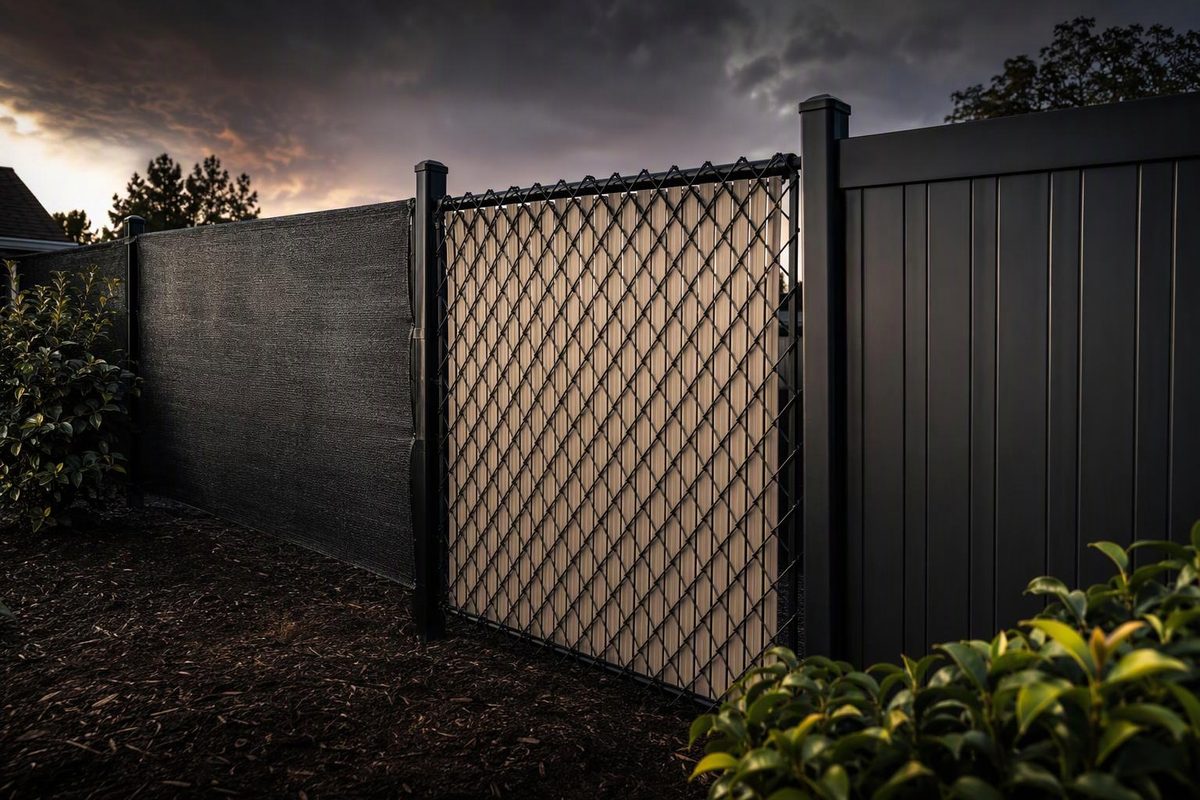
For a serviceable chain-link fence, mesh is usually the quickest retrofit, while compatible slats provide a cleaner integrated appearance. Use rigid panels only on a suitable frame. Do not add dense screening to a leaning, corroded or poorly anchored fence: closing the surface increases the wind force that its posts, rails and footings may have to resist.
Select your fence condition, type, and exposure to see which screen deserves a closer look.
Fence Privacy Screen Picker
This narrows the screen type; it does not calculate structural wind capacity.
Compare mesh with compatible chain-link slats
- Mesh is generally the quickest retrofit.
- Slats provide a more integrated appearance but must match the mesh and wire gauge.
- Confirm the fence is sound before covering it.
Sources: Pexco Bottom Lock and Winged Slat specifications; Chain Link Fence Manufacturers Institute January 2023 Wind Load Guide.
Compare the Main Screen Types
| Screen type | Best fit | Main advantage | Main limitation |
|---|---|---|---|
| Knitted or woven mesh roll | Serviceable chain link | Fast installation and broad coverage | Fabric, grommets and ties need inspection; high blockage adds wind load |
| Chain-link privacy slats | Compatible chain-link mesh | Integrated appearance without loose fabric | Fit depends on mesh, wire gauge, height and locking style |
| Rigid lattice or decorative panel | Purpose-built frame or suitable fence | Architectural appearance and potentially fuller coverage | Posts and attachments must carry panel loads |
| Reed, bamboo or faux-foliage roll | Decorative or short-term screening | Changes the appearance quickly | Durability, flammability and UV resistance vary by product |
Mesh is generally the simplest retrofit when speed and price matter. Slats are the cleaner chain-link-specific option. Treat a rigid panel as a small fence construction project rather than an accessory held up by cable ties.
For wood fencing, first decide whether a separate screen is necessary. Overlapped boards or an opaque backing can preserve screening as boards move and dry. Those design choices are covered in A Horizontal Privacy Fence Works as a System.
Privacy Percentages Do Not Guarantee Concealment
“Privacy,” “blockage” and “opacity” percentages are not interchangeable guarantees of complete concealment. Visibility changes with viewing angle, distance, sunlight and the contrast between the two sides of the fence. If the screen must hide people, equipment or neighboring windows, compare samples under conditions similar to the installation site.
For chain-link slats, confirm the claim for the exact style. Pexco lists an approximate 75% wind-load and privacy factor for its Bottom Lock slat. Its Winged Slat is listed at approximately 90%, but it fits only 2-inch, 9-gauge mesh and takes more installation time. These examples show why “chain-link slat” is not a complete specification: mesh size, wire gauge, fence height and lock design all matter (Pexco Bottom Lock specifications; Pexco Winged Slat specifications).
Before ordering slats, measure an actual diamond and identify the wire gauge. Before ordering a fabric screen, measure each run between terminal or tension points rather than multiplying nominal panel widths. Measure gates separately so the screen does not bridge a moving joint.
Check Wind Capacity Before Covering Chain Link
Open chain-link fabric lets much of the wind pass through. Adding a high-blockage screen or dense slats changes that behavior.
The Chain Link Fence Manufacturers Institute explains that fence height multiplied by line-post spacing determines the area transferring wind force to the posts and footings. Post shape and strength, soil, footing depth, exposure and local design wind speed also affect capacity. Its January 2023 guide uses ASCE 7-22 criteria and expressly recommends evaluation by a qualified engineer because site conditions vary (CLFMI Wind Load Guide).
That does not mean every residential screen needs an engineer. It does mean a screen should not go onto a fence with:
- leaning, loose or badly corroded posts;
- cracked or moving footings;
- bent top rail or loose rail connections;
- detached fabric or missing tension hardware;
- long post spacing, substantial height or known exposure to strong winds.
Full-height screening on an exposed 8-foot fence deserves more scrutiny than a short, breathable screen in a sheltered yard. If privacy is pushing an existing chain-link frame beyond its original job, compare larger posts and closer spacing rather than relying on stronger ties. See Chain Link Fence Post Size Chart by Post Role for the framework dimensions to discuss with an installer.
Install Mesh as a Fitted Panel, Not a Sail
Follow the screen manufacturer’s fastening schedule and warranty instructions. Recommendations differ by fabric and edge construction, so a generic bag of indoor cable ties is not a complete installation plan.
For a typical grommeted chain-link screen:
- Repair and tension the fence first.
- Lay out each panel against its intended run and orient the finished face correctly.
- Square one end against the tension bar, then work progressively along the top and bottom.
- Use UV-rated outdoor ties of the type and strength specified by the screen maker.
- Fasten every required grommet without stretching the fabric or overtightening the ties.
- Leave the specified ground clearance to avoid trimmer damage, standing moisture and debris.
- Trim tie ends safely and orient sharp cut ends away from people and pets.
Ball Fabrics instructs installers to attach its screen to the chain-link mesh rather than the top rail, avoid skipping grommets and replace broken ties promptly. It also recommends leaving a few inches below the screen for airflow and protection from lawn equipment (Ball Fabrics installation instructions).
CoverSports likewise calls for a separate tie at every grommet and warns that a loose screen can whip against the fence after ties fail (CoverSports installation guide). Use the instructions supplied with the product actually purchased where details differ.
Inspect the installation after the first windy period and seasonally thereafter. Replace broken ties before one loose edge enlarges grommet holes or abrades the fabric.
Local Rules May Treat a Screen as a Solid Fence
A screen can change an open fence into an opaque or solid fence in the eyes of a local code. Rules are highly local. Philadelphia, for example, requires a zoning permit for a front-yard fence up to 4 feet when it is more than 50% opaque. Buffalo Grove, Illinois, includes patio screening within work requiring a fence permit (Philadelphia fence permits; Buffalo Grove fence requirements). Check the local planning or building office and any HOA before ordering.
Do not assume added privacy makes a pool fence compliant. The U.S. Consumer Product Safety Commission’s nonmandatory guidance addresses barrier height, climbability, openings and self-closing, self-latching gates. For chain link, it recommends mesh no larger than 1¼ inches square unless top- or bottom-fastened slats reduce openings to no more than 1¾ inches. Enforceable state and local requirements may differ or be stricter (CPSC pool-barrier guidelines).
Specify Fit, Hardware, and Reinforcement in the Order
A useful quote or product order identifies:
- finished screen height and the measured length of every run;
- fence type, mesh size, wire gauge and post spacing;
- stated privacy or blockage factor;
- fabric weight or slat material, UV treatment and warranty;
- grommet spacing, reinforced edges and center attachment strips where required;
- compatible ties, locking channels or other attachment hardware;
- gate panels and other custom cuts;
- removal or repair of the existing screen;
- any framework reinforcement required for wind exposure.
The best fence privacy screen is not necessarily the most opaque one. It is the lightest system that provides the required screening, fits the existing fence and leaves the posts and footings capable of doing their job.