
Choose Cyclone Fence Privacy Slats by Mesh, Privacy and Wind
Choose cyclone fence privacy slats by mesh, wire gauge, screening level and wind exposure, then estimate packages and install the correct locking style.
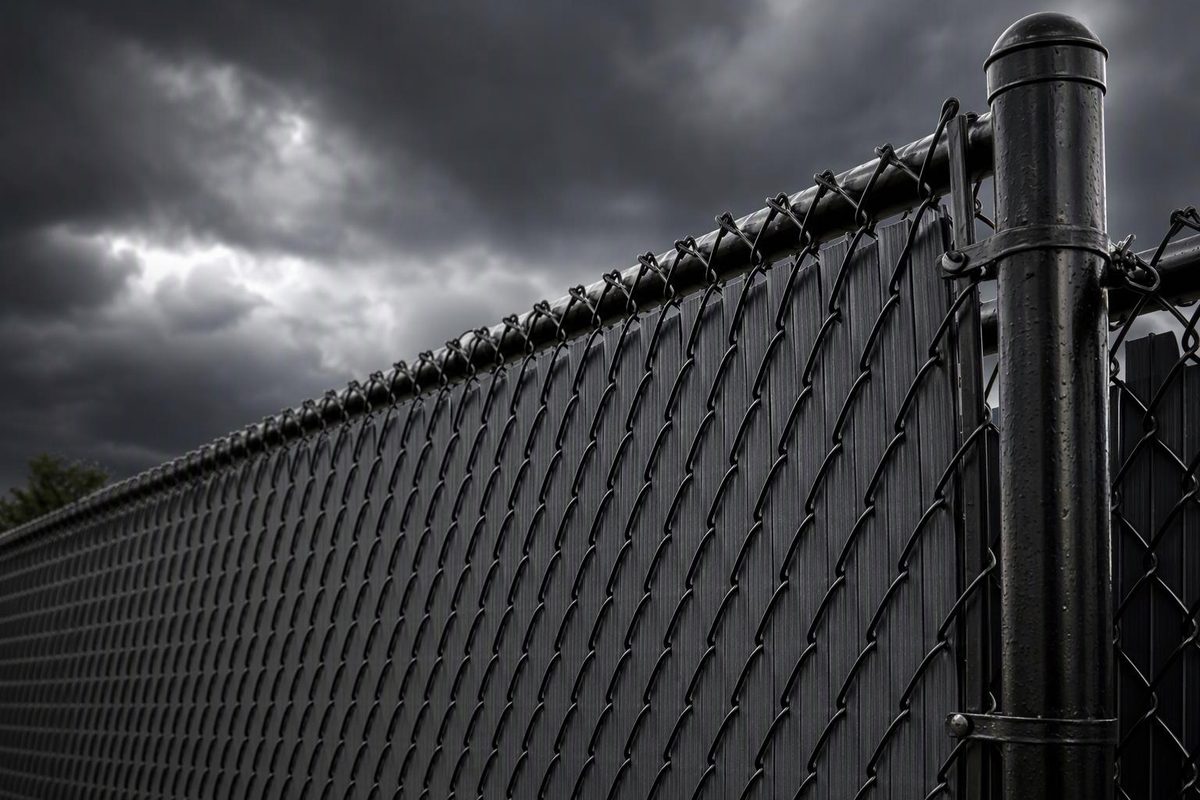
Cyclone fence privacy slats are vertical inserts fitted through chain-link fabric. They can reduce views through an existing fence without replacing it, but they do not make chain link equivalent to an opaque panel.
Choose them in this order: confirm the fit, decide how much screening you need, and assess whether the fence can carry the added wind load. Do not buy by nominal fence height and color alone.
Compare slat styles by screening and locking method
Privacy percentages are manufacturer estimates tied to a particular slat and fence configuration. Pexco, for example, rates its Bottom Lock and Top Lock products at approximately 75% privacy, while its Winged Slat and FinLink products are rated at approximately 90%. The company notes that actual privacy can vary with the wire, mesh and fabric tension (Pexco Bottom Lock specification; Winged Slat and FinLink comparison).
| Slat type | Example advertised privacy | Retention method | Main buying consideration |
|---|---|---|---|
| Bottom lock | About 75% | Slats snap into a channel at the bottom | Requires access to install the lower channel |
| Top lock | About 75% | A flexible channel passes through notches near the top | Installation and locking are completed from above |
| Winged or self-locking | About 90% | Serrated wings grip the chain-link fabric | Tighter fit can take longer to insert |
| Finned with bottom channel | About 90% | Side fins close gaps; a lower channel aligns the slats | Compatibility may differ from winged products |
| Factory pre-woven | About 90% | Slats are inserted while new fabric is woven | Intended for new fabric, not an existing-fence retrofit |
A higher percentage does not guarantee that people, lights or movement will disappear from view. Viewing angle, distance, mesh geometry and installation quality all affect the result. If near-opaque separation is essential, compare slats with a purpose-built solid privacy fence rather than assuming a 90% claim means complete blockage.
Factory-prewoven fabric can avoid inserting hundreds of individual slats, but it requires replacing or installing fabric. Pexco says its Fin2000 product is mechanically inserted during weaving and has an approximate 90% wind-load and privacy factor (manufacturer specification).
Measure the existing fence before ordering
Record these details for every fence run and gate:
- Fabric height: Measure the chain-link fabric rather than the portion of post extending above it. Slats are normally shorter than the nominal fence height. In the cited Pexco range, Top Lock and Winged Slats are 2 inches shorter, while Bottom Lock and FinLink slats are 3½ inches shorter.
- Mesh size: Measure using the supplier’s diagram or instructions. If you are uncertain, send the seller a close photograph with a ruler across a complete opening.
- Wire gauge and finish: Slat width is matched to both mesh and wire. A coated fabric may be described by finished wire diameter or by the steel core gauge, so confirm which specification the slat seller requires.
- Length at each height: Separate the main runs from walk and vehicle gates. Do not assume a slat can be shortened without affecting its notch, bevel or locking system.
- Fence condition: Check for leaning or loose posts, movement at the footings, corrosion at grade, bent rail, slack fabric and weak gate frames before adding screening.
Compatibility is product-specific. One current example shows why gauge matters: Pexco specifies its Winged Slat for 2-inch mesh with 9-gauge wire. Its FinLink product fits 2-inch mesh with 11, 11½ or 12-gauge wire and is not compatible with the 9-gauge configuration (Pexco compatibility details). Those limits should not be assumed to apply to another brand or profile.
Treat wind load as the structural decision
Open chain-link fabric has substantial free area. Filling its openings causes the fence to capture more wind and transfer more force to the fabric, ties, rails, posts and footings. Both Pexco and Hoover Fence specifically warn that privacy slats require adequate structural support for local wind conditions (Pexco Top Lock instructions; Hoover Fence product details).
The Chain Link Fence Manufacturers Institute Wind Load Guide, updated January 2023, identifies fence height, exposed surface area, post material and shape, soil resistance, footing design, wind speed, exposure and topography as relevant factors in line-post selection and spacing. Its tables assume defined conditions and are not a pass/fail test for an unknown existing fence; CLFMI says a qualified professional engineer should assess each application because site conditions vary.
A structural review is particularly important when the fence is tall, exposed on an open lot or ridge, located in a high-wind area, or already shows movement or undersized framing. An existing fence that performs acceptably with open mesh may not be suitable after most of its openings are filled.
For initial framing comparisons, see the chain-link post size guide. If the project also raises the fence, assess the additional height and screening together; the chain-link height retrofit guide explains why posts and footings matter more than the extension hardware alone.
Check local permit and zoning requirements before changing fence height or opacity. Corner visibility, pool-barrier rules and HOA restrictions may also apply depending on the property and fence location.
Calculate packages and compare complete cost
Slats are commonly sold by the approximate linear feet a package covers at a specified height, mesh and wire configuration. One current Pexco Top Lock listing includes 82 slats and a locking channel for approximately 10 linear feet. Its corresponding Winged Slat package contains 82 self-locking slats and covers approximately 10 feet without a separate channel (Top Lock package; Winged Slat package).
Use:
packages required = round up (length to be slatted ÷ coverage per package)
Calculate each height separately. Include gates only if their frames and hardware are suitable for the added wind area and weight, and confirm that the slats will not interfere with hinges, latches or ground clearance.
As a dated retail reference, Home Depot listed one black 6-foot-by-10-foot M-D slat package at $70.80 on September 28, 2026, equal to $7.08 per linear foot before tax, delivery and labor (product listing). This is one product price, not an average. Compare delivered cost for the correct height, profile, color, mesh and gauge rather than comparing package prices alone.
Follow the product’s locking sequence
Straighten distorted diamonds and repair loose fabric before inserting slats. The sequence then depends on the locking system:
- Bottom lock: Pexco directs installers to place the horizontal rail through the first full diamond at the bottom with its opening upward, insert each slat notched end down, and push it into the channel to lock (Bottom Lock instructions).
- Top lock: Insert the slats from top to bottom with their locking holes aligned near the top, then thread the flexible channel through the holes. Pexco advises checking that the finished top edge is straight and that the fence has adequate support for local wind (Top Lock instructions).
- Winged: Insert the angled end downward and work the flexible wings through the mesh. The friction fit eliminates a separate channel but may require more installation time (Winged Slat details).
Do not force a slat past bent wire if doing so deforms the mesh or pulls fabric away from a terminal post. After installation, make sure all channels are engaged and that gates still swing and latch without interference.
HDPE slats can generally be washed with water, but washing is not the main maintenance issue. Inspect the fence after major wind events for leaning posts, changed footing position, bent rail, loose ties and displaced channels. The slats provide the screening; the frame and footings carry the resulting load.