
How to Choose the Right Post for Your Fence and Site
See starting sizes for wood, chain link and other systems, plus how spacing, embedment, wind, soil, frost and gates change the choice.
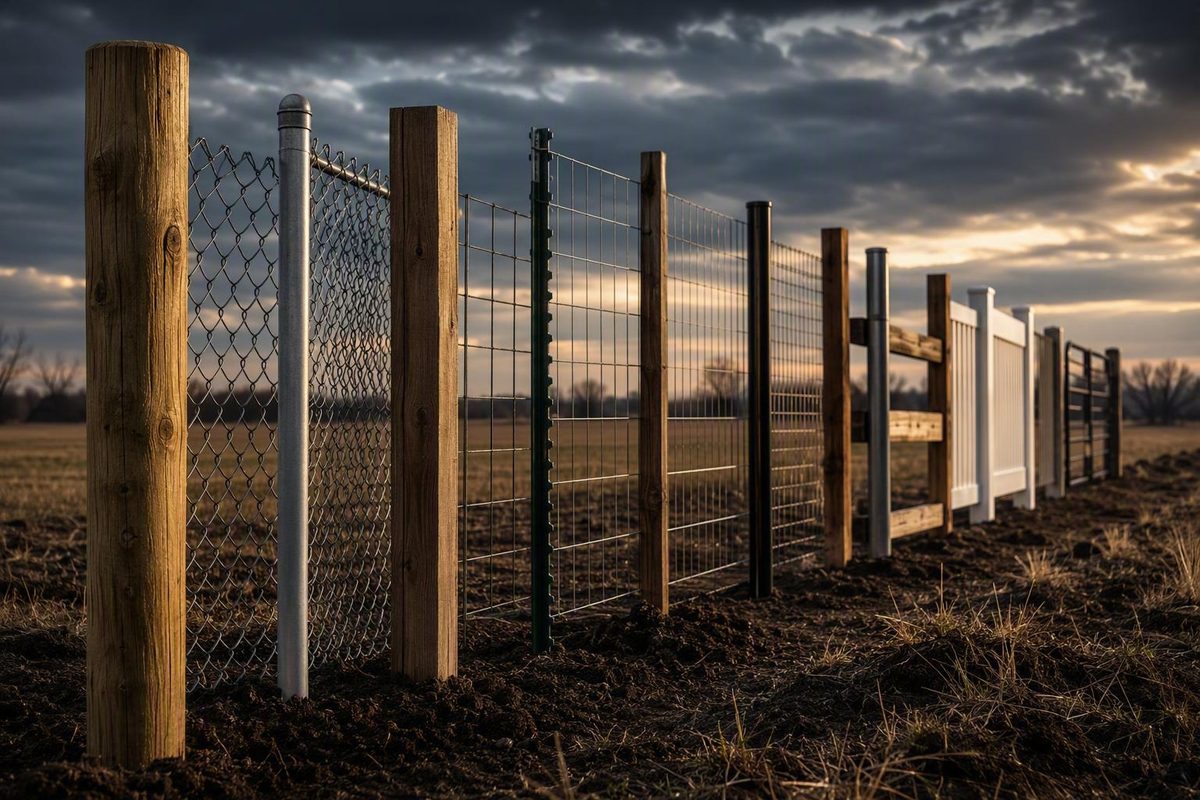
There is no universal fence-post size. Choose the post as part of a system: cross-section or pipe diameter, wall thickness, total length, spacing, embedment, footing, and post role all work together.
A nominal 4x4 is a common starting point for many ordinary residential wood fences, while a light-duty 4- to 5-foot residential chain-link fence often starts around 1-5/8-inch line posts and 2-inch terminal posts. Neither baseline is automatically suitable for every site. Before buying, account for fence height and openness, soil, frost depth, wind exposure, corners, gates, manufacturer instructions, and local requirements.
Quick fence-post size selector
Use this table to develop a materials list, not as a code standard or engineered schedule. A “loaded post” is an end, corner, brace, terminal, or gate post—or any post supporting an unusually tall, heavy, or wind-catching fence.
| Fence system | Line-post starting point | Loaded posts and spacing | Site checks |
|---|---|---|---|
| Residential wood picket or semi-open fence | Nominal 4x4; common contractor guidance | Consider a 4x6 or 6x6, bracing, or a stronger foundation at ends, corners, and gates; Roughly 6–8 ft; common practice | Height, lumber species and grade, rail span, wind, soil, frost, gate load |
| Residential wood privacy, board-on-board, or shadowbox | Nominal 4x4 as an initial planning concept, not automatic approval for every 6-ft fence | A larger or longer 4x6 or 6x6, closer spacing, or a stronger foundation may be appropriate; Roughly 6–8 ft; contractor guidance | Solid-panel wind load, panel weight, board orientation, exposure, weak soil |
| Light-duty residential chain link, 4–5 ft | About 1-5/8-in line posts; contractor or retailer guidance | About 2-in terminal posts; select gate posts separately; No more than about 10 ft; 8 ft or less is often used when loads increase | Wall thickness, actual O.D., screening, gate size, steel grade, coating, wind |
| Residential chain link, 6 ft | About 2-in line posts in one contractor guide | About 2-1/2-in terminal posts; Up to about 10 ft in light conditions; closer spacing may be selected | Privacy slats, exposure, gate loads, duty level, footing, local requirements |
| Vinyl panel system | Use the system’s specified post and reinforcement | Follow its corner, end, and gate-post details; Determined by panel width and post geometry | Manufacturer instructions, hardware, reinforcement, wind rating, footing |
| Ornamental panel system | Use the system’s specified post profile | Use the specified terminal and gate-post assembly; Determined by panel and bracket dimensions | Material grade, panel width, gate loads, manufacturer details |
| Split rail | A 5-in line post appears in contractor guidance for selected two- and three-rail systems | Confirm corner, end, and gate geometry separately; Determined by rail length and socket layout | Actual rail length, mortise geometry, terrain, livestock pressure |
| Agricultural woven or high-tensile wire | Use the applicable fence specification rather than a residential chart | Braced corner, end, and pull assemblies commonly use larger posts; Assembly-specific | Wire tension, brace design, terrain, post material, governing specification |
The wood, split-rail, vinyl, ornamental, and height-based chain-link figures are examples from a commercial contractor’s fence-post spacing tables, not adopted code requirements. That guidance pairs nominal 4x4 posts with several residential wood styles and increases residential chain-link framework from 1-5/8-inch line and 2-inch terminal posts at 4–5 feet to 2-inch line and 2-1/2-inch terminal posts at 6 feet.
Higher loads may require a larger section or diameter, heavier wall, shorter span, deeper embedment, wider footing, or bracing.
Understand what post-size labels actually measure
Post labels do not all describe the same measurement:
- Square wood notation: “4x4” identifies a nominal square lumber size, not necessarily its finished dimensions.
- Round-post diameter: A round wood post may be described by its diameter, sometimes at the small end and sometimes as a range.
- Total post length: The full end-to-end length, including the exposed and embedded portions.
- Steel trade size: A familiar pipe category used to order framework. It may not equal the measured outside diameter.
- O.D.: Outside diameter—the measurement across the outside of a round pipe.
- Wall thickness: The thickness of the steel wall. Similar outside diameters can be sold with substantially different walls and duty ratings.
A surfaced nominal wood 4x4 is commonly about 3-1/2 by 3-1/2 inches, but the product’s actual dimensions should be verified. Contractor guidance also illustrates why nominal post size must be considered together with fence style and spacing: horizontal-slat fencing may use nominal 4x4 or 6x6 posts at 6-foot centers rather than assuming a wider conventional span in every case in the contractor’s sizing table.
Chain-link trade names can differ from plumbing nominal pipe sizes and from measured diameter. Order against the supplier’s actual outside diameter and wall thickness, then match the fittings to that exact product. Do not treat a fence trade label as a standard NPS dimension.
That distinction affects caps, tension bands, brace bands, rail ends, loop caps, and hinges. Match fittings to the supplier’s stated actual O.D. and product family rather than relying on a familiar trade label alone.
Tapered wood notation works differently. Under one supplier’s convention, a 4–5-inch x 8-foot post is at least about 4 inches at the smaller end, increases toward about 5 inches at the other end, and is 8 feet long according to its tapered-post guide. Because sizing practices can vary among suppliers, confirm where the diameter is measured and whether the stated dimensions are nominal values, minimums, or ranges.
A label establishes dimensions or a product category. It does not establish that the post can support a particular fence. Suitability still depends on material properties, loading, spacing, embedment, and foundation design.
Wood post sizes: when to consider 4x4, 4x6, or 6x6
A nominal 4x4 is a practical starting point for many residential picket, privacy, board-on-board, and shadowbox fences. It should not be treated as a blanket rule for every fence up to 6 feet tall.
Before settling on a 4x4, consider:
- wood species and grade;
- actual finished dimensions;
- finished fence height;
- panel and rail weight;
- solid versus open construction;
- vertical versus horizontal boards;
- post spacing and rail span;
- embedment and footing design;
- soil, drainage, frost, and wind exposure; and
- whether the post is a line, end, corner, or gate post.
Consider a 4x6 or 6x6 when the fence is taller, uses heavy or horizontal boards, presents a solid face to the wind, stands on an exposed site, crosses weak soil, or uses relatively wide spans. Corners and gates also deserve separate assessment.
For many residential wood fences, roughly 6–8 feet on center is a useful initial range. Move toward the shorter end—or reassess the whole assembly—for heavy panels, horizontal cladding, weak soil, or stronger wind exposure. Closer spacing may reduce the panel and rail load assigned to each bay, but it does not prove that the posts or foundations are adequate.
Keep durability and capacity separate. A buried wood post should be naturally durable or treated and labeled for its intended ground-contact exposure. Preservative treatment addresses decay exposure; it does not demonstrate that a 4x4 is large enough for a tall privacy fence or gate.
Retail inventories include nominal 4x4 and 6x6 pressure-treated products in multiple lengths, including products identified for ground contact. That confirms availability only. A stocked 8-foot 4x4 is not automatically the correct post for a 6-foot fence.
Chain-link post diameter and wall thickness
Chain-link posts are selected according to their role:
- Terminal posts anchor the fabric at starts, ends, corners, significant grade changes, and gate openings.
- Line posts are intermediate supports for the mesh and top rail.
- Gate posts are terminal posts subjected to additional leverage from the gate, hinges, and repeated movement.
For light-duty residential chain link at 4–5 feet high, a common planning baseline is approximately 1-5/8-inch line posts and 2-inch terminal posts. At 6 feet, contractor guidance progresses to approximately 2-inch line posts and 2-1/2-inch terminal posts. These are commercial guidance figures, not universal requirements.
Diameter alone is inadequate. A useful framework specification identifies the trade size or actual O.D., wall thickness or recognized wall category, steel grade, coating, and post role.
Use the chain-link framework guide for the specialized comparison. Confirm actual outside diameter, wall thickness, steel grade and gate requirements with the system supplier.
Privacy slats, windscreens, fabric covers, and attached signs make open mesh more wind-catching. Adding them may require heavier framework, shorter spacing, and larger or deeper foundations. Do not approve a screening retrofit based only on the original fence height.
For light residential chain link, treat about 10 feet as a maximum planning span rather than a target that must always be reached. Eight-foot or closer spacing is often selected when greater strength or higher loading is anticipated. Divide each run into equal bays instead of leaving one unusually short bay at the end.
Gate posts cannot be selected accurately from fence height alone. Gate width, weight, hinge arrangement, anticipated use, latch forces, wind exposure, and whether the opening is single or double all matter. Generic gate-post charts remain product guidance until those inputs are known.
Vinyl, ornamental, split-rail, and agricultural posts
Manufactured vinyl and ornamental fences are systems rather than interchangeable collections of posts and panels. Panel width, post profile, routed openings, brackets, reinforcement, hardware, and specified spacing determine what fits and how loads transfer. Obtain the current installation instructions for the exact product line.
For orientation, one contractor table lists 4x4 vinyl posts for selected 4- and 5-foot configurations and 5x5 posts for selected taller configurations. The same guidance ranges from 2x2 ornamental posts for residential grade to 3x3 posts for industrial grade. These are product-category examples, not universal dimensions; the system manufacturer’s post, reinforcement, footing, and spacing instructions take priority.
For split rail, the same contractor guidance lists 5-inch line posts for selected two- and three-rail layouts. Before ordering, verify the rail length, socket or mortise geometry, corner arrangement, and the supplier’s method of measuring tapered products.
Agricultural dimensions must remain attached to their original fence assembly. An NRCS woven-wire detail specifies minimum 6-inch corner and brace posts and minimum 5-inch line posts, with each post at least 7 feet long for that woven-wire assembly.
A separate NRCS high-tensile smooth-wire detail specifies minimum 6-inch corner or center-brace posts, 5-inch brace posts, and 4-inch line posts, again with minimum lengths of 7 feet for that high-tensile assembly. Neither should be transferred to a residential privacy, vinyl, ornamental, or chain-link fence.
Retail agricultural catalogs list round products such as 4 x 7, 5 x 8, and 6 x 8, along with tapered products such as 5–6 inches x 8 feet among available treated posts. Those listings establish what can be purchased, not what a particular fence requires.
Calculate total post length, embedment, and hole size separately
Keep five measurements distinct:
- Finished fence height: The intended height of the fabric, boards, or panels.
- Required post projection above grade: The post length extending above the finished ground.
- Post embedment: The length of post below grade.
- Drainage-layer depth: Any gravel or specified base below the post.
- Total hole depth: Embedment plus the drainage layer, where one is used.
The basic planning formula is:
Required total post length = required above-grade post projection + required embedment
Above-grade projection may differ from nominal fence height. Chain-link terminal posts require room for fittings, while line posts terminate differently to accommodate loop caps and top rail. Manufactured vinyl and ornamental systems may also specify where posts sit relative to panel tops.
The “bury one-third” concept is only a preliminary heuristic. It is not a universal building-code rule, and frost depth, soil, fence loads, manufacturer instructions, or local requirements may call for a different foundation.
Calculate the required length before assuming a stock post will work. If a design genuinely requires 6 feet of post above grade and 32 inches embedded:
- 72 inches above grade
- plus 32 inches embedded
- equals 104 inches total
- or 8 feet 8 inches
An 8-foot post cannot provide both dimensions. The post length, projection, embedment, or complete design must change rather than quietly sacrificing depth.
A drainage layer changes excavation depth, not embedment. For example, 32 inches of embedded post over a 6-inch drainage layer requires a 38-inch hole, but only 32 inches of the post is embedded.
Obtain footing depth and width from the actual system and local site requirements. General retail depth rules differ and cannot settle soil, frost, wind or gate loads. Before excavation, contact 811 where applicable and follow the local waiting and clearance instructions.
Hole width is a foundation decision, not merely clearance around the post. Loose soil, gates, larger posts, and higher lateral loads may require wider or differently shaped footings.
Adjust the baseline for post role, wind, soil, and gates
Reassess the baseline if the project includes:
- solid privacy panels or chain-link screening;
- taller-than-ordinary fence height;
- ends or corners carrying fabric or wire tension;
- gates;
- sandy soil or recent fill;
- slopes or abrupt grade changes;
- frost movement;
- poor drainage;
- high wind or open exposure; or
- nearby retaining walls, foundations, or other structures.
A loaded post may need several upgrades together: a larger cross-section or diameter, thicker steel wall, deeper embedment, wider footing, closer spacing, bracing, or an engineered design. Increasing only one variable may not address the governing weakness.
Corner, end, terminal, brace, and gate posts should not automatically reuse the line-post specification. A chain-link terminal anchors stretched fabric; an agricultural corner transfers wire tension into a brace assembly; a gate post resists an eccentric load that changes as the gate moves. These are different structural jobs.
Contractor guidance often responds with deeper or wider foundations and tighter spacing, but those are practical recommendations rather than calculated requirements for a particular property.
Frost can control foundation design even when a general embedment heuristic appears generous. Check the locally applicable frost depth and footing practice rather than using a national climate assumption.
Do not select an exact gate-post size until the gate width, weight, hinge layout, expected use, and exposure are known. Seek qualified professional review for unusually tall fences, broad or heavy gates, extreme winds, uncertain or disturbed soil, steep slopes, and installations beside retaining walls or structures.
Worked sizing examples
These examples demonstrate the selection process. They are planning baselines, not code-compliant designs.
Example 1: Conventional 6-foot wood privacy fence
Assumptions
- 6-foot finished board height
- conventional wood rails and vertical boards
- ordinary residential use
- no unusual gate load
- soil, frost depth, wind, and local requirements not yet confirmed
Starting concept
Begin by pricing nominal 4x4 posts at roughly 6–8-foot spacing, which is a common commercial planning range for residential wood privacy fencing rather than a universal standard. Because this is a solid fence, test that concept against wind exposure, panel weight, actual lumber dimensions, species and grade, rail span, soil, frost depth, footing design, corners, and gates.
Next, calculate post length instead of assuming “6-foot fence equals 8-foot post.” If the required above-grade projection is 72 inches and the selected embedment is 32 inches, the post must be 104 inches long, or 8 feet 8 inches. An 8-foot post fails that dimensional check.
If the fence uses heavy boards, horizontal cladding, exposed terrain, weak soil, or a gate, possible revisions include:
- a longer post;
- a larger 4x6 or 6x6 section;
- spacing closer to 6 feet;
- a deeper or wider foundation;
- separate corner and gate-post details; or
- professional design where loads or site conditions are unusual.
Pre-purchase and pre-dig checklist
Before ordering posts:
- Confirm the fence material, finished height, openness, panel dimensions, total run, post spacing, and role of every post.
- Record gate width, gate weight, hinge arrangement, and expected use.
- For wood, verify species, grade, actual dimensions, treatment category or natural durability, and approval for ground contact.
- For steel, verify trade size, actual O.D., wall thickness, material grade, coating, and compatibility with caps, bands, hinges, rails, and other fittings.
- For vinyl or ornamental fencing, obtain the exact manufacturer instructions for post size, reinforcement, panel spacing, hardware, and foundations.
- Calculate total post length from required projection plus embedment; do not infer it from fence height alone.
- Keep post embedment, drainage-layer depth, and total excavation depth separate.
- Check locally applicable permits, height limits, setbacks, easements, frost depth, pool-barrier provisions, and other authority requirements.
- Confirm property boundaries where necessary.
- Before digging, request utility marking through 811 where that service applies, or use the applicable local utility-location service. The retailer installation manual includes this step with its permit, setback, and property-line checks.
- Do not treat a retailer’s stock size, treatment warranty, galvanizing claim, or coating description as proof of structural capacity.
- Obtain qualified design assistance for tall solid fences, major gates, extreme exposure, retaining-wall locations, steep slopes, disturbed soil, or any condition whose stability is uncertain.