
How to Choose a Slide Gate That Fits the Opening, Site, and Budget
Compares four support systems, clear opening versus side storage, complete component scope and advertised prices before installation.
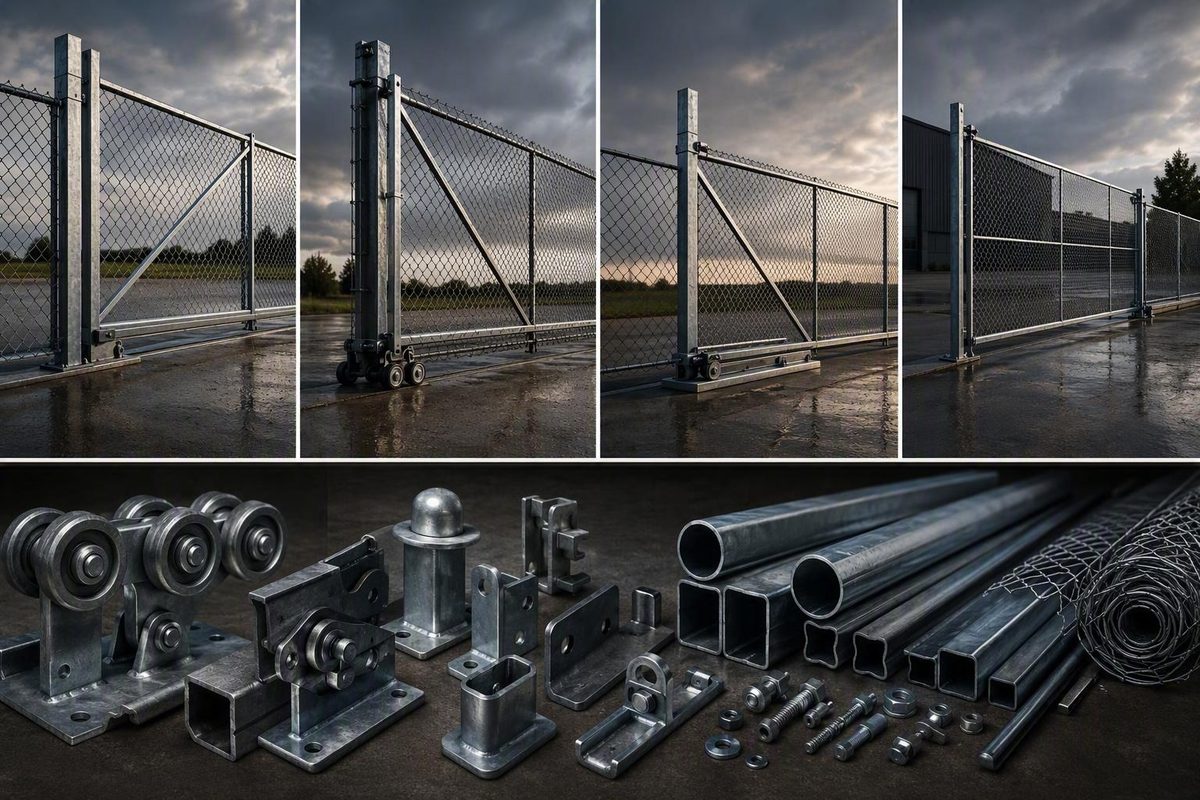
A sliding chain-link gate moves parallel to the fence instead of sweeping through an arc. That makes it useful where vehicle stacking, buildings, landscaping, or other obstructions make a swing gate impractical.
But “sliding chain-link gate” does not describe one standardized mechanism. A gate may roll on ground-contact wheels, follow a ground-level track, hang from cantilever rollers, or travel on trucks inside an elevated track. Each arrangement has different requirements for surfaces, posts, foundations, storage space, operating hardware, and maintenance.
Because seller terminology varies, classify a gate by how its weight is supported and guided, not by the product name alone. The practical purchase sequence is site first, mechanism second, and complete-system price third.
Related: Sliding Gate Kits Differ by Site and Package Type.
The three sliding gate mechanisms, explained
Buyers commonly encounter four labels—rolling, V-track, cantilever, and internal track—but these fit into three broad support arrangements: ground-supported, cantilevered, and elevated-track systems.
Ground-rolling or fence-track gate
A ground-rolling gate carries much of its weight on wheels at the leading end. Rear wheels or guides operate in relation to a horizontal pipe track mounted along the adjoining fence. As the gate opens, the front wheels cross the travel surface while the rear hardware keeps the frame aligned.
This design needs a smooth, durable wheel route. The exposed path can be affected by settlement, vegetation, loose gravel, mud, poor drainage, snow, ice, and debris.
V-track gate
Buyers should ask where the wheels run, where the track is installed, and what keeps the panel upright rather than inferring the mechanism from the title alone. American Fence & Supply lists cantilever and V-track configurations separately.
Cantilever gate
A cantilever gate is suspended above the driveway. Rollers or truck assemblies mounted at support posts carry and guide a rigid frame, so no gate wheel crosses the vehicle opening.
The frame includes a counterbalance tail behind the opening. This makes the fabricated gate longer than the clear passage and generally creates greater fence-side storage demand than a ground-rolling system. The support posts and foundations must resist the loads produced by the suspended frame.
Internal- or top-track gate
An internal- or top-track gate carries its weight on truck assemblies traveling inside an elevated track. Lower rollers primarily guide the panel rather than carrying its main weight. Sellers offer single- and double-track forms, sometimes using aluminum or box-style frames.
This is another suspended configuration, but it is not interchangeable with a traditional tubular cantilever gate. Track geometry, truck capacity, frame construction, support layout, and replacement components are specific to the selected product.
Mechanism comparison
| Feature | Ground-rolling or fence-track | V-track | Cantilever | Internal/top-track |
|---|---|---|---|---|
| Weight support | Front ground wheels plus rear track-associated wheels or guides | Ground wheels operating on a dedicated track system | Post-mounted rollers or trucks acting on the frame | Trucks inside an elevated track |
| Ground contact | Yes | Yes | No wheel across the opening | No primary ground-support wheel |
| Track location | Commonly along the fence | Along the ground-level travel route | Frame rails interact with support rollers | Elevated and integrated with the gate system |
| Side-storage pattern | Near the opening width, plus operating clearance | Near the opening width, plus operating clearance | Opening width plus counterbalance tail | Depends on the frame and tail design |
| Typical market positioning | Commonly offered for manual use | Manual or powered when the exact system permits | Frequently marketed for manual or powered use | Frequently marketed for powered entrances |
| Principal site constraint | Stable, unobstructed wheel path | Straight, supported, unobstructed track route | Greater lateral room and substantial supports | Compatible track, trucks, supports, and frame |
No mechanism is universally best. The choice depends on the clear opening, available side room, grade, travel surface, drainage, climate, gate weight, wind exposure, traffic pattern, and intended operating system.
Rolling vs. cantilever vs. internal track: which fits the site?
Begin by eliminating systems the property cannot accommodate. A favorable finish or low panel price cannot overcome insufficient storage space, an unstable wheel path, or inadequate structural supports.
| Decision factor | Ground-rolling/fence-track | V-track | Cantilever | Internal/top-track |
|---|---|---|---|---|
| Ground contact | Front wheels contact the travel surface | Wheels operate on a ground track | Suspended | Suspended |
| Wheel-path requirement | Smooth, durable route | Straight, stable track base | No wheel path through the opening | No primary ground-support route |
| Exposure to ruts and debris | High | High around the track | Lower at driveway level | Lower at driveway level |
| Snow and ice | Can obstruct wheels or their route | Can cover or disrupt the track | Avoids a driveway wheel track but still needs clearance | Avoids a ground track but still requires protected hardware |
| Lateral room | Usually near the opening width plus clearance | Usually near the opening width plus clearance | Greater because of the counterbalance tail | Product-specific and may include a substantial tail |
| Relative complexity | Often straightforward, but alignment remains important | Requires accurate track and guide installation | Requires a rigid frame, rollers, posts, and foundations | Uses product-specific tracks, trucks, and supports |
| Automation availability | Must be confirmed for the exact system | System-specific | Widely marketed for automation | Widely marketed for automation |
| Common fit | Level residential, agricultural, or light-commercial sites with a suitable path | Paved, straight routes suited to a ground track | Wider openings, commercial entrances, or poor wheel paths | Packaged commercial and industrial systems |
A ground-rolling gate needs a continuous route that will not rut, heave, become overgrown, or collect material. Drainage matters as much as surface smoothness: water can erode an edge, soften soil, deposit debris, or freeze around exposed components.
A cantilever gate removes the ground wheel from the driveway, but the tradeoff is a longer, more rigid frame supported by substantial posts and foundations. Internal-track systems provide another suspended option in single- and double-track forms, but the supplied evidence does not establish a universal capacity, durability, or maintenance advantage. Compare the actual product data.
Slope requires particular care. Commercial installation guidance recommends a substantially level travel plane and warns that excessive grade can contribute to binding or downhill movement. It does not establish a universal maximum slope for every sliding gate, so the selected fabricator must evaluate the actual survey and operating system. America’s Fence Store discusses these slope and alignment concerns in its sliding-gate installation guide.
A suspended gate can avoid a snow-covered ground wheel path, but it is not immune to winter conditions. Snowbanks, frost movement, ice around posts, and insufficient frame clearance can still interfere with operation.
Four common site scenarios
- Level residential driveway with adequate fence length: A manual ground-rolling gate may be practical if the wheel path is durable and easy to keep clear. Compare its complete hardware and surface work with a cantilever option rather than comparing panels alone.
- Snowy commercial entrance: A suspended cantilever or internal-track system avoids a ground wheel or track through the opening. Confirm snow-storage areas, plowing patterns, frame clearance, foundation design, and operator compatibility.
- Rough or poorly drained route: Eliminate ground-supported systems unless the project includes a suitable wheel path or track base. A suspended system may fit better if adequate side room and structural supports are available.
- Limited side storage: A ground-rolling design may require less storage than a cantilever gate, but it still needs enough unobstructed space for the panel, wheels, stops, latch release, and maintenance access. If neither side can store the gate, reconsider the entrance layout or gate type.
The short selection rule is simple: eliminate mechanisms the site cannot physically support before comparing finishes, accessories, or prices.
Calculate the opening, gate length, and storage space
Three dimensions must be kept separate:
- Clear opening: The usable width available to vehicles when the gate is open.
- Overall fabricated gate length: The full frame, including any overlap or counterbalance tail.
- Storage area: The unobstructed fence-side space occupied by the gate when fully open.
For preliminary cantilever planning, a counterbalance tail near half the clear opening commonly produces an overall gate length near one and a half times the opening. This is a planning estimate, not a fabrication specification. Frame design, gate height, infill, hardware geometry, wind exposure, and operator requirements can change the final dimensions. A manufacturer guide illustrates the relationship with a 22-foot opening and a 33-foot overall gate, including an 11-foot counterbalance. America’s Gate Company explains the counterbalance and storage calculation.
Cantilever examples
For a 20-foot clear opening, preliminary planning may indicate:
- Counterbalance tail: approximately 10 feet
- Overall gate length: approximately 30 feet
- Clear fence-side storage: approximately 30 feet
A second retailer example uses a 30-foot opening and an approximately 45-foot overall cantilever gate, with corresponding storage along the fence. These dimensions illustrate the same planning ratio but do not replace the fabricator’s design. America’s Fence Store publishes the 30-foot/45-foot example.
A bi-parting cantilever arrangement divides movement between both sides of the entrance. This reduces the distance traveled by each leaf, but each side needs its own counterbalance and unobstructed storage zone.
Ground-rolling gates generally need storage close to the opening width plus room for the frame, wheel carrier, stops, and latch release. One contractor illustrates a 25-foot opening with approximately 27 feet of slide area. That is a field example, not a universal ratio. SWI Fence presents the 25-foot/27-foot illustration in its comparison of gate mechanisms.
How to survey the opening
Measure and document:
- The clear opening at both the top and bottom on a consistent level plane
- Any difference between those measurements
- Longitudinal and cross-grade changes
- The highest point beneath the gate’s complete travel
- Whether the gate opens left or right, viewed from a clearly defined side
- Available fence length beside the opening
- Whether the panel runs inside or outside the fence line
- Buildings, walls, parked vehicles, bollards, controls, drains, utilities, trees, landscaping, and pedestrian routes
- Space needed to reach wheels, rollers, latches, and operators for service
Do not let the measuring tape follow the slope while recording a nominally level opening. Give the actual geometry to the fabricator. Ordering dimensions, overlap, post spacing, counterbalance length, and final overall length must come from the selected supplier before foundations or posts are installed.
Match the specifications to the opening and use
A useful specification begins with the job rather than a catalog size. Give every bidder the same operating conditions so proposals can be compared on equal terms.
Core specification checklist
- Clear vehicle opening
- Required gate height
- Maximum available overall gate and storage length
- Estimated fabricated gate weight
- Expected traffic and operating frequency
- Manual or powered operation
- Frame material and member sizes
- Chain-link fabric gauge, aperture, selvage, and coating
- Post material, outside diameter, wall or schedule, and finish
- Roller, truck, wheel, and track capacities
- Climate, drainage, corrosion exposure, and expected snow
- Wind exposure and proposed screening
- Latch, stops, guides, and guards
- Foundation assumptions
- Operator and access-control compatibility
One retailer’s catalog illustrates the range available from a single seller: residential, commercial, and industrial grades; steel and aluminum construction; galvanized, black, brown, green, and mill finishes; heights from 4 to 8 feet; and widths from 6 to 40 feet. These are catalog examples, not industry-wide availability or suitability limits. Hoover Fence lists those filters and product categories.
A specific 8-by-8-foot manual rolling gate listing shows why exact specifications matter. The product is described with a 1-5/8-inch-diameter frame, a 0.085-inch wall, and 9-gauge chain-link fabric with 2-inch apertures and knuckle-knuckle selvage. Those figures identify one listed product; they are not a universal specification for every gate of that size. First Fence US provides the product dimensions and construction details.
Taller or wider gates generally create greater structural demands. Heavier frames, barbed-wire extensions, opaque panels, or privacy screening can alter both moving weight and wind exposure. That may affect the posts, foundations, support hardware, and operator selection. Disclose future screening plans before fabrication rather than treating screening as a cosmetic addition later.
Separate the finish of the chain-link fabric from the finish of the frame, posts, fittings, fasteners, and moving hardware. “Black gate” might describe vinyl-coated mesh on galvanized framing, coated framing combined with galvanized hardware, or a more complete coating system. Request a component-by-component coating schedule.
Single-track, double-track, and box-frame labels are likewise product-specific. Do not apply a width, weight, or track threshold published for one product family to another manufacturer’s gate.
Quote-request details
Ask each vendor to state:
- Fabricated width, height, overall length, opening coverage, and tail length
- Frame material, outside dimensions, and wall thickness
- Fabric gauge, aperture, selvage, and attachment method
- Coating on fabric, frame, posts, fittings, fasteners, and repaired areas
- Gate weight and the assumptions used to select the frame
- Rated capacities of rollers, trucks, wheels, tracks, and brackets
- Support-post and latch-post schedule
- Foundation assumptions and exclusions
- Included latch, guides, end stops, roller covers, and guards
- Compatible operator models and required mounting provisions
- Limits involving opening width, slope, wind, operating cycles, or infill
- Shop drawings and installation instructions supplied before construction
What a complete sliding-gate system actually includes
A working sliding gate is an assembly, not merely a framed chain-link panel. Depending on the mechanism, the project may require:
- Gate frame and chain-link fabric
- Support or roller posts
- Latch post
- Ground wheels, cantilever rollers, or internal trucks
- Pipe track, ground track, or integrated elevated track
- Track and roller brackets
- Lower guides
- Positive opening and closing stops
- Latch and receiver
- Roller covers or guards
- Fasteners and adjustment hardware
- Excavation, reinforcement, concrete, and foundations
- Optional operator, drive hardware, controls, power supply, and safety equipment
A “rolling-gate hardware kit” is not necessarily a complete gate. One Signet Fence listing includes one double-wheel carrier, two wheels, two rear steel rollers, two rear-roller brackets, one padlockable rollo latch, and six universal track brackets. The listing does not establish that the frame, fabric, posts, track pipe, foundations, or installation are included. Signet Fence itemizes that hardware package.
By contrast, some cantilever and aluminum slide-gate products are described as complete kits containing the gate, posts, and slide hardware. Even then, “complete” should trigger a written scope review.
Other listings are ambiguous. A product image may show wheels or track without stating that those components ship with the panel. Never infer package contents from a photograph.
Vendor inclusions schedule
| Component or service | Included | Excluded | Optional price | Supplied by installer | Compatibility confirmed by | Freight class/details | Installation responsibility |
|---|---|---|---|---|---|---|---|
| Fabricated gate panel | |||||||
| Chain-link fabric | |||||||
| Support/roller posts | |||||||
| Latch post | |||||||
| Wheels/rollers/trucks | |||||||
| Track and brackets | |||||||
| Guides and guards | |||||||
| Stops and latch | |||||||
| Fasteners | |||||||
| Foundations/concrete | |||||||
| Operator/controls | |||||||
| Safety equipment | |||||||
| Freight/unloading |
Before purchase, confirm post outside diameter, track size, gate weight, opening width, roller or wheel capacity, latch geometry, finish compatibility, and provisions for future automation. Similarly named products are not comparable unless their dimensions, construction, hardware, posts, foundations, freight, and operating method also match.
Price examples and a realistic project budget
The available prices are advertised product snapshots, not a national installed-cost range. The following U.S.-dollar figures were reviewed on September 4, 2026, but retailer prices and configurations can change. Compare the scope of supply before comparing the displayed amount.
Advertised examples
- A Signet Fence rolling-gate hardware kit was displayed at $196.99. It listed wheels, rear rollers, brackets, and a latch but did not establish inclusion of the gate, posts, track, or foundations. See the Signet Fence hardware-kit listing.
- First Fence US displayed an 8-by-8-foot manual galvanized rolling gate at $247.91, with exact shipping added at checkout. The listing did not clearly establish whether the wheels, pipe track, posts, or other installation hardware were included. See the First Fence rolling-gate listing.
- Hoover Fence displayed residential rolling gates from $533.34 to $1,394.34 and commercial rolling gates from $637.68 to $1,742.91. The same category displayed manual steel cantilever kits from $2,038.87 to $3,759.93 and automated steel cantilever kits from $7,125.35 to $8,345.35. Listed aluminum single- and double-track packages extended to substantially higher prices. See the Hoover Fence slide-gate category.
These figures show how mechanism and package scope affect the advertised price. They are not typical national averages or complete installed-project costs. Options, freight, unloading, taxes, foundations, labor, power, controls, and site work require separate verification.
Total-cost worksheet
| Budget item | Vendor | Quoted amount | Included in another line? | Tax/freight included? | Notes and exclusions |
|---|---|---|---|---|---|
| Gate frame/panel | |||||
| Chain-link fabric/infill | |||||
| Wheels/rollers/trucks | |||||
| Posts and track | |||||
| Latch, guides, stops, guards | |||||
| Freight and unloading | |||||
| Taxes | |||||
| Survey, permits, and locating | |||||
| Excavation and spoil removal | |||||
| Reinforcement and concrete | |||||
| Installation labor/equipment | |||||
| Electrical service | |||||
| Gate operator and drive hardware | |||||
| Access controls | |||||
| Safety equipment and commissioning | |||||
| Contingency for site conditions | |||||
| Total project budget |
Date every quote. Obtain written confirmation of exclusions, freight terms, taxes, lead time, unloading requirements, warranty, and component compatibility. A low online price can become the expensive option if it omits proprietary hardware or requires unplanned civil work.
Installation sequence and site-readiness checklist
Installation must follow the selected gate drawings and applicable local requirements. The following sequence is for project planning, not a universal construction specification.
- Confirm site constraints. Determine which permits, setbacks, easements, property boundaries, and access requirements apply to the property.
- Arrange buried-utility locating before excavation. A commercial installation guide advises contacting the relevant utility-locating service before digging; the correct process depends on location and does not replace checking for privately installed services.
- Survey the opening and full travel route. Record level measurements, grade changes, obstructions, drainage, and the highest ground point.
- Obtain approved system dimensions. Do not set posts from a generic ratio or catalog photograph.
- Build foundations and set posts. Follow the project’s soil, frost, wind, gate-weight, manufacturer, and local requirements.
- Align the support hardware. Rollers, trucks, tracks, and guides must share the intended travel plane.
- Hang or place the gate using an appropriate handling plan.
- Install stops, guards, guides, and the latch.
- Move the gate through its complete travel. Check support, clearance, binding, drift, and latch alignment.
- Tighten, inspect, and document the finished installation.
A common cantilever arrangement uses two roller posts and one latch post, but the selected system controls the actual layout. Commercial guidance also warns that these gates are large and heavy and may require several people, lifting straps, or mechanical assistance during hanging. Hoover Fence’s installation guide describes the typical post arrangement, utility-locating step, and handling cautions.
The roller supports must be level relative to one another, and the frame needs sufficient clearance to avoid the highest grade and expected frost, snow, or ice conditions. Published commercial examples give different clearance figures, so no single number should be applied to every gate.
For a ground-rolling gate, the track must be straight and aligned, the wheel route stable, and the rear guides captured without binding. Positive stops should prevent the panel from leaving its guidance system. The latch should engage without pulling the frame sideways or lifting it out of alignment.
Generic footing dimensions are not substitutes for project-specific requirements. Wide or tall openings, uncertain hardware capacity, weak soil, substantial wind exposure, privacy screening, solid infill, difficult grades, unusual foundations, or powered operation justify review by a qualified installer or engineer.
Automation and moving-gate safety
Cantilever and internal-track systems are frequently marketed for automation, but that does not prove every gate of either type is operator-compatible.
One supplier describes roll gates as non-automatable, while other sellers frame cantilever or internal-track systems as preferred rather than universally required. Neither position should be treated as a rule for every product.
Before powered operation is specified, verify:
- Gate frame design and condition
- Total moving weight
- Clear opening and overall travel
- Support-hardware capacities
- Drive attachment and geometry
- Mesh and opening configuration
- Operating frequency
- Grade and potential downhill movement
- Operator mounting and foundation
- Control and safety-device locations
- Emergency and manual-release procedures
Moving gates can create pinch points at rollers and guides, impact and entrapment zones around the panel, and fall or derailment hazards. Sloped sites can add unintended movement. Covers or guards, secure guides, positive end stops, protected controls, and complete-travel testing are relevant considerations, but no individual measure proves that an installation is safe or compliant.
Commercial gate guides commonly cite UL 325 and ASTM F2200 in connection with automated vehicular gates. Those retailer and manufacturer summaries are not the standards themselves and cannot determine current applicability or certify compliance. Use current operator-manufacturer documentation and have the applicable authority and a qualified gate professional determine project requirements. America’s Gate Company discusses these standards in the context of cantilever-gate selection while also emphasizing site-specific design.
Before commissioning, resolve pedestrian routing, emergency access, manual release, power-failure behavior, access-control placement, and service access. A vehicle gate should not become the default pedestrian route simply because it is convenient.
Commissioning, maintenance, and troubleshooting
Commissioning evaluates the installed assembly rather than its individual catalog components.
Commissioning checklist
- Move the gate slowly through its complete opening and closing travel
- Confirm that it remains supported and guided throughout
- Check for scraping, binding, twisting, rear-wheel lift, or visible frame sag
- Verify that it does not move downhill without control
- Confirm positive stops at both ends
- Check latch engagement without forcing the frame sideways
- Tighten critical fasteners as directed by the system instructions
- Inspect covers, guards, guides, and exposed pinch areas
- Record clearances at the highest and lowest grade points
- Document as-built dimensions, adjustments, and maintenance responsibility
- For powered gates, complete the testing required by the operator documentation and qualified installer
Symptom-to-check table
| Symptom | What to check first |
|---|---|
| Hard rolling | Wheel route, track alignment, debris, damaged wheels, hardware capacity, and guide adjustment |
| Scraping | Highest grade point, frame sag, post movement, wheel wear, and roller elevation |
| Binding | Support alignment, frame distortion, guide adjustment, and displaced track |
| Gate sag | Frame condition, post movement, roller adjustment, loose connections, and hardware capacity |
| Rear-wheel lift | Front wheel route, gate balance, rear-guide geometry, frame distortion, and stops |
| Track obstruction | Gravel, vegetation, mud, ice, packed snow, bent track, and drainage deposits |
| Excessive noise | Contaminated or damaged components, loose hardware, and misalignment |
| Failure to latch | Settlement, post movement, frame sag, stop position, and receiver alignment |
| Uncontrolled movement | Grade, support condition, restraint, operator condition, and control system |
| Intermittent powered travel | Obstructions, power supply, drive alignment, operator diagnostics, controls, and safety devices |
For a ground-rolling gate, inspect the wheel route, track alignment, debris, vegetation, drainage, wheel condition, rear rollers, and brackets.
For a cantilever gate, inspect roller alignment, support-post movement, frame sag, clearance over the highest grade, loose mounting hardware, and unwanted guide-to-frame contact.
Follow the inspection and lubrication instructions supplied with the gate, hardware, and operator. No universal service interval is supported because usage, climate, hardware, and operator design vary.
Stop using a gate that is unstable, derailed, moving without control, contacting people or vehicles, or showing damaged structural or powered components. Secure access to the area and obtain qualified service. Powered-system testing, adjustment, and safety-device maintenance must follow the operator manufacturer’s documentation and any applicable qualified-service requirements.
Frequently asked questions
How much side room does a sliding chain-link gate need?
A ground-rolling gate generally needs clear side storage close to the opening width, plus room for the frame, wheels, stops, latch release, and service access.
A cantilever gate needs additional length for its counterbalance tail, so its storage requirement is usually substantially greater than the clear opening. Final dimensions must come from the fabricator before posts or foundations are installed.
Is a cantilever gate the same as a rolling gate?
No. Both move parallel to the fence, but they support their weight differently.
A rolling gate uses ground-contact wheels and may also use a fence-mounted pipe track or another ground-level track arrangement. A cantilever gate is suspended from post-mounted rollers or trucks and has no wheel crossing the driveway.
Because sellers sometimes use “slide,” “rolling,” and “cantilever” loosely, request a mechanism drawing instead of relying on the product title.
Can a rolling chain-link gate be automated?
Verify the frame, moving weight, wheel and guide capacities, drive geometry, travel, grade, mesh configuration, controls, safety devices, and operator documentation with a qualified gate professional.
Does a sliding-gate kit include the gate, posts, track, and hardware?
Not necessarily. “Kit” may mean hardware only, a gate with selected hardware, or a broader package containing the gate, posts, and slide components.
Require an itemized schedule covering the frame, fabric, posts, wheels or rollers, track, brackets, guides, stops, latch, guards, fasteners, foundations, freight, installation, operator equipment, and electrical work.
Can a sliding chain-link gate work on a slope or in snow?
It can, but no sliding mechanism is appropriate for every sloped or winter site. A level travel plane helps prevent binding and unintended movement. Ground-supported systems need a wheel or track route that remains stable and clear of snow, ice, vegetation, debris, and drainage damage.
Suspended cantilever and internal-track gates avoid a ground wheel path through the opening, which may help on rough or snowy sites. They still require adequate frame clearance, aligned supports, suitable foundations, and a snow-management plan.
The final purchase sequence should remain disciplined: identify the support mechanism, verify the clear opening and available side storage, evaluate the grade and wheel route, obtain a complete component and cost schedule, and have the fabricator confirm dimensions and capacities before posts are installed. For powered, unusually large, heavy, sloped, screened, or wind-exposed gates, require model-specific manufacturer guidance and qualified professional review.