
Choose Cedar Lattice That Fits Your Privacy and Support Needs
Compare cedar lattice openings, panel thickness and retail prices, then check framing, finished height and delivery terms before ordering your fence panels.
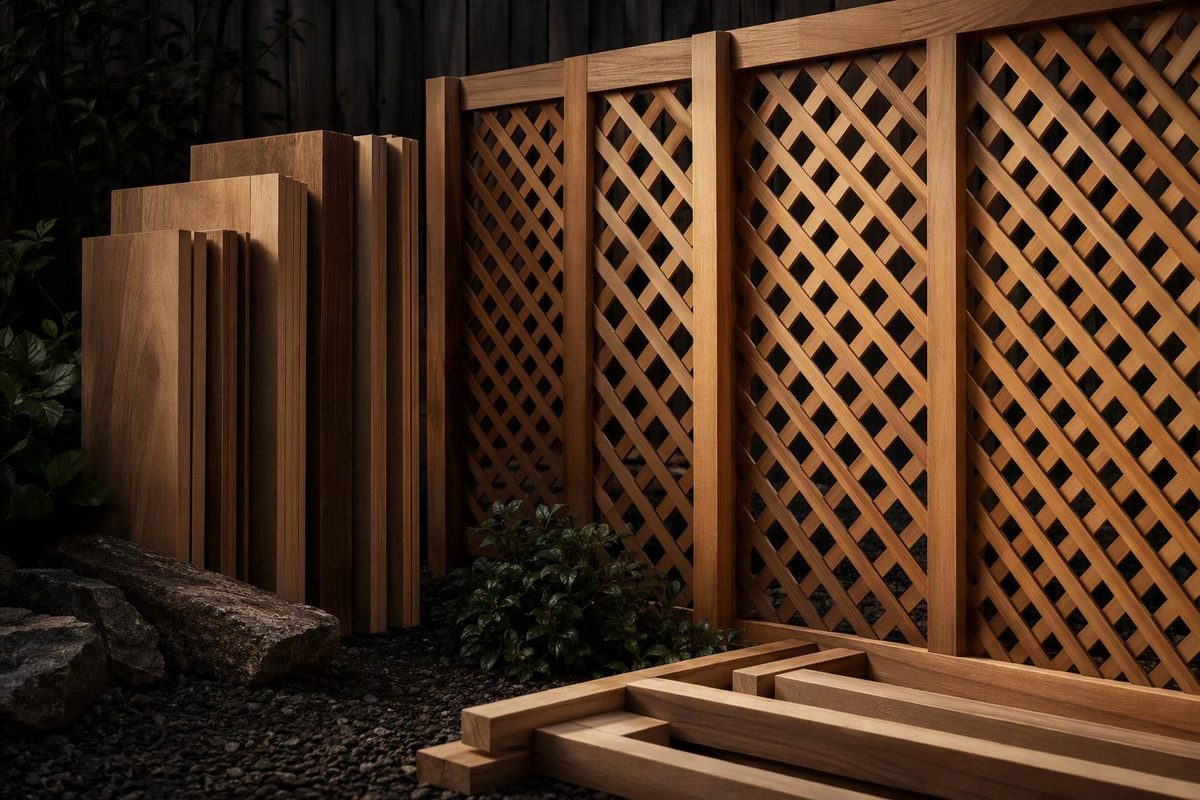
A cedar lattice fence works for a garden divider, a partly screened patio or a decorative top above solid fence boards. It is not the right choice for complete privacy: even products sold as “privacy lattice” have openings. Choose by actual opening size, panel thickness, framing and finished height—not by the privacy label or square-versus-diagonal pattern alone.
Pick a Woodway Classic pattern to compare its opening size; these specifications do not apply to every cedar lattice product.
Compare Classic Lattice Openings
All four use 1 1/2-inch lath.
Square privacy
1 15/16 in.Nominal opening
Smaller opening than square garden; still not opaque.
| Pattern | Opening | Lath Width |
|---|---|---|
| Square garden | 2 1/2 in. | 1 1/2 in. |
| Square privacy | 1 15/16 in. | 1 1/2 in. |
| Diagonal garden | 2 3/4 in. | 1 1/2 in. |
| Diagonal privacy | 1 7/8 in. | 1 1/2 in. |
Classic cedar thickness at intersections: standard 3/8 in.; heavy-duty 13/16 in. Confirm the exact product and matching frame groove before ordering.
Source: Woodway 2024 catalog; specifications are product-line specific, not privacy percentages.
Use Solid Boards Where You Need Blocked Sightlines
The Western Red Cedar Lumber Association describes a fence as posts, rails and infill, and recommends lattice alone or combined with solid boards where a lighter, more open fence is wanted. Treat lattice as infill—not as a substitute for the supporting fence structure. Source: Real Cedar fence construction.
| Layout | Best Use | Check Before Buying |
|---|---|---|
| Full lattice between posts | Garden definition, trellis or partial screening | Openings, edge support and suitability for intended plants |
| Solid boards with a lattice top | Privacy below an open decorative section | Whether the solid section blocks the relevant sightline |
| Lattice added to an existing fence | Changed appearance or partial screening above it | Existing posts, attachments and total finished height |
For a patio, check the view from seated and standing positions before choosing the height of the solid section. If blocking views is the main job, compare cedar privacy fence designs rather than assuming tighter lattice will be opaque.
For pet containment, assess the openings, bottom gap, gate gaps and strength of the complete assembly against the particular animal. The lattice pattern alone does not establish suitability.
Buy by Measured Openings and Intersection Thickness
“Garden” and “privacy” labels do not tell you the actual opening size. Woodway’s 2024 catalog lists these dimensions for its Classic lattice patterns:
| Woodway Pattern | Nominal Opening | Lath Width |
|---|---|---|
| Square garden | 2 1/2 in. | 1 1/2 in. |
| Square privacy | 1 15/16 in. | 1 1/2 in. |
| Diagonal garden | 2 3/4 in. | 1 1/2 in. |
| Diagonal privacy | 1 7/8 in. | 1 1/2 in. |
The same catalog lists standard cedar lattice at 3/8 inch thick and heavy-duty cedar lattice at 13/16 inch, measured at the lath intersections. These are specifications for this product line, not every cedar lattice sheet. Source: Woodway product catalog.
Ask whether a quoted thickness means one strip or the combined thickness where strips cross. That distinction matters when fitting the panel into grooved trim. Square versus diagonal is largely an appearance choice; neither pattern alone establishes how much screening or support you will get.
Inspect the assembly as well as the wood. Woodway’s catalog specifies stainless-steel fasteners for Clear-grade cedar lattice. Its No. 1 grade permits sound knots and normally uses galvanized fasteners, with a stainless upgrade available. A higher appearance grade can therefore change both the look and the factory fastening specification.
A seller’s “70% shade” or “80% shade” description is not the same percentage of visual privacy. Check a sample from the actual viewing angle and distance.
Match the Frame to the Panel Before Setting Posts
Woodway recommends securing lattice in a framed opening, using matching mouldings or sandwiching it with 3/4-inch stops and a bead of construction adhesive. Its catalog provides different groove sizes for standard and heavy-duty lattice. Do not assume one trim profile fits both.
Confirm the panel’s actual dimensions, installation orientation and required frame opening before ordering a complete run. Nominal sheet size is not automatically post-center spacing.
Decide how the fence will follow slopes: stepped framed sections or a custom layout. Include the resulting bottom gaps in the plan, especially where containment matters.
Have post size, spacing, footing depth and connections specified for the finished fence, soil and wind exposure. Ask whether the design allows for intended vines or added screening rather than treating those additions as weightless.
For a retrofit, inspect the existing posts and footings before adding height. Our fence extension guide covers the choice between an extension and rebuilding. Check local placement, height and permit requirements using the complete finished assembly, including the lattice top.
In the United States, contact 811 before digging fence-post holes and follow your state’s waiting period and safe-digging requirements. Source: 811 before you dig.
Sheet Prices Do Not Establish an Installed Fence Cost
Retail examples checked October 6, 2026, at Capitol City Lumber in Raleigh, North Carolina:
| Product | Listed Sheet Size | In-Store Sale Price |
|---|---|---|
| Square heavy-duty cedar privacy lattice | 4 × 8 ft. | $114.19 |
| Highland Park cedar privacy lattice | 4 × 6 ft. | $152.99 |
These are different designs and sheet sizes, not an installed-price range. Both pages restrict the sale price to in-store purchases and direct out-of-area buyers to an online store with a ten-sheet minimum and motor-freight shipping. The cited examples do not provide a complete installed cost.
Confirm specifications before ordering trim. The Highland Park retail listing gives an 11/16-inch thickness, while Woodway’s catalog gives 13/16 inch for its cedar Highland Park panels. Ask the supplier to confirm the exact SKU and actual thickness rather than resolving that discrepancy by assumption.
Budget for posts, rails, frame lumber or mouldings, hardware, footing materials, finish, tax, delivery and labor. Include solid boards for a privacy base, plus gates, demolition and waste where applicable.
For cost per linear foot, divide the complete project total by the finished fence length—not by the sheet’s longest dimension.
Finish Before Assembly and Plan for Panel Replacement
Woodway recommends applying finishes before installation because the many openings and intersections make coating harder afterward. Its catalog also notes that unfinished cedar lattice develops a natural silver patina.
Choose the intended appearance before assembly; the cedar fence sealer guide explains finish trade-offs. Ask how a damaged lattice section would be removed from its frame, especially where adhesive is specified.
A useful contractor quote identifies the cedar species and grade, lattice opening size, thickness at intersections, frame profile, posts and footings, finished height, coating scope and delivery terms. “Cedar lattice fence” alone leaves those purchase details undefined.