
Fence Replacement Cost: Budget for the Rebuild, Not Just the Panels
Estimate fence replacement cost by length and material, then check demolition, post reuse, gates, footings and the exclusions in contractor quotes.
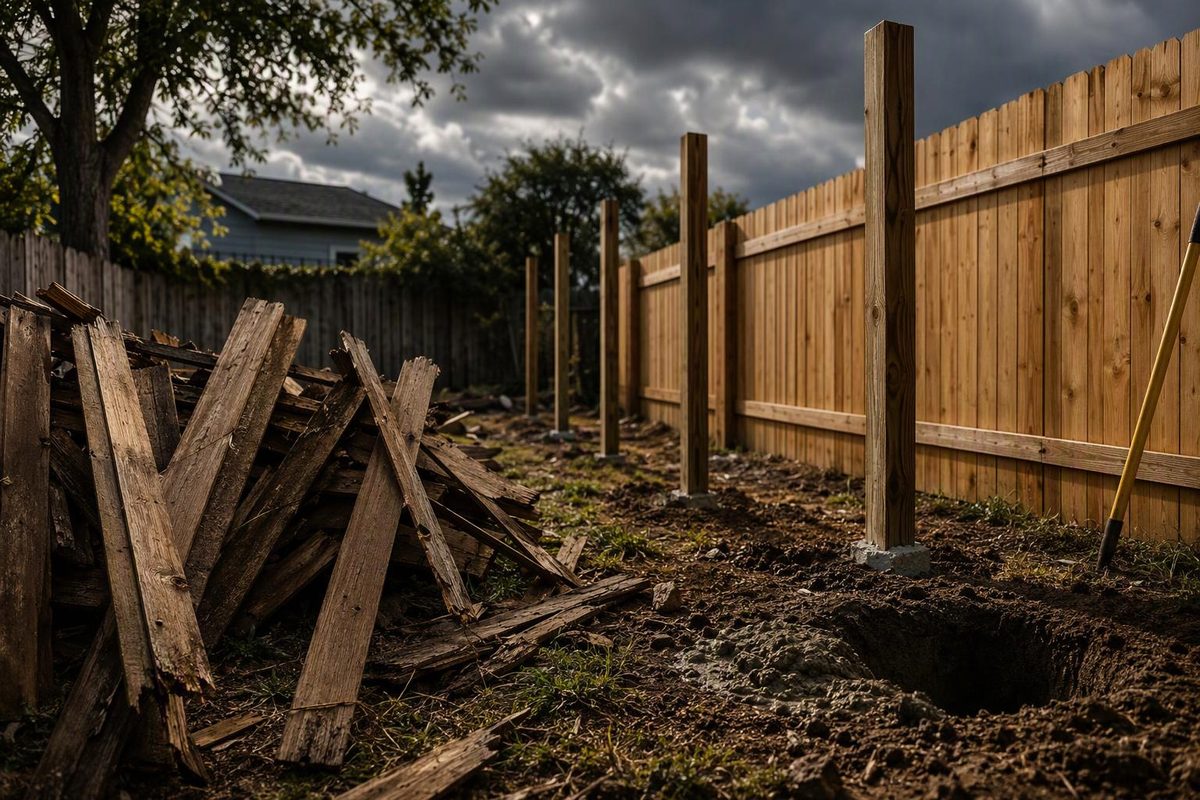
For an initial U.S. budget, wood or vinyl fence replacement runs roughly $30–$80 per linear foot, according to HomeGuide’s 2026 cost guide. That makes a 150-foot replacement about $4,500–$12,000. Treat this as a planning range, not a local quote: the guide covers common wood and vinyl projects, and your estimate still needs to specify removal, gates, finish and site work. Source: HomeGuide
The useful calculation is:
Replacement cost = old-fence removal + new fence materials and installation + separately priced gates and site-specific work.
Do not add demolition or labor again if the contractor’s replacement price already includes them.
First decide what is actually being replaced
A panel replacement and a complete rebuild are different purchases. Ask the contractor to distinguish between:
- Repair: replacing individual boards, rails, mesh or hardware.
- Partial replacement: rebuilding a damaged run while retaining other sections.
- Full replacement: removing the fence and rebuilding its posts, supports and fence surface.
Before choosing new panels, have the posts and footings assessed. Ask whether retained posts are sound, correctly aligned and suitable for the proposed height, spacing, gate weight and fence design. Reusing posts should be an inspected option, not an assumption built into the cheapest bid.
A change of material may also require a different layout. For example, Weatherables specifies post spacing for its vinyl systems and additional installation steps in high-wind areas. Existing posts are not automatically compatible simply because they stand along the right route. Source: Weatherables installation guidance
Terrain belongs in this assessment too. Rocks, steep slopes, poor soil and restricted access can increase installation costs. Ask how the crew will set posts and handle grade changes before comparing material prices. Source: HomeGuide
Finally, match the replacement to its job. An open fence is not a substitute for a privacy fence. If you choose wood, request a separate finishing price and consider future stain upkeep; do not compare unfinished wood with a finished alternative as though the scopes were identical.
Installed prices by material—before the replacement extras
For budgeting in October 2026, HomeGuide publishes the following broad U.S. ranges. They include new-fence materials and installation, not a guaranteed complete replacement scope.
| New fence material | Installed planning range per linear foot | Base cost for 150 feet |
|---|---|---|
| Wood | $20–$50 | $3,000–$7,500 |
| Vinyl | $30–$60 | $4,500–$9,000 |
| Chain-link | $10–$40 | $1,500–$6,000 |
| Aluminum | $25–$75 | $3,750–$11,250 |
Sources: HomeGuide’s general installation guide for wood, vinyl and aluminum; its chain-link cost guide for chain-link. The totals are arithmetic examples. These categories cover different heights, designs and specifications; they are not four equivalent fence systems.
A narrower local specification can produce a much tighter range. Two Sons Fencing publishes $18–$22 per foot for 4-foot galvanized chain-link and $23–$29 for 6-foot galvanized chain-link in North DFW. Gates, removal, vinyl coating and special site conditions require a written quote. Those are North Texas examples, not national rates. Source: Two Sons Fencing
For a closer material comparison, see chain-link versus wood fence costs. For wood-only replacement details, use the wood fence replacement cost guide.
How much does old-fence removal add?
Published removal allowances differ substantially:
- BuyAFence lists $5–$10 per linear foot, depending on material, access and site condition.
- HomeGuide’s general installation guide lists $10–$20 per linear foot for removal and disposal, depending on fence type and hauling distance.
For 150 feet, those allowances translate to $750–$1,500 and $1,500–$3,000, respectively. They are estimates from different providers, not one consistent national average. Sources: BuyAFence, HomeGuide
The demolition line should answer four questions:
- Are panels or fabric, posts and concrete footings being removed?
- Are hauling and disposal included?
- Will abandoned holes be filled and disturbed ground made safe?
- What happens if the crew finds unusually large footings, buried obstructions or inaccessible posts?
“Remove existing fence” is too vague if one bidder means the above-ground fence and another means a complete tear-out.
A worked 150-foot replacement budget
Suppose the proposed wood-fence route is 150 feet total, including one 4-foot walk-gate opening. If the gate is priced separately, the solid fence length is 146 feet. This example assumes demolition is charged over the entire old route, including its gate.
Using illustrative rates within the published allowances above:
| Item | Calculation | Budget |
|---|---|---|
| New wood fence, materials and labor | 146 ft × $35 | $5,110 |
| Remove and dispose of old fence | 150 ft × $8 | $1,200 |
| One walk gate | Illustrative allowance | $450 |
| Subtotal | $6,760 |
BuyAFence lists approximately $400–$500 for a single gate, which supports the example’s allowance but does not establish a price for every gate size or design. Source: BuyAFence
This is not an itemized contractor quote. Permits, surveying, staining, unusual excavation, landscape restoration and applicable tax remain unpriced. Confirm whether the contractor charges for solid fence length or the entire route with gates added separately; use the same convention when comparing bids.
What a comparable replacement quote should contain
Give each bidder the same route, height, privacy requirement and gate openings. Request written details for:
- Materials: wood species and board dimensions; vinyl brand, model and color; or chain-link height, wire gauge, mesh and coating.
- Structure: post material, size and spacing; footing dimensions; gate-post support; and any retained posts.
- Scope: demolition, concrete removal, disposal, delivery, installation, finish and cleanup.
- Extras: slope work, rock excavation, permits, boundary verification, restoration and taxes.
- Contract terms: payment schedule, change-order pricing, workmanship warranty and exclusions.
Check local rules before assuming the old fence’s height or position can simply be copied. Permit exemptions and zoning limits are separate questions: Seattle, for example, generally exempts fences up to 8 feet from a construction permit if they have no masonry or concrete elements over 6 feet and are not in a flood-prone area. Its zoning rules impose lower height limits in many locations. That example is specific to Seattle; consult your own jurisdiction. Source: Seattle SDCI
Before digging or excavating posts, contact 811 a few days in advance and follow your state’s process. Small or shallow digging still warrants a locate request. Source: 811 Before You Dig
The lowest useful bid is the lowest price for the same specified fence and complete replacement scope—not the lowest number beside the word “fence.”