
How Long Does a Vinyl Fence Last? Plan for 20–30 Years
Use 20–30 years as a planning range for a well-installed vinyl fence. See how posts, exposure, repairs and warranty terms affect useful life.
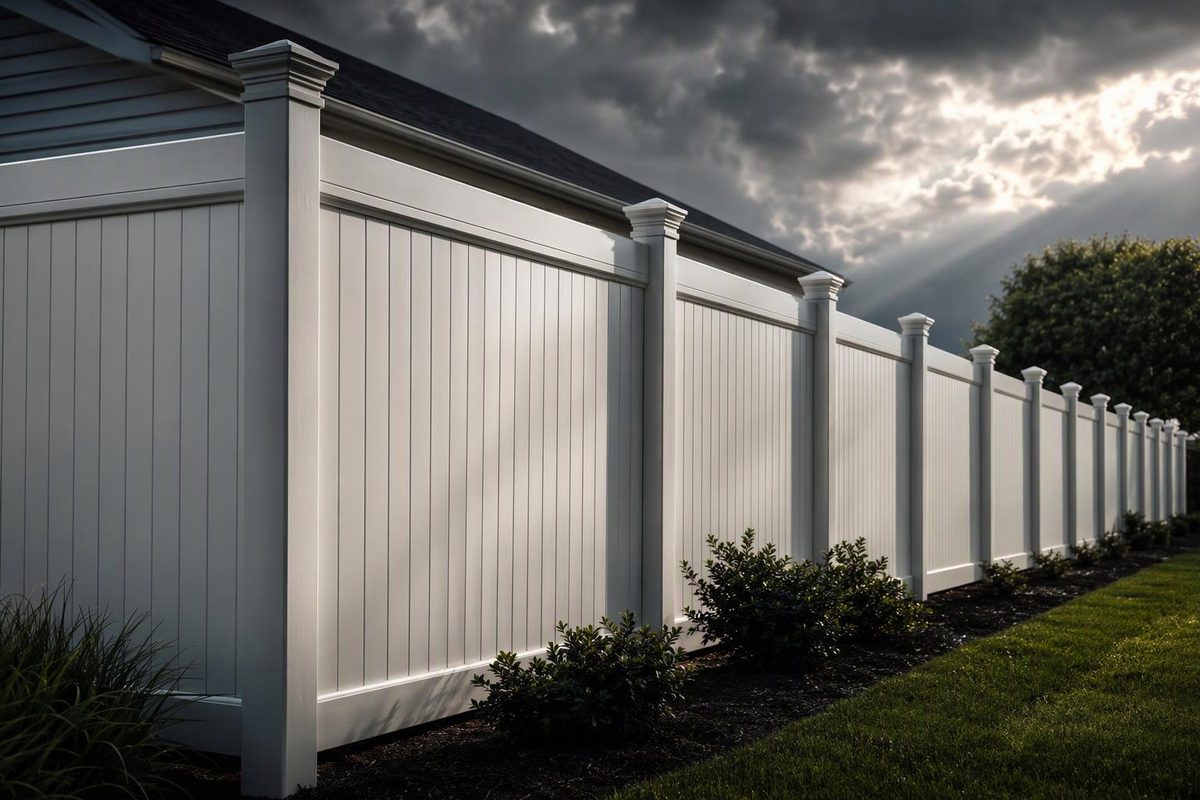
Use roughly 20–30 years as a planning range for a well-installed residential vinyl fence, with longer service possible. That range assumes quality components, sound posts and footings, ordinary cleaning, and repairs when needed. Valleywide Fence & Deck gives a 20–30-year estimate, while manufacturer ActiveYards advertises upwards of 30 years.
Treat those figures as supplier and installer estimates—not a measured national average or an expiration date. They refer here to rigid PVC fencing, not vinyl-coated chain link. A lifetime warranty also does not mean every part of the installed fence will last your lifetime.
What determines whether it reaches that range?
Posts, footings and panel connections
The useful life of the fence depends on more than whether the plastic still looks good. Check the installation specification before comparing panel prices:
- Post spacing must match the actual panel and connection system.
- Footings must suit the product, soil, frost conditions and applicable local requirements.
- Rails and brackets must be fully engaged and secured as directed.
- Gate posts and gates need the support specified for that system.
For example, Barrette’s Cameron panel instructions calculate post centers from panel width, bracket allowance and post width, and tie hole depth to the site’s frost line. Those dimensions are product-specific; they are not a universal recipe for vinyl fencing.
Ask the installer to identify the exact system and include its post support and footing details in the quote. Our vinyl fence installation guide explains why nominal panel width alone is not enough to lay out the holes.
Material quality and exposure
Look for documented performance rather than broad claims such as “premium vinyl.” ASTM F964-13(2024) addresses PVC profile quality, weatherability, impact resistance and dimensional stability. It is a profile-quality standard, not a lifespan guarantee, and does not address the assembled fence’s wind-load capacity.
For an exposed privacy fence, ask for wind-load documentation covering the proposed height, panel design, posts, reinforcement and footing arrangement. A statement that the vinyl meets F964 is not a substitute for that information.
Appearance and structural life are also different. Some gradual fading does not necessarily mean the fence needs replacing. Catalyst’s warranty expressly recognizes normal gradual fading and notes that its degree varies with location and exposure. It also excludes damage from impacts, hail, hurricanes and ground movement. Rot resistance should not be confused with damage resistance.
Low maintenance still means inspections
Vinyl’s practical advantage is that it generally needs cleaning rather than regular painting, staining or sealing. ActiveYards describes mild soap-and-water cleaning once or twice a year.
Use the care instructions for your particular finish. A garden hose and mild soap are a sensible starting point; do not assume a strong solvent or aggressive pressure-washer setting is suitable for every product.
During cleaning, check for loose posts, displaced rails, cracked boards and gates that drag or fail to latch. Catalyst’s maintenance guidance recommends an annual gate and hardware check, keeping gates secured when unused, and avoiding stacked materials against the fence. Follow the hinge maker’s instructions for lubrication and adjustment.
What a lifetime warranty actually buys
Read the warranty for the exact product—not just the heading on a brochure. As one example, Catalyst’s published vinyl warranty provides limited lifetime coverage for the original purchaser at a single-family residential property. After one permitted transfer, coverage runs only to 30 years from the original purchase. This certificate applies in the United States and Canada to products purchased after January 1, 2024.
Its standard remedy excludes labor, removal, disposal and reinstallation costs, although eligible installations can have separate PerformancePlus coverage for two to five years. It also calls for registration within 30 days of purchase and proof of purchase for a claim.
Before buying, confirm those requirements, the installation warranty, exclusions and who pays to replace a defective section.
Repair a section or replace the fence?
Judge an existing fence by condition, not age alone. One damaged board or rail is a reason to investigate a local repair, not automatically replace the whole run. Leaning posts, recurring connection failures or widespread cracking deserve a broader assessment.
Check parts availability before choosing a new system, too. Catalyst warns in its warranty that discontinued products may receive comparable replacements and that replacement color or gloss may not match weathered material. Save the manufacturer, style, color, receipts and installation documents. Our vinyl fence repair guide covers checking part fit, connections and support before deciding what to replace.