
Do Not Buy a Swing-Clear Gate Hinge by Name Alone
Choose swing-clear gate hinges by clear opening, swing angle, post and frame size, load rating, mounting method and full-swing clearance.
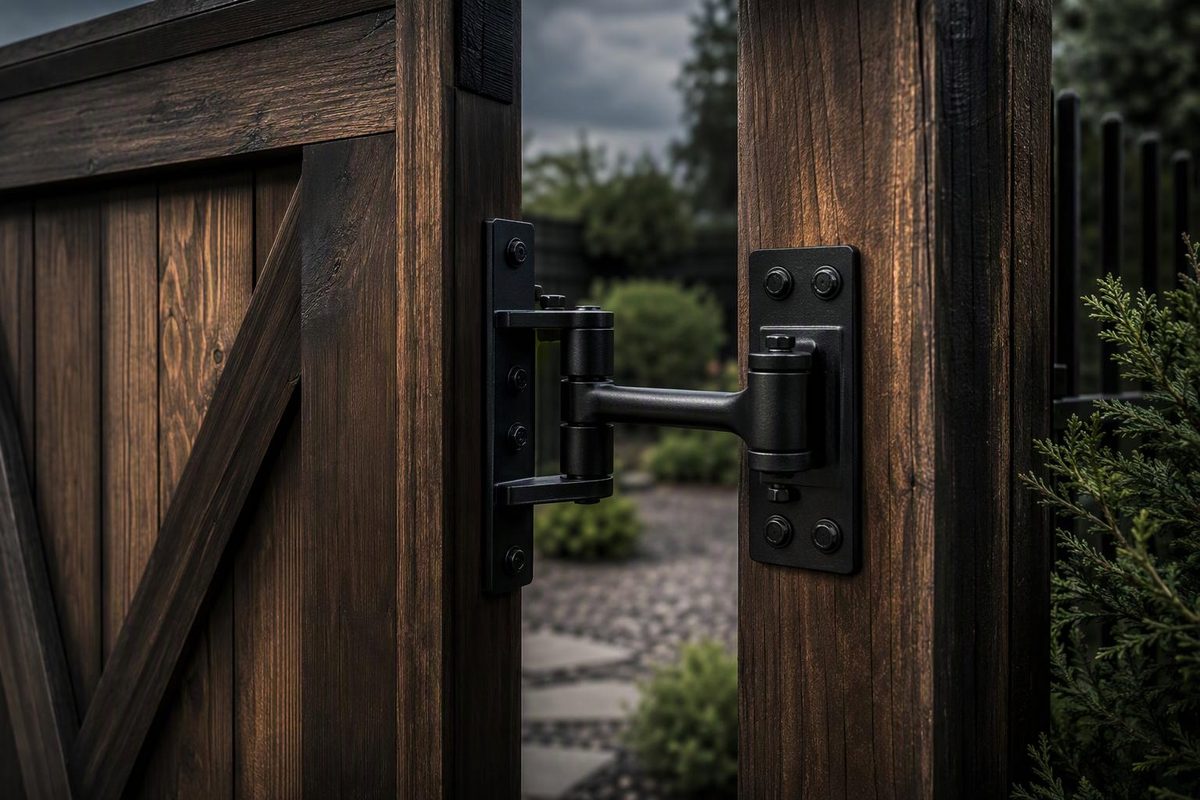
A swing-clear hinge offsets the pivot so an open leaf moves out of the usable opening instead of occupying part of it. On a fence gate, similar offset hardware can preserve passage width for a mower, cart, wheelchair or vehicle. Some versions also let the gate fold back close to the fence line.
The terminology is inconsistent, however. Architectural suppliers use swing-clear hinge for an offset door hinge that removes the leaf from a doorway at roughly 95 degrees. Fence suppliers are more likely to use 180-degree offset hinge, 180-degree gate hinge or swing adapter. These products solve related clearance problems but are not automatically interchangeable.
Swing-clear and 180-degree are different specifications
A true architectural swing-clear hinge changes the pivot geometry so the open door no longer narrows the framed opening. A wide-throw hinge instead carries a door around thick trim or a deep reveal and can reduce clear width when measured at 90 degrees. Hardware consultant Lori Greene illustrates that distinction in her comparison of swing-clear and wide-throw hinges.
Fence-gate listings use looser terminology. For example:
- One chain-link offset butt hinge is specified for a full 180-degree swing, a nominal 2-1/2-inch gate frame with 2-3/8-inch actual outside diameter, and a 4-inch post. Its offset lets the leaf swing clear of the post, according to the product specification.
- A retrofit adapter for chain-link butt, box and bulldog hinges changes their listed swing from 90 to 180 degrees while maintaining the opening width. It requires one adapter per hinge and includes U-bolts, according to Hoover Fence’s listing.
These examples show why the name alone is insufficient. A hinge may clear the opening at 90 degrees, permit a 180-degree fold-back, or do both. Confirm each function on the exact model drawing.
Measure the gate as a system
Before shopping, record:
- Required clear opening. Measure the narrowest unobstructed width you need, not merely the distance between posts.
- Opening width with the leaf at 90 degrees. Note whether the gate frame, pickets, hinge knuckles, latch or stop projects into the path.
- Desired maximum angle. A gate that clears the opening at 95 degrees is not necessarily able to lie against the fence at 180 degrees.
- Gate width, height, thickness and weight. Include infill, decorative steel, privacy boards and attached hardware.
- Post and gate-frame profiles. Record actual outside dimensions and whether each surface is round, square, wood, masonry or flat steel. Nominal pipe size and actual outside diameter can differ.
- Hinge-side gap and offset. Check both the closed gap needed for alignment and the space swept by the leaf as the offset hinge rotates.
- Surrounding clearance. Include fence rails, post caps, walls, grade changes, plants, latch hardware and vehicle paths.
Then compare those measurements with the manufacturer’s template or dimensioned drawing. A stated “180-degree” capability does not prove that a particular gate can reach 180 degrees beside your post and fence construction.
For broader load, gap and hinge-spacing checks, see How to Choose Fence Gate Hinges.
Do not substitute an interior door hinge by appearance
Many residential swing-clear hinges are full-mortise door products. Their leaves fit routed recesses in a door and jamb, and their finishes and fasteners may not be intended for an exposed, heavy fence gate. Gate-specific products may instead clamp around pipe, bolt to flat posts or weld to steel frames.
For an outdoor gate, verify all of the following on the exact product:
- gate use and exterior exposure;
- maximum gate weight and width, including whether the rating is per hinge or per pair;
- allowed mounting orientation and number of hinges;
- post and frame compatibility;
- through-bolt, lag-screw, clamp-on or weld-on installation;
- galvanized, stainless or otherwise suitable corrosion protection;
- adjustment range after installation;
- whether a separate stop is required.
Treat a large advertised load rating cautiously. Post stiffness, fastener withdrawal, weld quality, hinge spacing and wind on solid infill can govern the installation before the hinge body reaches its stated capacity.
Installation checks that protect the clearance
Mount the upper and lower hinge axes plumb and in line; misalignment can create binding and unwanted gate movement. Fasten into the structural gate frame and post rather than only into thin cladding or a vinyl shell. Follow the exact hinge maker’s instructions, especially for welding, fastener size, orientation and required stops.
Before final tightening or welding:
- support the leaf at the intended ground clearance;
- dry-fit the latch and any closer;
- move the gate slowly through its complete arc;
- check for pinch points at the offset mechanism and post;
- confirm that the leaf does not strike the fence, wall or grade;
- install a positive stop if the hinge is not designed to serve as one;
- remeasure the usable opening with the gate at 90 degrees.
That last measurement decides whether the hinge actually solved the problem.
Accessibility requires more than an offset hinge
Where a manual gate is part of an accessible route, the 2010 ADA Standards require at least 32 inches of clear width. For a swinging gate, that width is measured between the face of the gate and the stop with the leaf open 90 degrees. Section 404 also addresses projections into the opening, maneuvering clearance, hardware, closing speed, surfaces and opening force (2010 ADA Standards §404).
A swing-clear hinge can help preserve width, but it does not make a gate compliant by itself. Measure the completed opening at 90 degrees and verify every applicable gate requirement with the authority having jurisdiction. For an ordinary private residential gate that is not on a regulated accessible route, use the same clear-width measurement as a practical design check rather than assuming the federal standard applies.
The purchasing decision is straightforward: buy from a dimensioned specification, not the phrase “swing clear.” The correct hinge must deliver the required clear width and opening angle while fitting the actual post, frame, gate load and outdoor exposure.