
Stop Fence-Line Digging With a Barrier—and Fix the Cause
Compare buried mesh, drive-in barriers and stone edging to stop dogs digging under a fence, with checks for gates, sharp edges and underground utilities.
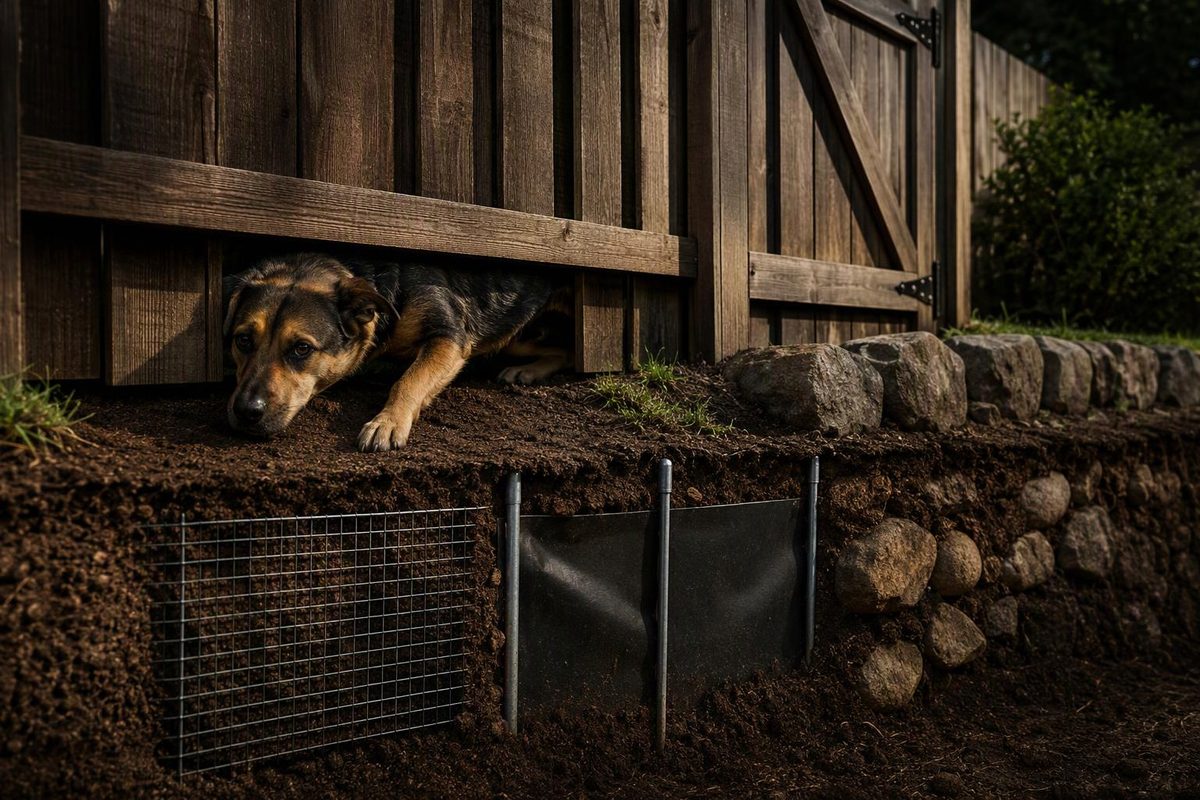
Use a continuous physical barrier at the fence bottom, then address why the dog is digging. For an existing fence, the main options are a buried mesh apron, drive-in steel barriers or substantial, partially buried rocks. Simply refilling the hole leaves the same route available.
Until the repair is secure, supervise yard time or use another secure enclosure. A barrier that stops digging does not necessarily stop climbing, chewing or pushing through loose fence fabric.
Find the weak point before buying materials
Walk the entire fence line, including gates and corners. Look for:
- Fresh soil and tunnels beneath an otherwise sound fence.
- Chain-link fabric that lifts when pushed at the bottom.
- Broken boards, loose mesh or gaps caused by uneven ground.
- Clearance beneath gates and beside gateposts.
Repair loose or damaged fencing before adding an underground barrier. If chain link lifts, check its bottom tension wire and fabric attachments. Hoover Fence explains that tension wire reinforces the bottom against lifting and is secured to the fabric with hog rings. Burying mesh will not fix an unsecured connection above it. Our guide to chain-link hog rings explains the hardware used to connect fabric to tension wire.
Measure the run requiring protection, not just the width of the current hole. Include corners and gate transitions in your plan so the dog cannot simply move to an unprotected opening.
Before trenching or driving spikes in the U.S., contact 811 and follow your state’s waiting and clearance procedure. Shallow work still risks buried utilities, according to the national safe-digging guidance. Private lines may need a separate locate: Colorado 811 explains that utility owners mark only their own lines, not private installations such as sprinkler lines.
Choose a barrier that fits the fence and soil
Buried mesh apron: for a continuous fence-line repair
An L-shaped apron connects to the fence, extends downward and turns horizontally into the yard—the side where your dog starts digging. The horizontal section places mesh in the digging path rather than relying only on depth.
Wire Fence’s installation guide describes this method using welded mesh or chicken wire, a trench approximately 30 cm deep by 30 cm wide—about 12 inches each way—and attachment to the existing fence before backfilling. Treat those dimensions as that supplier’s example, not a guaranteed specification for every dog or site.
For your installation:
- Select mesh with openings appropriate to your dog, and enough width for the fence attachment, vertical drop and horizontal leg.
- Attach it to sound fence components, not rotten boards or loose fabric. For vinyl or ornamental systems, ask the manufacturer about compatible attachment hardware before drilling.
- Secure joins and corners without leaving openings the dog can enlarge.
- Fold or cap cut edges and cover the apron with soil. Do not leave sharp wire or projecting anchors exposed.
Humane World for Animals recommends buried wire and specifically warns to roll sharp edges away from the yard. It also lists burying the fence bottom 1–2 feet deep as an alternative. That is generally a more substantial excavation than adding an apron to an existing fence.
Drive-in steel barriers: for localized work without a trench
These panels extend below the fence using steel tines driven into the soil. Compare tine spacing, panel height and actual buried depth, rather than buying by the label “dog barrier.” Any portion left above ground to close a gap reduces the depth below ground.
For example, Dig Defence’s large-animal model lists 32-inch-long, 10-inch-high units with 2.5-inch tine spacing. That is a product specification, not proof it suits your dog.
The manufacturer’s installation instructions say to stop driving when the top lateral wire meets the fence bottom. They recommend the 2-inch and 2.5-inch spacing models for largely intact ground, and the XL model for established digging spots. Check the actual hole depth and the chosen model’s dimensions before buying; rocks and hard ground can complicate installation.
Partially buried rocks: for a short, stable section
Humane World also recommends large rocks partially buried along the fence bottom. This can suit a short landscaping repair where substantial stones are already available.
Set them securely and inspect the spaces between them. Loose gravel is not the same barrier. At gates, preserve the full swing and avoid creating a trip hazard or blocking drainage.
Remove the reason to dig
A fence retrofit handles the escape route, not the motivation. Humane World’s behavior guidance identifies entertainment, prey, comfort and escape as possible causes.
- Under-stimulation: add walks, play, training and suitable enrichment.
- Digging to lie in cool soil: provide comfortable shelter, water and more indoor time.
- Chasing burrowing animals: use humane exclusion; avoid poisons that could also harm the dog.
- A dedicated digger: provide a separate digging zone with loose soil or sand and reward its use.
Do not punish digging after the fact. If escape attempts continue—particularly when fear or anxiety may be involved—keep yard access supervised and consult a behavior professional.
After installation, check the fence bottom during supervised outings and after rain. Look for new holes, exposed wire, shifted stones and openings at barrier ends before relying on the repair.