
Make Six Feet Work With Geometry, Not More Height
Retrofit a six-foot fence with a continuous roller, anti-dig mesh and closed gate gaps while respecting local and HOA height restrictions.
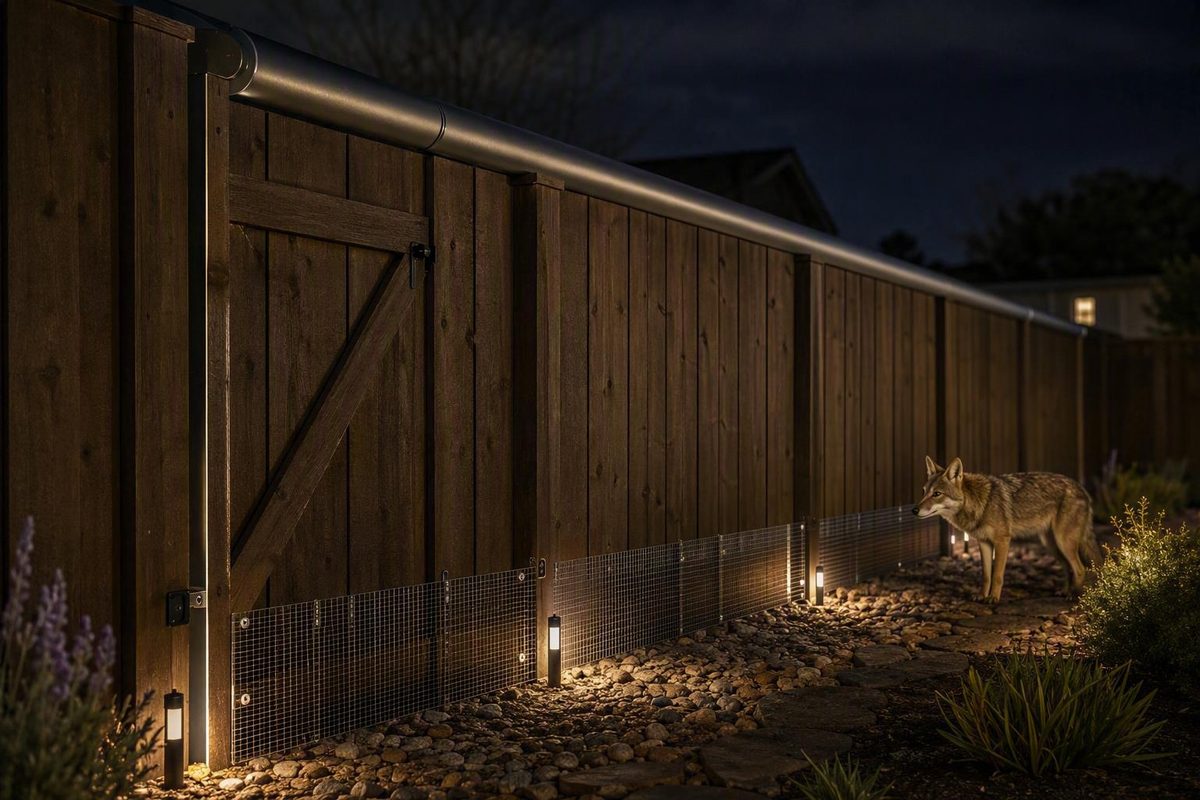
A bare 6-foot fence is not reliable coyote protection. The practical retrofit is geometry rather than more height: add a continuous free-spinning roller at the top, either bury suitable mesh at least 6 inches or run an apron at least 12 inches outward at the bottom, and close every gate and transition gap. That keeps the nominal height at 6 feet where the roller does not project above it, while addressing climbing and digging routes that extra height alone leaves open. No practical residential fence is completely coyote-proof, so the accurate goal is a coyote-resistant perimeter backed by supervision.
Set your fence, legal height cap, animals and soil conditions; the builder will show whether a zero-height retrofit fits and which layers are still required.
Build a layered specification from the fence and exposure you actually have. The result checks the proposed finished height against your cap.
| Layer | Article Specification | What It Addresses | Selected? |
|---|---|---|---|
| Structural repair | Sound posts, panels and gates | Openings and failed support | Yes |
| Roller | Continuous free-spinning top | Grip at the top edge | Yes |
| Angled top | 45° only as reported in one case | Upper crossing geometry | — |
| Added height | No universal height established | Jumping/climbing distance | — |
| Buried edge | At least 6 inches | Digging below fence | — |
| Outward apron | At least 12 inches | Digging at fence line | Yes |
| Gate correction | Close threshold/side gaps; reliable latch | Easiest direct opening | Yes |
| Site-specific ground detail | Professional design where needed | Drainage, erosion and slopes | — |
| Supervision/inner enclosure | Covered, dig-resistant run for vulnerable animals | Consequence if perimeter is crossed | Supervision |
Sources: Urban Coyote Research (more than 6 feet with a roll bar; pets still at risk); Humane World for Animals (at least 6 feet, plus 6-inch buried edge or 12-inch apron); CBS Los Angeles (reported 6- and 8-foot failures and successful roughly 9-foot fence with 45-degree top at one property). These measures reduce risk; they do not guarantee exclusion.
The Case For A Taller Fence
The received wisdom is understandable: a 6-foot privacy fence already blocks ordinary access and sight lines, so a coyote crossing it appears to call for 8 or 9 feet of barrier. At one Orange County property, coyotes reportedly jumped a 6-foot fence and killed seven goats. The owners said an 8-foot mesh extension and blinking lights also failed, while a roughly 9-foot barrier with a 45-degree angled top finally worked. That is a strong practical reason to associate successful exclusion with height.
But the same case shows the legal and technical limits of that answer. The Nellie Gail Ranch HOA sued over a fence that exceeded its 6-foot limit and had been extended without approval. It also was not height alone that distinguished the reported successful configuration: the final barrier had a 45-degree top. CBS Los Angeles reported the dimensions, earlier failures and HOA dispute.
This does not prove that every roller-equipped 6-foot fence will stop every coyote. Urban Coyote Research says fencing may deter coyotes, particularly when it is more than 6 feet high and has a roll bar across the top. The organization uses qualified language rather than promising exclusion. Where additional height is lawful, structurally sound and approved, it can improve deterrence. A fully covered enclosure is stronger protection for a small, vulnerable area.
The narrower verdict is that homeowners facing a 6-foot cap should not treat an unapproved 8- or 9-foot extension as their only useful option. Wildlife guidance supports attacking the routes over and under the fence. Humane World for Animals says a coyote fence must be at least 6 feet tall and should extend at least 6 inches underground or have an apron extending at least 12 inches along the ground. Its guidance provides both bottom-edge specifications.
A Roller Changes The Top Without Simply Adding Feet
A climbing canid needs usable traction at the upper edge. A free-spinning roller is intended to rotate under contact so the animal cannot establish a stable grip. It is a traction-denial device, not a sharp obstacle.
That mechanism explains why a bare 6-foot board fence and a 6-foot fence with a continuous roller are not equivalent barriers. Urban Coyote Research couples greater height with a roll bar in its guidance rather than recommending height alone. Its conflict guidance also warns that fenced pets remain at risk outdoors.
A roller can preserve a 6-foot finished height only if the selected system and mounting arrangement do not extend above the existing limit as measured under the applicable rule. HOA and municipal definitions vary. Some regulate projections, appearance or additions even when nominal height does not increase. Get written approval where required before ordering hardware.
Continuity matters. A roller over the center panels does little if it stops at a gate, corner, short return or transition to a building. It must remain free to turn and clear of vines, branches, wires, warped rails and misaligned brackets. Preserve gate swing, latch access, emergency egress and safe head clearance.
The supporting fence also has to carry it. Inspect end, corner and gate posts; sagging rails; rotten wood; cracked vinyl; corroded connections; loose masonry caps; and chain-link terminal fittings and top rail. A sound-looking picket is not necessarily a structural mounting point. Follow the fence and roller manufacturers’ limits, and have a qualified contractor assess movement, doubtful footings or unsuitable mounting points.
An angled or projecting topper applies the same broad geometric principle by making the upper boundary harder to negotiate. The supplied evidence establishes one reported successful 45-degree top in the Orange County case, but it does not establish a universal projection, bracket spacing, attachment method or direction. Some toppers are designed to retain dogs rather than exclude wildlife approaching from outside. Use a professionally designed system and do not leave cut wire, sharp edges or projecting fasteners accessible.
The Bottom Needs Six Inches Down Or Twelve Inches Out
Top protection does nothing about excavation. Humane World’s two starting details are straightforward: extend suitable fence material at least 6 inches underground, or attach an apron that runs at least 12 inches outward along the ground and secure it with landscaping staples.
| Bottom Detail | Cited Minimum | Best Fit |
|---|---|---|
| Buried edge | 6 inches | Trenchable, stable ground |
| Outward apron | 12 inches | Dig-exposed ground where trenching is avoidable |
A buried edge should connect securely to the above-ground barrier and remain continuous at posts, corners and material changes. Before trenching, use the applicable utility-locating process and separately identify private irrigation, lighting and drainage lines. Roots, rock, frost-affected soil and erosion can make a standard trench unsuitable.
An apron turns outward on the side from which coyotes approach. Its inner edge attaches to the fence base; adjoining sections stay joined; and the mesh lies close to the soil rather than curling upward. Continue it through corners, low spots and disturbed soil instead of stopping before the locations most likely to be tested. Finish exposed edges safely.
Neither cited dimension is a guarantee or an engineered specification for every site. The supplied evidence does not establish that a deeper commercial detail is universally necessary. Drainage swales, steep grades, retaining walls, vehicle paths, shallow rock and major roots may require a site-specific design.
Gates And Grade Changes Decide Whether The Retrofit Works
Before installing a topper, walk the entire line from both sides where access permits. Push lightly on panels and fabric, look for failed ties and fasteners, and view the bottom from near ground level. Vegetation often hides daylight beneath a fence, washouts, detached boards or loose chain-link.
The critical openings tend to occur at:
- the threshold, hinge side or latch side of a gate;
- inside and outside corners;
- triangular gaps below stepped panels;
- drainage channels and erosion low points;
- transitions to a house, garage, shed or retaining wall;
- changes between fence materials;
- loose chain-link beside a terminal post.
No sourced universal maximum gap is available, so do not substitute an invented measurement. Eliminate visible openings and loose sections. A gate should complete its travel, align with its latch and remain closed after use. Compatible self-closing and self-latching hardware can reduce human error, but it is not a validated stand-alone coyote specification.
Carry the top obstacle across the gate where the system permits. Continue the anti-dig treatment beneath or around it where practical. A gate over a driveway or drainage swale may need professional design so a threshold or mesh detail does not obstruct operation or water flow.
On slopes, nominal fence height can remain 6 feet while the descending grade leaves a substantial triangular opening. Correct the fence or grading detail and the cause of erosion; repeatedly adding loose fill does not repair runoff.
Match The Hardware To The Existing Fence
Wood fence posts and rails must be sound where brackets attach. Replace split boards, reconnect loose rails and probe suspect rot. A sagging wood gate may indicate a post, hinge or frame failure rather than a latch problem.
On chain-link, check terminal posts, top rail, fittings, fabric tension, ties and gate frames. Retension fabric and secure the bottom so it cannot be pushed upward easily. If the fence needs rehabilitation first, compare chain-link gauges and coatings.
Hollow vinyl components should not be treated like structural wood or steel. Follow the original fence manufacturer’s reinforcement and attachment limits. For masonry, verify caps, joints and anchor locations before drilling. On ornamental metal, preserve gate movement and avoid creating hazardous projections or an open route around the topper.
If the fence moves significantly, the posts have uncertain footings or the proposed system imposes loads the original fence was not designed to carry, obtain a structural assessment. Geometry is useful only when the hardware remains attached and aligned.
Approval Comes Before An Extension Or Trench
Confirm the HOA and local rules before changing the top, even if the proposal adds no height. Ask about architectural review, measurement of finished height, front-side-rear yard differences, permits, setbacks, sight lines, shared boundaries, easements, projecting components and hazardous treatments. Do not assume a legal 6-foot fence makes every roller or angled attachment automatically permissible.
The Orange County dispute is a warning about process, not a reason to ignore wildlife risk. The reported owners acknowledged making the extension without approval, and the HOA sought to restore the 6-foot limit. A design that remains within the cap can avoid the central height conflict, but it may still require architectural approval.
Never trench or drive long anchors before utilities are located under the applicable process. Private owner-installed lines may require separate locating. Electrification is governed by product requirements and local rules; do not improvise it or use a pet-containment wire as an exclusion barrier. An invisible boundary may influence a trained pet but does not stop wildlife from entering.
Vulnerable Animals Still Need A Second Layer
A modified perimeter reduces access risk; it does not make unattended outdoor time safe. Urban Coyote Research says pets remain at risk even inside a fenced yard. Bring pets indoors at night and supervise small dogs, cats, poultry and other vulnerable animals outside.
For chickens, rabbits, small goats or a small dog, a roofed, dig-resistant inner run can be more controllable than further hardening every foot of the property line. A covered top removes the open crossing route. Secure its doors and access panels, reinforce its ground line and inspect it frequently. The yard fence then serves as the first barrier and the enclosure as the second.
The Orange County account supports caution for livestock: seven goats were reportedly killed after coyotes crossed the 6-foot fence, and an 8-foot mesh extension reportedly did not solve the problem. That remains one property’s experience rather than a controlled test, but it is enough to reject unsupervised reliance on nominal fence height.
Attractants And Footholds Increase Pressure On The Fence
Keep pet food, livestock feed, garbage, compost and fallen fruit inaccessible. Clean spilled bird seed and address rodent harborage around sheds, brush and feed storage. Bird feeders can matter indirectly when they sustain prey animals.
Move bins, lumber, firewood, furniture, planters, play equipment and machinery away from the fence. These objects can reduce effective height, offer a launch point, hide digging or block a roller. Trim overhanging branches and control vines that interfere with inspection or rotation.
Lights and sounds are secondary measures. Wildlife guidance describes deterrent effectiveness cautiously and notes that repellents have not been thoroughly tested. Blinking lights reportedly failed at the Orange County property. That anecdote does not disprove every device, but it does show why one should not replace physical exclusion, secure housing or supervision.
Do not add improvised sharp top hazards, mothballs, unverified scents or makeshift electrical systems. Follow labels, manufacturer instructions, safety guidance and applicable law.
Install The Layers In Failure-First Order
Start with approvals and utility locating. Then stabilize posts, rails and panels; replace broken boards and ties; retension loose fabric; and rebuild gates that cannot hold alignment. Close active openings and washouts before buying a sophisticated topper.
Install the buried edge or apron through corners, transitions and gate areas where feasible. Add the compatible roller or approved topper only after the supporting fence is sound. Finally, remove attractants and climb aids and operate every gate during a complete perimeter check.
Inspect again after heavy rain, flooding, landscaping, excavation, impact or visible animal activity. Watch for new digging, soil settlement, displaced anchors, lifted mesh, exposed edges, loose brackets, seized rollers, vegetation interference, gate sag and new objects stored against the fence. No universal inspection interval is established; activity, weather, vegetation and the animals being protected should determine frequency.
A daytime coyote sighting alone is not necessarily cause for alarm; Humane World says daylight activity is not by itself evidence of aggression. Report aggressive or unusually fearless behavior through the appropriate local authority. Do not approach or physically confront wildlife.
Six Feet Is A Starting Geometry, Not A Guarantee
A coyote can cross a bare 6-foot fence, and a roller cannot stop digging. The defensible 6-foot specification therefore combines a continuous traction-denying top, a 6-inch buried edge or 12-inch outward apron, closed gaps, sound gates and removal of nearby footholds.
Where repeated crossing continues, escalation may mean greater approved height, a professionally designed angled topper, drainage or grading work, structural rebuilding, or a fully covered run. The Orange County barrier shows that a 9-foot, 45-degree configuration can work at one property; it does not establish that 9 feet is universally required. The wildlife guidance supports treating height, top geometry and the ground line as one system—and continuing to supervise vulnerable animals after the work is done.