
Chain Link Fence Materials: What to Buy Beyond the Mesh
Build a complete chain-link materials list: posts, rails, fabric, fittings, gates and footings, with a 100-foot example and specification checks.
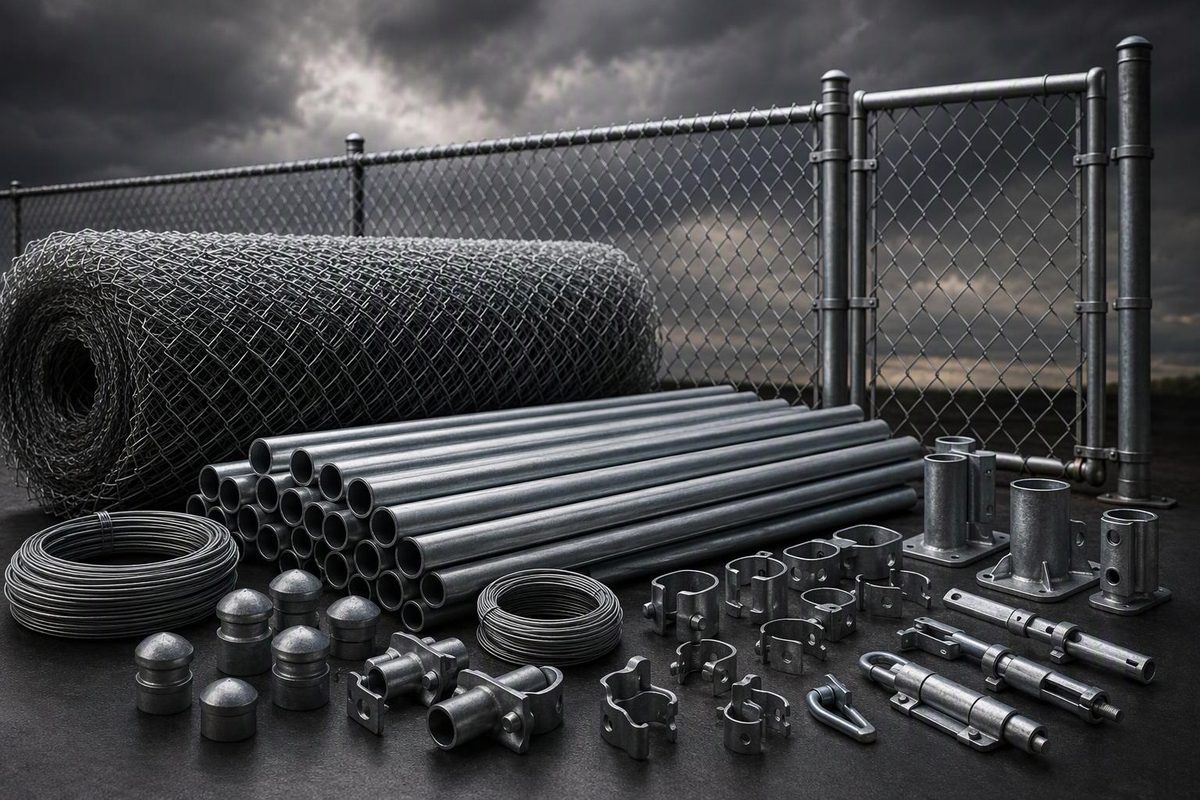
A complete chain-link fence needs more than rolls of mesh. For a typical residential fence with top rail and bottom tension wire, the materials include fabric, line and terminal posts, rail, caps, tension bars, bands, ties, hog rings, fasteners and the specified post foundations. Gates add their own frames, hinges and latches.
Start with a measured layout, not a roll price. Corners, gate openings, changes in grade and the chosen post spacing determine how many supporting parts you need.
Set the layout and support requirements first
Mark each end, corner and gate opening. These locations need terminal posts—the posts where the fabric ends and attaches through tension bars and bands. Intermediate supports are line posts. The Chain Link Fence Manufacturers Institute (CLFMI) defines line posts as spaced no more than 10 feet on center; that is a maximum, not a promise that every fence should use 10-foot spacing. CLFMI product manual, March 2017
Decide whether the fence will remain open mesh or carry privacy slats or screening. Hoover Fence advises considering closer spacing and larger-diameter, thicker-wall framework when privacy products increase wind load. Make that decision before ordering posts or sizing footings. Hoover installation manual
Post length must include the required embedment, not just the fence height. Settle hole diameter, depth and foundation method for the site before calculating concrete quantities. Hoover’s guide notes that dimensions vary with location, fence height and materials, and that gate-post holes typically need greater depth and diameter. Check local frost conditions, height, setback and permit requirements. Installation planning and post-setting guidance
Before digging in the United States, contact 811 a few days in advance and follow your state’s locate procedure. Even shallow digging can damage buried utilities. 811 safe-digging guidance
The chain-link materials checklist
This list assumes a conventional top-rail system with bottom tension wire. Other designs may require brace rails, truss rods, bottom rail or different foundations.
| Material | What it does | What to check before buying |
|---|---|---|
| Chain-link fabric | Forms the woven mesh barrier | Height, roll length, wire gauge, mesh opening, coating and edge finish |
| Terminal posts | Anchor fabric at ends, corners and gates | Diameter, wall thickness, length and gate-support requirements |
| Line posts | Support intermediate sections | Diameter, wall thickness, length and specified spacing |
| Top rail | Supports the fabric’s upper edge | Diameter, wall thickness and swedged versus plain-end joints |
| Loop caps and terminal caps | Carry rail at line posts and close terminal-post tops | Compatibility with the selected post and rail sizes |
| Rail ends and brace bands | Connect rail to terminal posts | Rail-end size, band size and included bolts |
| Tension bars and tension bands | Attach each fabric end to a terminal post | Bar length, band size and quantity per connection |
| Fence ties | Attach fabric to line posts and rail | Length, gauge, finish and specified spacing |
| Bottom tension wire and hog rings | Support and connect the fabric’s lower edge | Wire specification, end fittings and ring spacing |
| Foundations and fasteners | Anchor posts and secure fittings | Foundation dimensions, concrete quantities and bolt sizes |
| Gates and gate hardware | Provide access | Required post opening, frame size, hinges, latch and any drop rods |
The component roles follow Home Depot’s materials guide and Hoover’s installation manual. Hog rings connect fabric to tension wire; they do not replace the ties securing fabric to posts and rail.
Match fittings to the tubing actually supplied. Trade labels can differ from measured outside diameter. Ask the supplier to confirm the band, cap and rail-end sizes against its tubing dimensions, particularly when combining new parts with an existing fence. Plain-end rail needs connecting sleeves; swedged rail has a reduced end that fits into the next section. Hoover system overview
Put the fabric specification on the order
Record the height, mesh opening, wire gauge, coating standard and class, and top and bottom edge finish. For polymer-coated fabric, ask for core-wire gauge and finished coated diameter separately: CLFMI specifies fabric gauge by the core wire, while Hoover describes retail fabric labeled by finished gauge. Those labels can represent different amounts of steel. CLFMI specification guidance; Hoover’s retail gauge explanation
Use our chain-link specification guide to compare gauge, mesh and coating options before building the parts order.
Example: a straight 100-foot, 4-foot-high run
Assume level ground, no gates or corners, terminal posts 100 feet apart on center, and line posts every 10 feet. This is a counting example, not a structural specification.
The starting list is:
- 2 terminal posts and 9 line posts, with 2 terminal caps and 9 loop caps.
- Fabric sufficient for the run, plus the supplier’s recommended ordering allowance.
- Top rail sufficient for the run, allowing for joint overlap, cuts and rail-end connections; sleeves if using plain-end rail.
- 2 tension bars and 6 tension bands—three bands at each fabric-end connection under Hoover’s residential rule for a 4-foot fence.
- 2 rail ends and 2 upper brace bands, plus 2 additional brace bands for the bottom-wire connections in Hoover’s illustrated system.
- 10 compatible bolt-and-nut sets for the six tension bands and four brace bands.
- Bottom tension wire with enough extra length for its end wraps, plus hog rings and fence ties in quantities based on the specified attachment spacing.
- Foundations sized for all 11 posts.
The fitting counts follow Hoover’s installation details. A corner normally adds two fabric-end connections at one post; a gate interrupts the fabric and rail and adds gate-specific hardware. Recalculate each stretch separately rather than multiplying one straight-run package by total footage.
Compare complete orders
Ask the supplier or contractor to itemize fabric specifications, framework dimensions, every fitting, gate hardware, foundations, delivery and tax. For DIY work, keep tool purchases or rentals separate: a fabric stretcher is equipment, not a permanent fence component.
A lower fabric price is not necessarily a lower project price if sleeves, bottom wire, gate hardware or concrete are missing. Use the chain-link installation guide to check the build sequence, and the top-rail buying guide when matching rail lengths, joints and fittings.