
Set Fence Posts Without Mixing Up the Instructions
Use fast-setting concrete for fence posts by following the bag’s water order. Compare set and load times, calculate bags, and avoid footing errors.
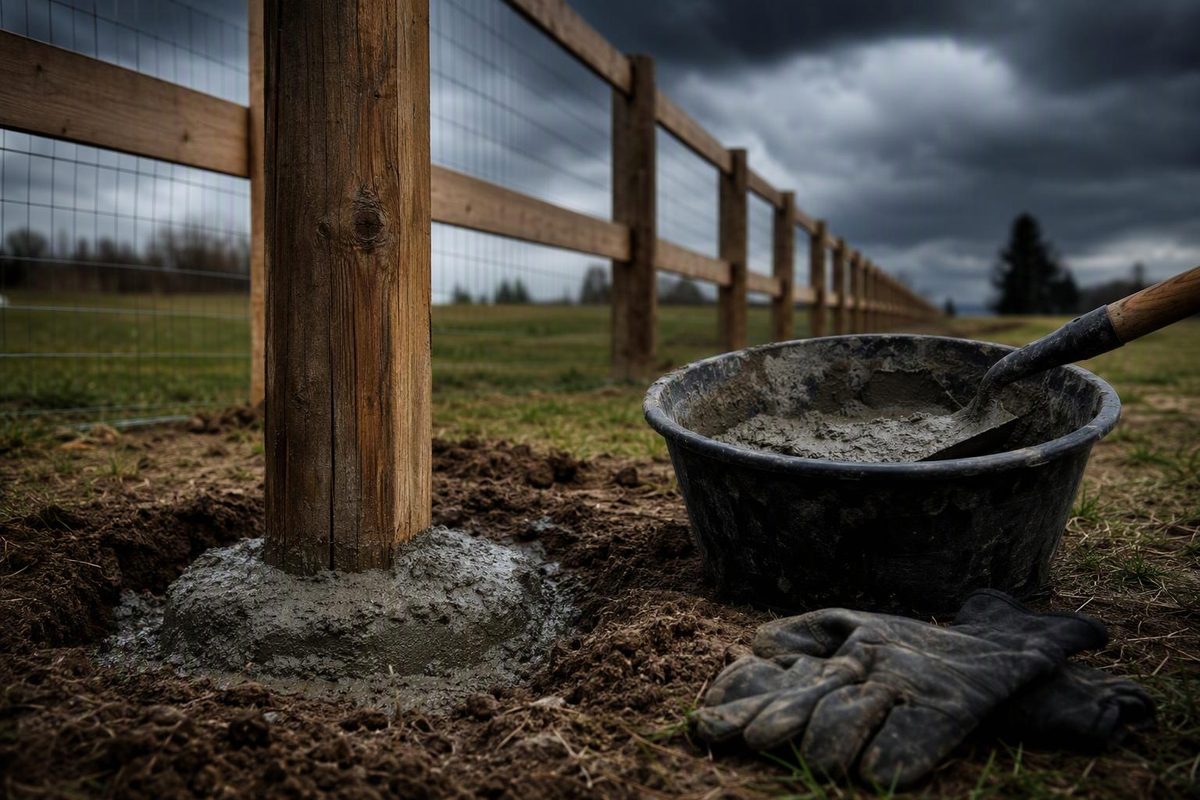
Use fast-setting concrete for a fence post when you need quick stability, but follow the post-setting method printed on that specific bag. Quikrete directs users to pour dry mix into the hole before adding water, while Sakrete directs users to add water first. Do not combine one product’s water quantity, placement order or load time with another product’s instructions.
Enter the round-hole and square-post dimensions; the calculator estimates whole 50-lb bags for both cited products.
Ideal cylindrical-hole estimate. Round up to whole bags; irregular or collapsed holes can use more.
50-Lb Bag Estimator
For one round hole containing one square post.
Source yields: Quikrete Fast-Setting Concrete, about 0.375 ft³ per 50-lb bag; Sakrete Fast-Setting Concrete, about 0.38 ft³ per 50-lb bag.
Fast Set Does Not Mean Fully Cured
Fast-setting mix reduces working time and may shorten the wait before a post can accept a load. It does not make an undersized post, shallow hole or poorly planned footing adequate.
Quikrete Fast-Setting Concrete reaches final set in 20–40 minutes, but its published compressive strength continues to develop from about 1,000 psi at 24 hours to 4,000 psi at 28 days. The same data sheet says to wait four hours before subjecting a post to strain. Set time is not full cure time or necessarily load time (Quikrete technical data sheet).
Fast-setting mix makes the most sense for a small number of posts, a same-day workflow or a location where prolonged bracing would be inconvenient. Conventional concrete provides more working time, which can help when setting many posts or making careful alignment adjustments.
Water Order and Load Times Differ by Product
These manufacturer methods illustrate why “dump in the bag and add water” is not a complete instruction.
| Specification | Quikrete Fast-Setting | Sakrete Fast-Setting |
|---|---|---|
| Post-setting sequence | Pour dry mix around the post, then saturate with water | Fill the hole about one-third with water, then add dry mix |
| Published set time | 20–40 minutes | About 30 minutes |
| Post-load guidance | Wait four hours before applying strain | Hold steady for 3–5 minutes; wait 30 minutes before applying a load |
| 50-lb bag yield | About 0.375 ft³ | About 0.38 ft³ |
| Top of footing | Stop 3–4 inches below grade and replace soil or sod | Bring concrete to the top and slope it away from the post |
Sources: Quikrete’s November 2025 data sheet and Sakrete’s post-setting guide.
These are not interchangeable recipes. Even the water quantity can differ between no-mix post setting and premixing the same product. Quikrete, for example, specifies approximately one gallon per 50-lb bag for its dry-pour post method but approximately 4–5 pints when the material is mixed in a container. Read the post-setting section rather than relying only on the general mixing directions.
Prepare the Hole Before Opening the Bag
- Confirm the fence layout and local rules. Check property boundaries, easements, permits and local requirements before excavation. In the US, request a utility locate through 811 before digging; the national service specifically identifies fence installation as a project requiring a locate (811 Before You Dig).
- Size the post and hole for the actual load. Fence height, wind exposure, soil, frost conditions and post role all matter. Gate and end posts carry different loads from ordinary line posts. Fast-setting mix does not change those design factors. See the guides to fence post sizes and post-hole depth, mix and bag count.
- Stage the water, level and braces. Have a measuring container and all necessary tools within reach. Confirm post orientation, especially for routed vinyl posts and gate posts, because the adjustment window is short.
- Prepare the hole for the selected system. Both cited manufacturers generally call for a hole about three times the post width or diameter and a compacted gravel base. Local frost requirements or an engineered fence detail may require something different.
- Position and plumb the post. Check two adjacent faces with a level. Brace the post when the product instructions or site conditions require it.
- Add water and mix in the stated order. Follow the exact no-mix sequence and water quantity for that product and bag size. For a deep hole, check whether the manufacturer requires placing and wetting the material in lifts; Quikrete does this for holes deeper than 30 inches.
- Recheck the post immediately. Verify plumb, post height and alignment with the fence line before initial set. Do not try to force a correction after the concrete has stiffened.
- Finish the footing top as directed. Some instructions leave room for soil; others call for exposed concrete sloped away from the post. Avoid creating a depression that directs surface water toward the post.
- Keep the fence unloaded for the stated period. A post that feels firm may not be ready for rails, tensioned wire, panels or a gate. Use the product’s post-load guidance rather than its headline set time, extending the wait when the instructions require it in cool conditions.
Calculate Bags From Concrete Volume
For a round hole, calculate the hole volume, subtract the volume occupied by the embedded post, and divide the result by the yield per bag.
Concrete volume in cubic feet equals hole volume minus embedded post volume.
Use the post’s actual dimensions rather than its nominal lumber size. When measurements are in inches, divide cubic inches by 1,728 to convert to cubic feet. Divide the concrete volume by the bag’s stated yield and round up to whole bags. If the hole has a gravel base, enter only the depth that will contain concrete.
The calculator above models a cylindrical hole around a square post. It uses the published approximate yields of 0.375 cubic foot for a 50-lb bag of Quikrete Fast-Setting Concrete and 0.38 cubic foot for a 50-lb bag of Sakrete Fast-Setting Concrete. A rectangular or round post requires the corresponding post-volume calculation.
As a manufacturer benchmark, Quikrete says two 50-lb bags will set a 3-inch-square post in a 9-inch-diameter hole containing 30 inches of concrete (Quikrete technical data sheet). That is a product-specific published example, not a universal allowance for every fence post.
Real holes are rarely perfect cylinders. Loose soil, enlarged bottoms and wall collapse increase consumption, so an estimate with no spare material can leave a footing unfinished. Check the current manufacturer calculator or coverage table against the arithmetic before buying material.
Temperature and Cement Exposure Still Matter
Rapid-setting products are sensitive to placement conditions. Quikrete says extreme heat or cold changes set time and calls for at least 48 hours of protection from freezing. Sakrete specifies air, mix and substrate temperatures of 40–90°F in its technical sheet and also calls for 48-hour freeze protection (Sakrete technical data sheet). Follow the current bag if its limits differ.
Dry concrete creates hazardous dust, and wet cementitious material can injure skin and eyes. Manufacturer instructions call for protective gloves, eye protection and respiratory protection, as well as outdoor use or adequate ventilation. Pour close to the hole rather than dropping dry material from height, and wash exposed skin promptly.
Fast-setting concrete saves time only when the footing is properly sized, enough bags are on hand, the product’s exact water sequence is followed and the fence remains unloaded for the stated period.