
Two-Way Gate Latch Types: Choose by Access and Swing
Compare two-sided and bidirectional gate latches, including gravity, handle-set, keyed, livestock and double-gate designs, plus fit checks.
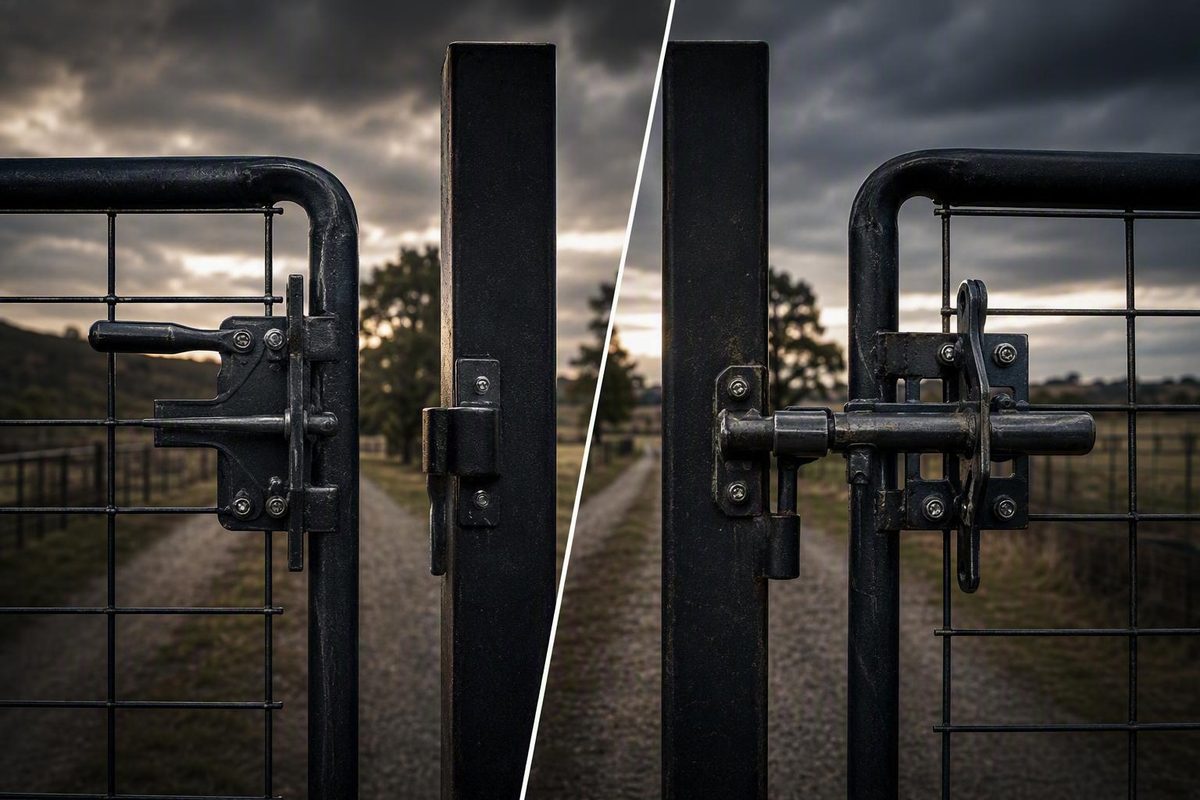
“Two-way gate latch” does not describe one precise function. In residential-hardware listings, it often means a latch that can be opened from either side of the fence. In agricultural hardware, it can mean a latch that releases so the gate can swing in either direction. Current seller and manufacturer descriptions use the term both ways: Wild West Hardware defines two-way latches around operation from both sides, while Sure-Latch describes its two-way model as allowing the gate to swing either direction (Wild West Hardware; Sure-Latch).
Decide which function you need before comparing styles:
- Two-sided operation: A person can release the latch from the yard side or street side. The gate may still swing only inward or only outward.
- Two-direction swing: The gate can pass through the closed position and swing both ways. This also requires compatible hinges and clear swing space on both sides.
- Both functions: Some products provide both, but never assume that from the words “two-way.” Verify the manufacturer’s operation diagram.
The main two-way latch types
| Latch type | What “two-way” usually provides | Best fit | Main limitation |
|---|---|---|---|
| Thumb, ring or lever latch set | Handles or releases on both faces | Wood pedestrian and garden gates | Usually configured for one swing direction |
| Gravity latch with remote release | Automatic latching plus a wire, cable or linkage to the opposite side | Simple wood gates | Exposed release arrangements offer less refinement than an integrated handle |
| Integrated two-sided keyed latch | Operation and locking from both sides | Privacy, side-yard and pedestrian gates | Post shape, gate gap and lock access must match the exact model |
| Bidirectional farm or livestock latch | Gate release and swing in either direction | Round-tube field gates | Often needs substantial post-to-gate clearance and is visually bulky on residential gates |
| Double-drive latch | Access from either side while securing two meeting leaves | Commercial or chain-link double gates | “Double drive” refers to paired gate leaves, not automatically to two-direction swing |
Thumb, ring and lever sets
These are the decorative two-sided choices. A thumb press, ring or lever on one face moves the latch bar on the other. Manufacturers offer all three as two-way categories, but still tell buyers to check inward-versus-outward swing compatibility (Wild West Hardware). Choose among them mainly by grip, appearance, lock provision and the space available for the interior latch bar—not by the handle name alone.
Gravity latches with opposite-side release
A gravity latch can close automatically when its striker lifts the latch arm and the arm drops into the catch. A basic version may be released from the opposite side with a wire; D&D lists that arrangement on a reversible, self-latching, padlockable model for wood gates (D&D Technologies). This is a practical low-complexity option, but “reversible” means it can be installed left- or right-handed—it does not mean the installed gate swings both ways.
Integrated two-sided keyed latches
This type combines a latch, outside access and keyed locking in one assembly. One current D&D magnetic model explicitly operates and locks from both sides, but it is specified for square-to-square mounting, a minimum 1½-inch post and an ideal ¾-inch gate gap (D&D Technologies). Those dimensions are an example, not a general rule. Measure your own frame and use the exact model’s drawing before drilling.
Bidirectional farm latches
A true two-direction latch is useful when a tube gate must be pushed away from the operator regardless of approach. Sure-Latch specifies release for swing in either direction and one-handed operation (Sure-Latch). Fit can be restrictive: Tarter’s heavy-duty version fits 1⅝- to 2-inch-OD round tube gates and requires 1½ inches between post and gate (Tarter). Check whether the listed package includes the gate pin, post fasteners and lock; inclusions vary.
Double-drive latches
Do not confuse a two-way latch with hardware for two gate leaves. A double-drive latch secures the meeting uprights of a paired gate. Some can be operated from both sides: one commercial model is specified for double-swing chain-link gates, 1⅝- or 2-inch round frames and a roughly 3- to 6-inch opening between leaves (Signet Fence). For a residential pair, first work out which leaf remains inactive and how it will be held; the double-gate latch guide covers that setup.
Measure before choosing
Record these details at the gate in its normal closed position:
- Required operation: release from both sides, swing both directions, or both.
- Gate and post profiles: wood face dimensions, square metal section or round tube outside diameter.
- Closed gap: measure at latch height, not only at the top or bottom.
- Mounting area: note trim, routed vinyl walls, welds, mesh and fastener access. For a metal frame, use the metal-gate latch fit checks.
- Swing and handing: inward, outward or genuinely double-acting; left- and right-handed reversibility is a separate feature.
- Locking access: determine whether a key or padlock must work from one side or both.
- Gate movement: lift and close the gate while watching the gap. Correct loose hinges or sag before using latch adjustment to hide the problem; see the gate hinge selection guide.
After installation, test slow closure and closure from several open positions. Closing, latching and locking are separate functions; a lockable latch does not make a gate self-closing.
Pool gates are a separate safety decision
Do not select a pool-barrier latch from a generic “two-way” label. The U.S. Consumer Product Safety Commission recommends that pedestrian pool gates open away from the pool and be self-closing and self-latching. Its guidance also addresses release placement when the mechanism is below 54 inches, while noting that the guidelines are not mandatory requirements and that owners should check local codes (CPSC). Confirm the adopted requirements with the local building authority and choose a complete gate, closer and latch arrangement that meets them.
For an ordinary yard gate, the shortest buying rule is simpler: search for two-sided when access from either face matters, and bidirectional or double-acting when the gate itself must swing both ways. Then verify the drawing, dimensions and installation instructions rather than relying on the product title.