
Wooden Fencing: Specify More Than the Wood Species
Choose wooden fencing by its purpose, posts, lumber grade, treatment, terrain fit and upkeep—and compare quotes for the complete installed fence.
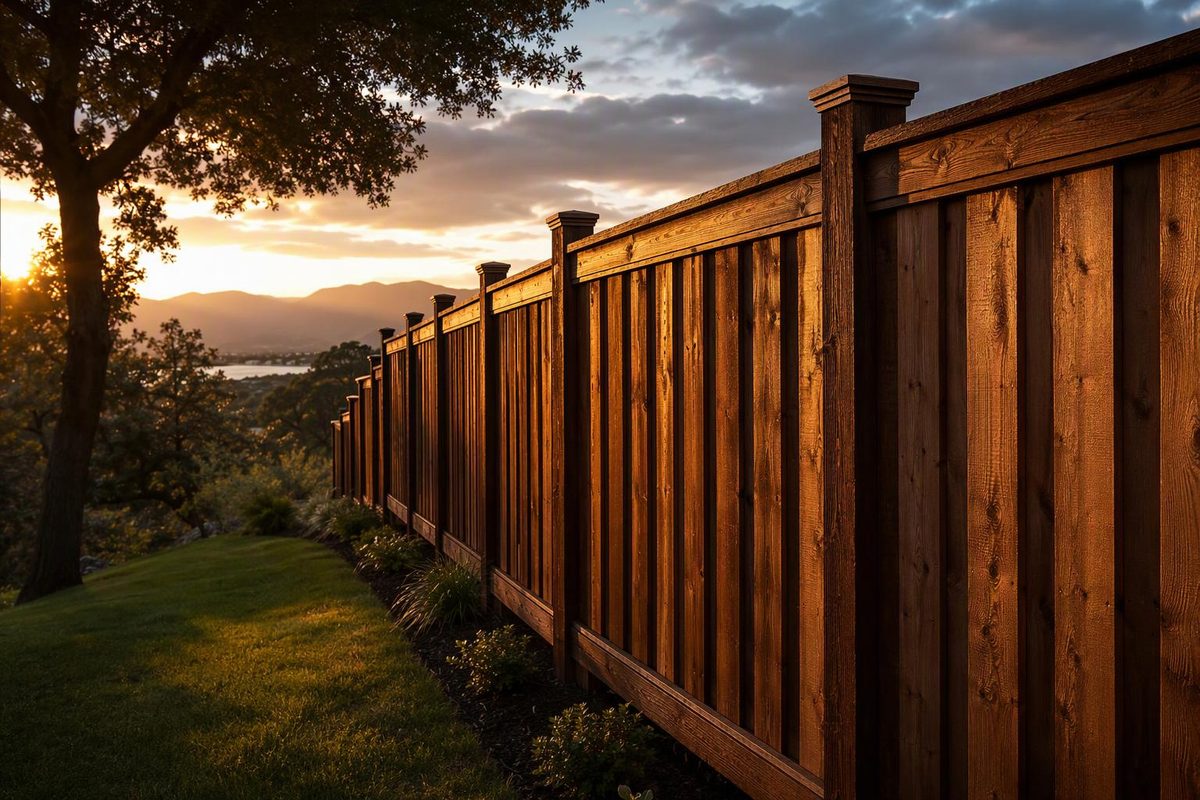
A useful wooden fencing quote describes more than “cedar” or “pressure-treated pine.” It identifies the posts, rails, boards, connections and installation details—and explains how the fence will provide privacy or containment on your particular site.
For a residential fence, settle the design and support system before paying extra for better-looking boards. A premium face board is not a substitute for correctly specified posts and footings.
Match the design to the job
| Main purpose | Design to consider | Check before buying |
|---|---|---|
| Privacy | Solid-board or overlapping-board construction | Sightlines at an angle, drying gaps and clearance beneath the fence |
| Decorative boundary | Spaced pickets or lattice | Actual openings, finished height and framing |
| Pet containment | Pickets or solid boards with suitable gaps | Your animal’s jumping, squeezing and digging behavior; gate and ground gaps |
| Rural boundary appearance | Post-and-rail or split rail | Whether separate mesh or another containment system is needed |
“Privacy fence” does not always mean an opaque screen. Lowe’s shadowbox design alternates pickets on opposite sides of the rails and permits views through the fence at an angle. Look at a sample from the direction that matters—not just straight on. Lowe’s wood-fence guide illustrates that distinction.
Also ask how the design accommodates drying. YellaWood recommends installing its wet stockade pickets tightly together because they shrink as they dry. That minimizes later gaps; it does not promise a permanently gap-free fence. Where uninterrupted screening matters, ask for an overlap detail that accommodates movement. YellaWood building tips
Specify posts, footings and terrain fit first
Wood fences generally have three main elements: posts, horizontal rails and infill boards. Each needs its own specification, rather than inheriting the species or grade advertised for the visible boards. Real Cedar’s construction guide
Ask the installer to state:
- Post material, actual dimensions, length and spacing.
- Hole depth and diameter, backfill or concrete method, and curing requirements.
- Rail dimensions, number and attachment method.
- Separate support and hardware details for gates.
- How the design addresses fence height, wind exposure, soil and drainage.
Do not adopt a generic post-depth rule as the complete design. Lowe’s notes that local codes may specify post holes and may require depths below the frost line. Confirm the applicable requirements for your property, along with height, placement, permits and HOA restrictions. Verify the boundary rather than assuming an existing fence marks it. Lowe’s planning and installation guidance
On uneven ground, decide whether the fence will follow the slope or step between sections. Have the quote identify the resulting bottom gaps, especially for pets. Lowe’s guide notes that preassembled panels can speed installation, while a component-built fence can follow yard contours more closely. Before ordering panels, check their actual width and how they attach to the posts; our cedar fence panel buying checks cover those details.
In the United States, contact 811 before digging and follow your state’s waiting period and safe-digging instructions. Confirm who handles the request if a contractor is doing the work. 811’s before-you-dig guidance
Do not assume the request covers privately owned buried lines. Colorado 811, for example, excludes private sprinkler systems and gas lines to backyard grills from its locate requests. Confirm coverage locally and arrange separate locating where needed.
Read the lumber specification, not just the label
Pressure-treated wood: match treatment to exposure
Treatment category and lumber grade answer different questions. The use category describes exposure hazards; it does not establish that a board is straight, attractive or adequately sized for its span.
For wood treated to AWPA standards, check the end tag for AWPA U1, the use category, preservative and retention. The American Wood Protection Association identifies:
- UC3B: exterior above-ground use, uncoated or with poor water runoff.
- UC4A: general ground-contact use.
- UC4B: heavy-duty ground-contact use.
AWPA’s residential selection guide lists protected above-ground fence pickets as UC3B or higher and ground-contact posts as UC4A or higher. It also warns that some physically above-ground components experience ground-contact-like hazards. Choose for actual conditions, not merely whether the board touches soil.
Ask how cuts and drilled holes will be treated. YellaWood recommends brush-on endcoat preservative on saw cuts and in drill holes, following the preservative manufacturer’s instructions. YellaWood building tips
Cedar: separate appearance from decay resistance
For Western Red Cedar posts and rails, Clear and Knotty specifications offer different appearances. Clear does not necessarily mean completely free of natural characteristics. Specify the named grade or product standard, surface texture and actual dimensions; do not accept “premium cedar” as the whole description. Real Cedar fence specifications
Natural decay resistance also deserves qualification. The USDA Wood Handbook groups Western Redcedar heartwood as resistant, but says untreated sapwood of essentially all species has low decay resistance. It cautions against assuming naturally durable wood will perform equally well in ground contact or severe exposure. A cedar appearance grade is therefore not a lifespan guarantee. USDA Wood Handbook, Chapter 14
Inspect delivered boards for unacceptable bow, twist, splits and holes, and agree on rejection criteria before installation. Ask whether the quoted fence uses cedar throughout or combines cedar boards with treated posts and different rails.
Include fasteners and upkeep in the purchase
“Exterior screws” is less useful than an identified fastener compatible with the wood treatment and exposure. For its micronized-copper-treated products, YellaWood lists specified hot-dip galvanized, qualifying coated-steel and stainless-steel options, and requires stainless steel under prolonged wet conditions. Follow the requirements for the actual lumber and connector products being used. YellaWood fastener information
If using steel posts with wooden rails, specify the bracket system and attachment method too. See attaching wooden rails to metal posts.
Budget for cleaning, inspections and finish renewal. Keep soil and mulch from accumulating against above-ground boards, correct recurring wetting, and repair loose connections. Moisture conditions are central to fungal decay, as the USDA Wood Handbook explains.
Stain timing should follow the wood’s condition and the finish instructions—not a universal waiting period. YellaWood advises checking surface dryness before applying semi-transparent stain and gives different guidance for products with factory-applied water repellent. YellaWood finishing guidance
Compare complete installed quotes
Get local, dated prices for the same length, height and design. Require separate entries for lumber or panels, posts, footings, fasteners, gates, labor, removal, disposal, delivery, permits and finishing. Identify exclusions such as rock excavation, access difficulties and grading.
Compare the total first, then divide by the same stated fence length if a per-foot figure helps. Keep gate quantities and widths identical. A panel-only price and a complete installed quote are not competing prices for the same purchase.
Before signing, make sure the contract records the species and grade of each component, treatment categories, actual dimensions, spacing, footing details, gate hardware and finish scope. That is the information that lets you judge what a higher—or lower—wooden fencing price actually buys.