
Keep, Modify, or Replace Your Wood Fence Under Zone 0
California's Zone 0 fence rule targets the house-end connection. See when a five-foot metal transition or gate is required and the likely deadline.
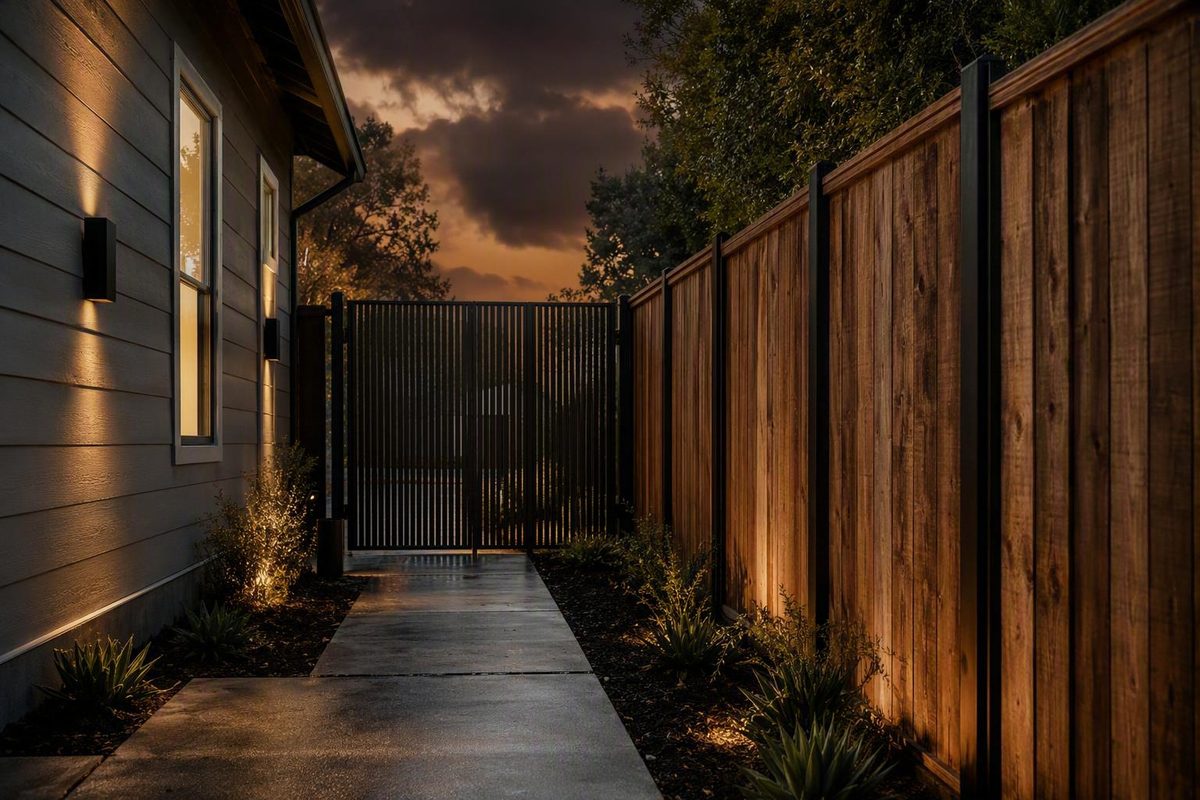
No—you generally do not have to tear out an entire wood fence attached to your house. For a covered California property, the Board-approved Zone 0 rule requires a five-foot noncombustible section where a combustible fence attaches to the structure or comes within one foot of it. An accepted metal gate can serve as the transition. Existing wood fencing can be repaired, but new combustible fencing or gates cannot be installed within Zone 0 once the applicable provisions take effect.
The California Board of Forestry and Fire Protection approved the final package 8-0 on August 19, 2026. The vote did not make it immediately enforceable: remaining administrative steps determine the operative date, reported as potentially as early as late September 2026. Covered new work must comply once the rule applies, while local jurisdictions set deadlines for covered existing properties within five years of the statewide effective date. Reporting on the vote and implementation process distinguishes Board approval from enforcement.
Choose your location, fence position, material, and project scope; the checker returns the likely action and deadline.
California Zone 0 Fence Decision Checker
This checker applies the Board-approved August 2026 fence language. Local ordinances and parcel-specific interpretations can be stricter.
Install an accepted five-foot noncombustible section or gate beginning at the attachment point.
Deadline: the date assigned by the local jurisdiction, no later than five years after the statewide effective date.
Targeted retrofit; full replacement not required by this clauseCompare Your Contractor Quotes
No supported statewide installed-cost figures were supplied. Enter two quotes from contractors pricing the same height, access, finish, permits, demolition, and hardware.
Rule Outcomes by Layout and Scope
| Covered Property | Fence Condition | Scope | Likely Result |
|---|---|---|---|
| SRA or local VHFHSZ | Combustible; attached or within 1 ft | Existing | Five-foot noncombustible transition by local Phase 2 deadline |
| SRA or local VHFHSZ | Combustible; attached or within 1 ft | Limited repair | Wood repair allowed, but transition deadline still applies |
| SRA or local VHFHSZ | Combustible; within 5 ft | New or replacement | Combustible installation barred once applicable |
| SRA or local VHFHSZ | All-metal gate at connection | Existing | May satisfy transition if complete assembly is accepted |
| SRA or local VHFHSZ | Documented noncombustible section | Existing | No material change indicated if assembly and length are accepted |
| SRA or local VHFHSZ | Existing combustible fence more than 1 ft away | Existing | No five-foot attachment transition indicated by this clause |
| SRA or local VHFHSZ | New combustible fence within 5 ft | New or replacement | Use an accepted noncombustible assembly |
| SRA or local VHFHSZ | Fence more than 5 ft away | Any | No Zone 0 fence-material action indicated by this clause |
| LRA outside designated VHFHSZ | Any position or material | Any | Statewide rule not indicated; check local ordinance |
| Unknown designation | Any position or material | Any | Verify parcel before designing or demolishing |
Source: California Board-approved August 2026 Zone 0 summary and cited August 2026 reporting. Costs are unknown (—) unless entered by the user. Local approval controls.
The checker cannot provide a reliable installed-cost estimate because the supplied evidence contains no supported prices for a five-foot steel or aluminum transition or a complete fence replacement. It lets you enter comparable contractor quotes and calculates the difference without inserting an unsupported statewide price.
The Rule Targets the House-End Connection
The five-foot requirement starts at the combustible fence’s attachment point. If the fence or gate does not touch the structure but comes within one foot, the transition starts at the point nearest the structure. These provisions appear in the August 2026 summary of the Zone 0 language.
The rule does not direct every homeowner to remove all wood panels along a side or rear property line. A sound wood fence can generally remain farther from the structure while its house-end section is replaced with an accepted noncombustible assembly.
Three layouts produce the usual outcomes:
- A wood fence attached to the house needs a five-foot noncombustible transition.
- A wood fence passing within one foot of the house is treated similarly, even without physical contact.
- A metal gate can occupy the transition if the complete gate assembly is accepted as noncombustible.
A small air gap is not a workaround. Stopping a wood fence several inches short of the siding still places it inside the one-foot trigger. The supplied evidence does not establish that any air gap can substitute for the required transition.
The measurement may also involve more than the siding. Exterior walls, roof projections, attached decks, stairs, and pergolas can affect where Zone 0 begins. A fence that appears sufficiently distant from the wall may be closer to an attached deck or another covered exterior feature.
Zone 0 Does Not Cover Every California Parcel
The statewide rule applies to covered property in a State Responsibility Area, or SRA, and property in a Very High Fire Hazard Severity Zone within a Local Responsibility Area, or LRA. An LRA address outside a designated Very High Fire Hazard Severity Zone is not brought under the statewide rule merely because it is near vegetation or described informally as a high-fire area.
A city, county, or fire district may have a separate or stricter local ordinance. That local rule can matter even when the statewide geographic test is not met or the statewide effective date has not arrived.
Verify the parcel using the applicable government hazard map. Save the address, assessor parcel number, designation, map result, and date checked. Then identify the fire authority and building or planning department that will review the work.
Walk the fence line before calling them. Record whether the fence:
- Touches the wall or a house-mounted post
- Passes within one foot of the structure
- Connects to a deck, stair, railing, or pergola
- Runs below an eave or roof projection
- Approaches a garage, shed, or other building
- Turns or runs parallel to the house in a narrow side yard
- Reaches a property line less than five feet from the structure
A detached garage or outbuilding can create a separate near-structure condition. Ask whether that building is covered rather than assuming only the main residence counts.
Keep, Modify, or Replace Depends on the Project Scope
An untouched fence, a limited repair, a house-end retrofit, and a complete reconstruction are not the same project. The Board-approved language preserves a repair allowance but restricts new combustible work in Zone 0.
| Project | Likely Treatment | Confirm Locally |
|---|---|---|
| Existing wood fence | Add the transition by the local deadline if attached or within one foot | Parcel coverage and deadline |
| Limited repair | Combustible replacement material remains allowed | Whether the scope is truly repair |
| House-end retrofit | Keep distant wood; install an accepted five-foot section or gate | Measurement and full assembly |
| Complete replacement | Current new-work requirements may apply | Materials, permits, and layout |
| New fence or gate | No new combustible installation within five feet once effective | Effective date and local amendments |
Existing Fences Can Usually Receive a Targeted Retrofit
For an existing covered fence, the practical solution is normally to remove or redesign the first five feet nearest the structure rather than demolish the entire run. The remaining wood may stay if no other rule or condition requires replacement.
Local jurisdictions assign the compliance schedule for existing properties. The outside limit is five years after the statewide regulation’s effective date—not five years after the Board vote. A jurisdiction may set an earlier date or already enforce a separate ordinance.
Ask for the deadline applying to the parcel in writing. A statewide estimate cannot establish when a particular homeowner must finish the work.
Limited Wood Repairs Remain Allowed
The rule allows an existing combustible fence to be repaired with combustible replacement materials. Replacing several damaged pickets or rails is easier to classify as repair than demolishing and rebuilding most of the fence.
The repair allowance does not erase a separate deadline for modifying the connection to the house. It also does not guarantee that extensive work will be classified as repair.
Before demolition, describe the scope in writing. State how many posts, panels, rails, and pickets will be replaced; whether the gate will change; whether the height or footprint will move; and whether existing supports will remain. Ask the reviewing authority to classify the work.
Replacing posts, relocating the line, adding a gate, increasing the height, or reconstructing most of the run can push a project into replacement or new-work rules.
New Combustible Fencing Is Barred Within Five Feet
Once the applicable provisions take effect, a new combustible fence or gate cannot be installed in the first five feet around a covered structure. A complete reconstruction may be treated as new work even if a fence previously occupied the same location.
Do not remove an existing fence on the assumption that it can be rebuilt in wood. Confirm the scope first when the fence is shared, sits in an easement, functions as a pool barrier, provides animal containment, affects utility or emergency access, or is legal nonconforming work.
A Metal Gate Counts Only as a Complete Assembly
A steel or aluminum gate can provide the five-foot transition, but “metal gate” is not a complete specification. The reviewer may examine the leaf, frame, posts, rails, hinges, latch, privacy inserts, brackets, backing, coatings, and installation method.
A metal gate installed between wood posts may leave a combustible route to the building. The same issue arises when a metal panel uses wood rails, wood framing, or combustible decorative inserts.
Potential transition materials include steel, aluminum, masonry, concrete, and properly documented assemblies using other accepted materials. Generic material names do not guarantee approval. “Fire-resistant,” “fire-retardant,” and “noncombustible” are not interchangeable regulatory terms.
Wood remains combustible when treated. A coating may affect ignition performance without converting a wood fence into a noncombustible assembly. Vinyl and composite fencing also require product-specific evidence rather than assumptions based on marketing descriptions.
Submit the exact proposed assembly, including:
- Panel, mesh, or infill specifications
- Post, rail, channel, and frame materials
- Gate leaf, hinges, latch, stops, and supports
- Privacy inserts and decorative components
- Coatings, finishes, fasteners, and brackets
- Manufacturer installation instructions
- Available test reports or fire-performance documentation
Fire Safe Marin likewise describes a noncombustible end section or gate as a way to interrupt the path between combustible fencing and a house, garage, deck, or attached structure.
Transition Details Must Fit the Site
The rule supplies a length and material concept, not a universal construction detail. Footings, post sizes, gate loads, wind exposure, corrosion protection, drainage, setbacks, and utility clearances remain project-specific.
A typical end-panel retrofit replaces the final five feet of wood with a noncombustible panel and support system. A gate layout places a noncombustible gate and accepted supports in that span, preserving side-yard access. A close-but-detached fence places the transition beside the wall, measured from the point nearest the structure.
Obtain a written interpretation for corners, narrow side yards, parallel fence runs, sloped sites, retaining walls, roof projections, attached decks, and property lines inside the nominal five-foot area. Show which way a gate swings because its open position may bring combustible components closer to the structure.
Include gas meters, electrical equipment, vents, hose bibs, plumbing cleanouts, and irrigation controls on the plan. The transition cannot block required service or emergency access.
The Five-Year Deadline Starts From the Effective Date
The Board’s August 19 vote approved the final package, but it was not itself the effective date. Administrative review and implementation steps still separate approval from statewide enforcement.
The sequence is:
- Board approval of the package
- Completion of the remaining state process
- The regulation’s operative date
- Publication of local procedures and existing-property deadlines
- Enforcement by the responsible authority
Covered new construction and new fence work must follow the provisions once they become applicable. Existing properties enter the later locally scheduled phase, with a deadline no later than five years after the statewide effective date.
Do not calculate five years from August 19, 2026. Obtain the operative date and the local implementation schedule before setting a project deadline.
Verify the Rule Before Ordering Materials
Start with a dimensioned sketch showing the house, roof line, attached exterior features, property line, fence, gate, five-foot boundary, and shortest measured distances. Add clear photographs of every point where the fence touches or approaches a structure.
Ask the fire and building authorities:
- Is the parcel in a covered SRA or local Very High Fire Hazard Severity Zone?
- What is the statewide regulation’s operative date?
- Does a local ordinance already apply?
- Is the project a repair, retrofit, replacement, or new installation?
- Where does the five-foot measurement begin on this layout?
- Is the proposed complete assembly accepted as noncombustible?
- Which permits, plans, and inspections are required?
- What deadline applies to this existing property?
- Are approved alternatives available for constrained sites?
Keep the written interpretation, rule version, drawings, product documents, permit, and approval conditions together. Local guidance is not transferable across jurisdictions. For example, the City of San Diego’s defensible-space requirements can guide covered city properties but do not establish deadlines elsewhere in California.
A contractor quote should identify the exact panel, posts, rails, frame, gate, hardware, finish, transition length, measurement basis, permit responsibility, and connection to the remaining wood fence. “Zone 0 compliant metal gate” is not enough without the assembly and the agency determination supporting that claim.
Clear Combustible Debris Even Before Construction
The fence clause addresses a recognized ignition route. The National Fire Protection Association identifies embers and small flames as the main ignition mechanisms for most homes that ignite in wildfires. Its immediate zone extends from the home to five feet from the furthest attached exterior point. See the NFPA’s wildfire preparation guidance.
A wood fence can carry fire toward siding, a deck, an eave, or a vent. Leaves, needles, weeds, mulch, lumber, and stored items at its base can reinforce that path.
A noncombustible transition can still trap fuel. Clear leaves beneath rails, weeds around posts, debris behind panels, and stored material beside the house. Move firewood and lumber away from the connection. Gravel, pavers, concrete, or another suitable noncombustible surface can reduce fuel at the fence base.
CAL FIRE calls the first five feet the most important area for ember resistance and advises replacing combustible fencing, gates, and arbors attached to a home with noncombustible alternatives. Its Zone 0 guidance also recommends removing material that embers could ignite.
Cleanup can begin without deciding the construction question. Structural alterations should wait until the parcel, measurement, material, project classification, permits, and deadline have been confirmed.