
The Cheapest Privacy Fence Often Reuses the Support You Already Own
Compare low-cost privacy mesh, reed rolls and treated-pine panels, with 2026 retail snapshots and the extra costs that can change the winner.
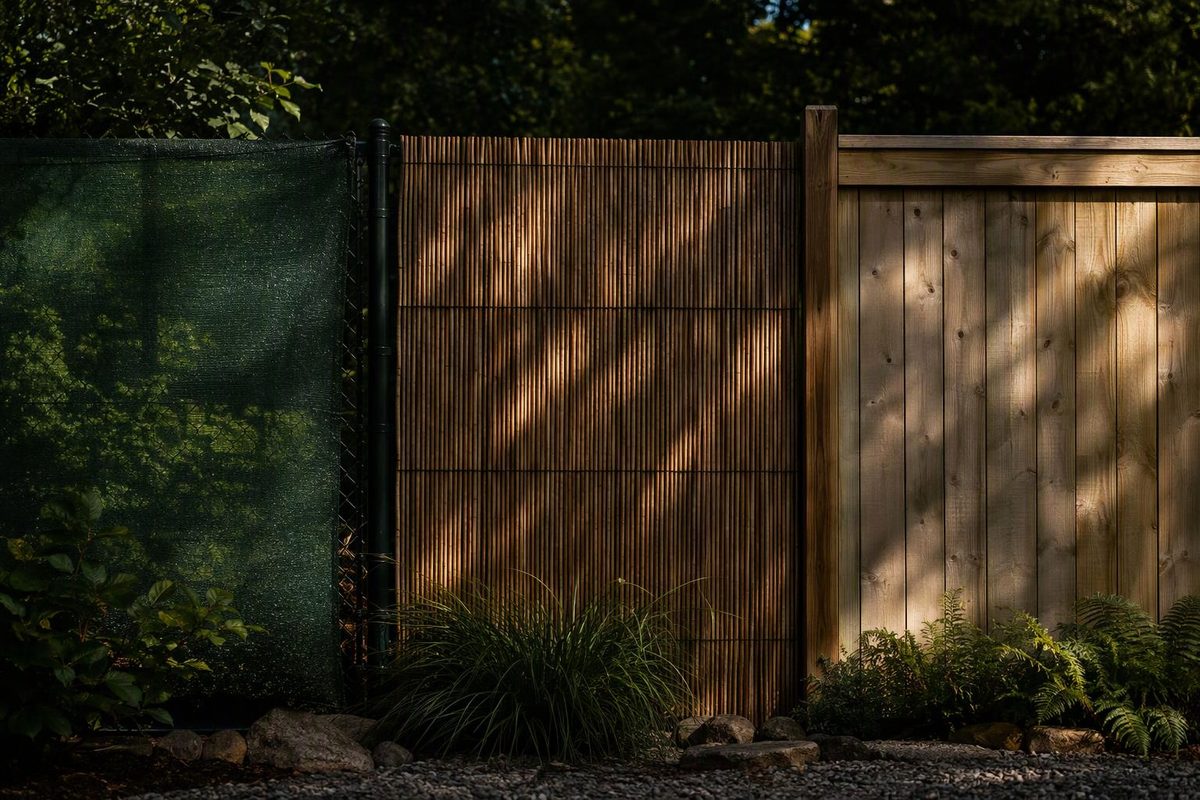
The cheapest privacy fence is rarely the product with the lowest shelf price. It is the option that reuses sound support, covers only the necessary sightline and avoids extras such as an unnecessary gate.
If you already have a sturdy chain-link or open fence, mesh screen is usually the least expensive way to add visual screening. If you need a new permanent six-foot enclosure, basic pressure-treated pine panels are a sensible first option to price. Reed rolls and short panel runs fit between those choices, but they are not substitutes for a structural boundary, security or animal-containment fence.
Quick cost comparison
These are material-price snapshots captured September 30, 2026—not installed national averages. Prices and availability vary by location. Screen prices exclude the supporting fence, ties and other hardware; the wood-panel price excludes posts, footings, fasteners and gates.
| Idea | Example material cost | Best use | Main compromise |
|---|---|---|---|
| HDPE mesh on an existing fence | About $1.00/linear ft | Lowest-cost screening when support is already sound | Not guaranteed opaque; adds wind load |
| Reed roll on existing support | About $5.64/linear ft | A warmer appearance around a patio | Weathers over time; small sightlines may remain |
| Pressure-treated pine panel | About $9.37/linear ft, panel only | New permanent, full-height privacy fence | The support system can cost as much as the visible panels |
| One or two targeted panels | Same panel rate, fewer total feet | Blocking a deck, window or seating area | Does not enclose the yard |
| Spaced-board semi-privacy fence | Project-specific | Using fewer boards where full opacity is unnecessary | Angled views pass through the gaps |
The calculations use a 6-by-50-foot HDPE screen listed at $49.99, a 6-by-16-foot natural reed product at $90.24 and a 6-by-8-foot treated-pine panel at $74.98. The retailers warn that local prices and availability can change (Home Depot screen listing, Lowe’s reed listing, Lowe’s pine-panel listing).
1. Screen only the view that bothers you
Before pricing the full perimeter, check the view from the patio, kitchen window and normal seating height. Identify the shortest run and height that interrupt it. Two eight-foot panels shielding a 12-foot patio will generally cost much less than fencing 100 feet of property line.
This approach is for visual privacy, not containment, security or establishing a boundary. A short return panel at one end can block an oblique view that would pass around a straight screen.
2. Add mesh to a sound existing fence
In this comparison, mesh is the cheapest option because the posts, footings and fence fabric already exist. Buy a roll close to the fence’s actual dimensions to limit waste, and use the outdoor-rated fasteners specified by the screen manufacturer.
Treat the screen as added wind area rather than decoration. The Chain Link Fence Manufacturers Institute tells designers to consider wind load when selecting posts and spacing, particularly for less-open fabric (CLFMI product manual). Covering an open residential fence can similarly expose its framework and footings to forces they were not selected to carry.
Inspect loose posts, corroded rail connections and failing footings before adding anything. Do not use a solid tarp. One windscreen manufacturer recommends UV-resistant ties, regular inspection and a tie arrangement designed to release at the top in high winds; follow the instructions for the particular screen rather than assuming that method fits every product (Ball Fabrics installation guide). See the broader comparison of mesh, slats and rigid privacy products.
3. Use reed screening for appearance, not structural enclosure
A reed roll can soften chain-link, welded wire or another rigid frame without the expense of a new wood fence. At the captured price, however, the example costs more than five times as much per covered foot as the HDPE mesh.
Buy it for the appearance, not because “natural” automatically means cheaper or longer-lasting. Thin reeds can split and weather, and the roll may obscure rather than eliminate views. Keep it off damp soil and fasten it to continuous support. It is screening, not a freestanding fence panel.
4. Reuse sound posts and rails
If an old wood fence has failed pickets but plumb, firmly set posts and solid rails, replacing only the boards can remove excavation and concrete from the budget. Probe wood near grade and at rail connections. A post that rocks, is soft at the soil line or has a major split through a fastener zone is not a saving.
Metal posts can also support new wood rails with correctly sized brackets. Measure each post’s shape and outside dimensions and inspect its footing before buying hardware. This metal-post-to-wood-rail guide covers the system checks.
5. Price basic treated-pine panels for a complete new fence
For a complete new privacy fence, compare plain stockade or dog-ear pressure-treated pine before cedar, decorative tops, horizontal layouts or vinyl. Preassembled panels avoid fastening every picket separately and can work well on a flat, regular run. The captured $74.98 panel equals about $9.37 per linear foot before support and installation.
A complete takeoff should include:
- panels, cuts and waste;
- line, corner, end and gate posts;
- concrete or another specified footing system;
- exterior-rated brackets and fasteners;
- gate frame, hinges and latch;
- delivery, demolition and disposal; and
- stain or another planned finish.
Match treated lumber to its exposure. The American Wood Protection Association identifies UC4A as ground-contact general use and UC3B as exterior, above-ground use with poor water runoff. It advises buyers to check the end tag for “AWPA U1,” the use category and an accredited quality mark. AWPA also says exterior cut ends and drilled holes must receive a suitable field preservative (AWPA guidance).
Stock panels are easiest to lay out on level ground. Stepping them down a slope can leave triangular gaps or require trimming and extra height. A stick-built fence may fit uneven terrain better even though assembly takes longer.
6. Use spaced boards only when semi-privacy is enough
Spacing vertical boards reduces the board count and the area blocking wind. It can suit gardens or utility areas where filtered screening is acceptable. It is not full privacy: even a narrow face-on gap creates a longer sightline when viewed at an angle.
Do not set wet boards edge to edge and assume they will remain opaque. Wood movement can open unexpected gaps. For dependable screening, use an overlapping pattern or opaque backing; see why a horizontal privacy fence works as a system.
7. Extend a usable fence instead of replacing it
If an existing fence is sound but slightly below the required sightline, a short lattice, mesh or framed topper may cost less than replacement. Calculate both the finished height and the added wind area first. Extensions transfer load into the existing posts and footings, so weak support can turn a cheap retrofit into a rebuild. Compare the structural and legal checks in this guide to fence height extensions.
Check the costs beyond the infill
A gate, demolition, rocky soil, steep grade, roots, utility conflicts and property-line uncertainty can outweigh the advertised material price.
Before digging post holes, contact 811 a few days in advance. National 811 guidance says every digging project requires a locate request regardless of depth and notes that even hand shovels can damage utilities (811 Before You Dig).
Check city or county rules and any HOA requirements before ordering materials. Local rules may regulate height, front-yard opacity, setbacks, finished-side orientation and approvals. Woodlawn, Ohio, for example, generally limits residential side- and rear-lot fences to six feet, restricts the opacity of decorative front-yard fences and requires a zoning certificate (Woodlawn fence code). That does not establish the rule elsewhere; it shows why “six feet is always allowed” is unsafe advice.
Be cautious with pallet walls and miscellaneous reclaimed sheets unless you can verify ownership, treatment, condition and local acceptance. Free infill is not inexpensive if it contains protruding fasteners, fails quickly or must be removed.
Buying order: price a short targeted screen first, then a retrofit on sound support, and finally a complete treated-pine panel system. Compare the same height, opacity, gate count, footing work and finish—not just the cheapest advertised roll or panel.