
Choose a Rustic Fence That Works as Well as It Looks
Compare split rail, picket, framed wire, woven wire, wood and metal by privacy, views and containment; installed split rail runs about $12–$45/ft.
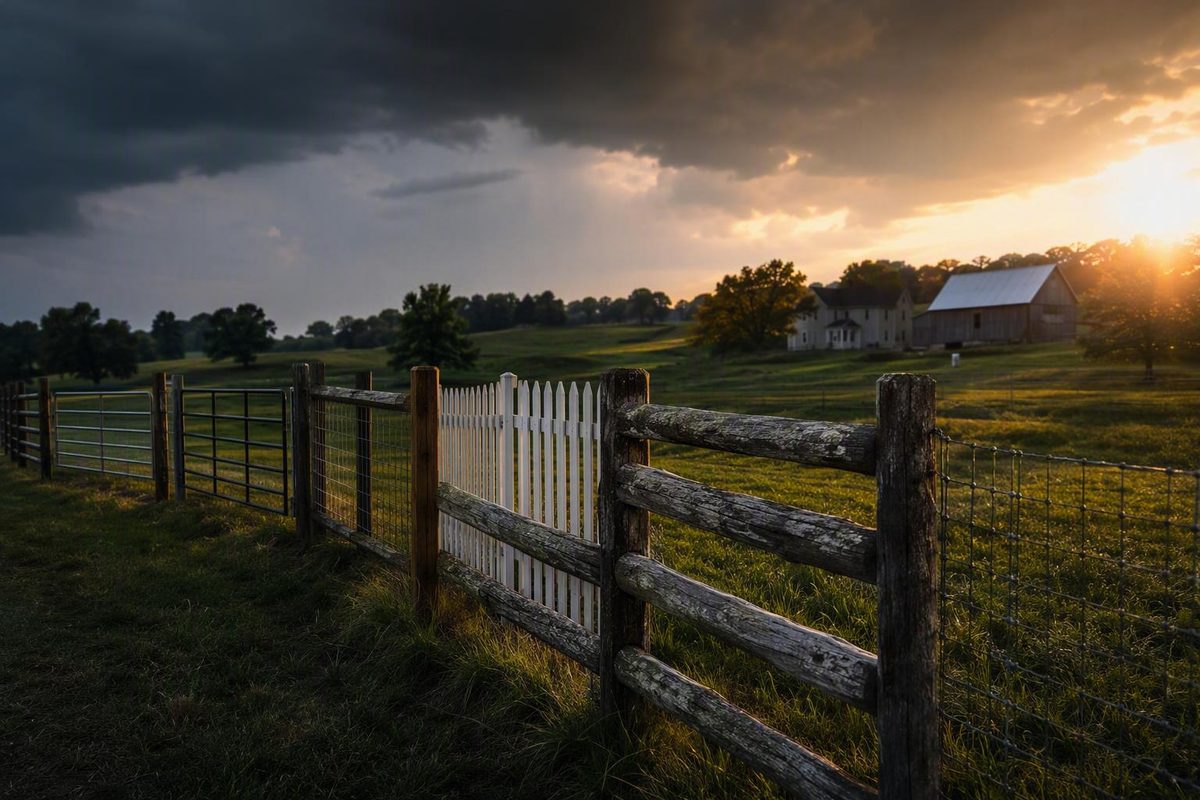
A farmhouse fence can be a rough cedar rail along a country road, a white picket fence around a front garden, a wood-framed wire enclosure, or a crisp combination of timber and dark metal. These designs share a visual language, but they do not share the same performance.
That distinction matters. A decorative split rail fence may mark a boundary beautifully while providing little privacy or small-animal containment. A solid board fence may screen a patio effectively but block the landscape that made an open rural design appealing. A tensioned woven-wire pasture fence performs a different job from a decorative rigid-wire panel framed in wood.
Choose in two passes. First, define the farmhouse character you want. Then specify what the fence must do—provide privacy, preserve views, protect a garden, contain animals, accommodate gates, follow slopes, or cover substantial acreage. The right farmhouse fence is the system that satisfies both lists.
What Makes a Fence Look Farmhouse?
It generally refers to fencing inspired by rural boundaries, farm gates, paddocks, gardens, and traditional residential yards.
Common visual features include:
- Long horizontal lines
- Natural or traditional-looking materials
- Open views through rails or wire
- Straightforward, practical-looking construction
- Substantial wood posts
- Field-, paddock-, or garden-style gates
- Weathered, stained, painted, galvanized, or dark-coated finishes
- Details such as crossbucks, post caps, stone piers, and simple timber frames
Recurring forms include split rail, post-and-rail, crossbuck, picket, solid-board, wood-framed wire, woven farm wire, and mixed wood-and-metal fencing. Commercial descriptions also include slip-board and board-on-board construction, with the latter using overlapping boards to create a privacy barrier (overview of farmhouse fence forms).
A farmhouse fence is not necessarily a farm fence. A residential rail fence may borrow the proportions of a pasture fence without having the wire, bracing, visibility, fasteners, spacing, or strength required for a particular animal.
Appearance therefore cannot establish suitability. A fence that resembles horse fencing is not automatically safe for horses. A split rail fence that looks appropriate around sheep or goats is not necessarily capable of holding them. Decorative mesh sold for patios may differ substantially from wire intended to be tensioned around a pasture.
Traditional farmhouse treatments emphasize rough-sawn or reclaimed-looking wood, split rails, stone, painted pickets, and visible joinery. Modern farmhouse designs retain the rural geometry but sharpen the finish. Common combinations include clean timber frames with galvanized mesh, black-coated posts, rigid wire panels, or corrugated steel.
Before selecting a style, finish this sentence:
This fence must primarily ____.
Possible answers include:
- Decorate a road frontage
- Mark a property line
- Define a front yard
- Preserve an open view
- Screen a patio
- Protect a vegetable garden
- Contain a pet
- Enclose poultry
- Manage livestock
- Separate several uses across an acreage property
If the answer includes more than one job, rank the jobs. A fence can combine style and function, but compromises become unavoidable when priorities conflict—especially privacy versus views, or decorative openness versus containment.
Farmhouse Fence Styles Compared by Function
Project length, material grade, terrain, local labor, finish, gates, and required performance can reverse any simple ranking.
Use this matrix as an initial screening tool, not a construction specification.
| Style | Visual character | View retention | Privacy | General containment role | Maintenance exposure | Installation considerations | Main cost drivers |
|---|---|---|---|---|---|---|---|
| Split rail | Informal, rustic, traditional | Excellent | Very low | Boundary marking; may need mesh | Exposed wood, rail pockets, and joints | Accurate layout and stable posts still matter | Rail count, wood choice, mesh, and gates |
| Post-and-rail | Orderly paddock or estate look | Excellent | Very low | Large-area division; performance depends on rails and added wire | Material- and finish-dependent | Long alignment and consistent rail spans | Post size, rail count, material, and total length |
| Crossbuck | Decorative rural or equestrian look | Good | Very low | Usually visual separation unless supplemented | Numerous board faces and joints | More cutting and intersections than plain rails | Additional boards, fitting, and finishing |
| Picket | Cottage or residential farmhouse | Moderate to good | Low unless closely spaced | Yard definition and decoration | Many edges and fasteners | Panels can simplify installation; custom layouts add work | Height, spacing, profile, and gate details |
| Solid or board-on-board | Traditional privacy fence | Very low | High | Privacy and general yard enclosure | Large exposed surface area | Posts and framing must suit the solid surface and site | Lumber quantity, finish, posts, and gates |
| Framed welded wire | Rustic-modern garden look | Excellent | Very low | Gardens and selected enclosures when properly specified | Wood or metal frame plus wire coating | Mesh must be cut, supported, and fastened within bays | Frame labor, mesh specification, and finish |
| Woven wire | Functional pasture appearance | Excellent | Very low | Livestock system when properly selected and tensioned | Wire, fasteners, braces, and tension | Requires suitable terminal and corner assemblies | Bracing, wire, gates, terrain, and installation |
| Rigid hog-wire panels | Modern rustic or industrial farmhouse | Excellent | Very low | Decorative infill or selected enclosures | Frame, cut edges, and coating condition | Each panel needs suitable edge support | Panel specification and custom framing |
| Full-height metal panels | Contemporary farmhouse | Very low | High | Privacy where the complete system is suitable | Coating, cut edges, fasteners, and connections | Solid panels require site-appropriate framing and support | Panel finish, framing, freight, and fabrication |
Split rail and post-and-rail are clear choices when the goal is an open rural boundary. Their horizontal lines visually organize a property without creating a wall. They provide little privacy, however, and their open spaces cannot be assumed to contain dogs, poultry, goats, sheep, or other smaller animals. Adding suitable mesh changes both the appearance and the performance.
Crossbuck fencing uses diagonal boards to form an X or V pattern. It reads as more architectural than plain rails, but the extra boards and intersections create additional cutting, fastening, finishing, and inspection points.
Picket fencing is generally more residential than agricultural. It works around front gardens, porches, and modest yards where charm and boundary definition matter more than pasture performance. Wider spacing preserves openness; closer spacing provides more screening. Where privacy is the primary goal, solid or overlapping boards are usually the more direct choice.
Solid-board and board-on-board fences create the strongest visual separation in the traditional wood category. Board-on-board designs overlap adjacent boards, reducing direct sightlines. These systems use more material than open rails and create a larger solid surface, so the complete post-and-frame design must suit the site.
Framed welded wire combines a timber or metal framework with mesh whose intersecting strands are welded together. It preserves views and can look rustic or contemporary depending on the frame and finish. It is especially useful around gardens and yards where visibility is important.
Rigid hog-wire panels can create a similar appearance, but the name is imprecise. Traditional hog panels generally have smaller openings toward the bottom, while products informally sold as “hog wire” can include several kinds of rigid or rolled mesh. Verify the panel dimensions, opening pattern, wire gauge or diameter, coating, edge condition, and intended application before buying (hog-wire and welded-panel terminology).
Woven wire is a different construction category. Its wires are joined by knots or wraps and installed as a tensioned system. It depends on suitable corners and terminal assemblies, compatible line posts, controlled tension, and appropriate fasteners. It should not be treated as decorative mesh casually stapled between posts.
Full-height corrugated or ribbed metal offers privacy with a modern farmhouse expression. Wood trim can soften the industrial surface, while dark posts create stronger architectural contrast. Treat promises that a system will never warp, require almost no care, or last indefinitely as marketing unless the seller supplies measurable material, coating, installation, exposure, and warranty terms.
Match the Fence to the Property’s Real Job
One property may need several fence types. Start with each zone instead of forcing one design around the entire perimeter.
Decorative road frontage. Split rail, post-and-rail, or crossbuck fencing preserves an open, welcoming appearance. It can frame a driveway and make a boundary legible without visually closing the property. If animals can reach that line, the decorative rails may need a separately specified containment layer.
Front yard. Picket, low post-and-rail, or framed wire can work where curb appeal and visibility matter. Consider how the fence relates to the porch, house trim, mailbox, driveway, and pedestrian gate. A visually heavy pasture system may feel out of scale on a small frontage, while a delicate residential fence may look disconnected from broad acreage.
Privacy near a patio. Use solid boards, overlapping boards, or full-height panels when screening is the actual objective. Split rail and open wire cannot provide meaningful visual privacy. If only one outdoor room requires screening, a short privacy run combined with open fencing elsewhere may avoid enclosing the entire property.
If the fence will also serve as a pool barrier or another regulated safety barrier, do not infer compliance from its farmhouse appearance or product name. Ask the local code authority to review the proposed height, openings, gate, latch, location, and complete configuration before construction. Products promoted for pools, balconies, railings, or retaining-wall installations may still require project-specific code review (limitations of general-purpose rigid-panel applications).
Garden enclosure. Wood-framed welded wire offers a practical balance between visibility and protection. One retailer-documented method attaches welded mesh to wood posts and rails and buries lower mesh outside the perimeter to discourage rabbits, dogs, and some burrowing pests (wood-and-wire garden fence example). Buried mesh is not a guarantee of exclusion; results depend on the animal, soil, opening size, gate gaps, route, and installation condition.
Pet or poultry area. Open rails commonly need wire or mesh. Choose that infill according to the animal’s size and behavior, expected pressure, and potential for climbing, digging, escape, or contact with sharp edges. Inspect the complete enclosure, including bottom gaps, corners, gates, latches, cut wire ends, and transitions to buildings. Do not select height or openings by appearance alone.
Large-animal pasture. Animal behavior and pressure must drive the specification. Wire type, visibility, openings, rail configuration, sharp-edge control, gate location, maintenance access, and any electrified components may all matter. University of Georgia Extension emphasizes matching the fence to the animals because horses, cattle, sheep, and hogs challenge fences differently (farm-fence planning and selection guidance).
For livestock or other high-consequence containment, consult agricultural extension guidance, the fence or wire manufacturer, and experienced local installers. Request recommendations specific to the animal, property, terrain, and intended management system rather than accepting a generic “farm fence” label.
Mixed-use acreage. Hybrid zoning is often the most rational approach. Place attractive rail, crossbuck, or framed-panel fencing along the road, driveway, and house. Transition to a suitable functional wire system in less-visible pasture areas. This concentrates decorative spending where it has the greatest visual effect without requiring the same material around every remote boundary.
Materials: Appearance, Upkeep, and Tradeoffs
Material choice affects more than color. It changes the available forms, joint design, post requirements, repair methods, finish options, and exposure to decay or corrosion. The comparisons below are planning tendencies, not validated lifecycle rankings.
| Material | Visual fit | Common upkeep questions | Broad price tendency |
|---|---|---|---|
| Pressure-treated pine | Familiar and adaptable; accepts many finishes | Treatment category, drying, checking, drainage, finish condition, and fastener compatibility | Often among the more accessible wood options |
| Cedar | Warm, recognizable rustic character | Weathering, movement, finish condition, grade, and exposure suitability | Commonly priced above basic treated pine |
| Black locust | Strong rural character, especially for posts and rails | Local availability, irregular form, and replacement sourcing | Highly dependent on regional supply |
| Vinyl | Clean ranch, rail, or picket appearance | Cleaning, impact damage, component compatibility, and temperature exposure | Depends on profile and reinforcement |
| Composite | Uniform contemporary interpretation | Product-specific support, fastening, movement, and replacement requirements | Often a higher initial material purchase |
| Galvanized wire | Traditional agricultural appearance | Damaged zinc, cut ends, fasteners, and localized corrosion | Often economical as infill; support systems add cost |
| Coated or painted steel | Strong modern farmhouse contrast | Scratches, cut edges, connections, and coating repair | Commonly above basic agricultural wire |
Pressure-treated pine can form posts, rails, boards, frames, and gates while accepting many painted or stained finishes. Treatment category, lumber grade, drying, drainage, cuts, compatible hardware, and soil contact all need to be addressed in the project specification.
Cedar provides a warm wood character and may be allowed to weather or finished to retain more color. “Cedar” alone is not a complete buying specification; the exact product, dimensions, grade, exposure, and intended use still matter.
Black locust is associated with rural posts and rails in some areas, but availability and form vary.
Wood generally remains exposed to moisture, ultraviolet weathering, dimensional movement, and finish deterioration. Drainage and installation quality can matter as much as species. Published service-life figures vary because treatment, climate, soil, workmanship, pressure, and maintenance are rarely identical; treat any lifespan as a conditional estimate rather than a promise.
Vinyl can reproduce a white post-and-rail or picket appearance without painting or staining. It may still need cleaning and inspection, and damaged sections may require compatible replacement components. Profile, reinforcement, fastening, and exposure differ among products, so “vinyl” is not itself a performance grade.
Composite products also vary. Check the manufacturer’s permitted spans, support requirements, fastening instructions, exposure limitations, movement allowances, and warranty exclusions rather than assuming a composite component behaves like solid wood.
Galvanized wire pairs naturally with rustic timber and agricultural construction. Galvanizing reduces corrosion exposure but does not make wire corrosion-free. Inspect damaged coatings, cut ends, fasteners, and areas that remain damp.
Coated or painted metal can create a refined contrast. Black-coated posts and wire tend to recede visually, while galvanized surfaces look more agricultural. Corrugated steel creates a solid privacy surface. Ask how drilled holes, cut edges, welds, fasteners, and coating damage should be protected.
Useful mixed-material combinations include:
- Wood rails with functional wire backing
- Timber frames with welded mesh
- Wood or steel frames around rigid panels
- Black metal posts supporting wood rails
- Wood trim around corrugated steel panels
- Stone entrance columns with simpler fencing between them
When buying wire or metal, reject vague descriptions such as “standard wire,” “hog panel,” or “weatherproof” unless the quote also states measurable specifications. Request the wire type, gauge or diameter, opening size and pattern, panel or roll dimensions, galvanizing or coating, frame material, fasteners, repair method, intended application, and warranty. Guidance on chain-link gauge and galvanizing illustrates why measurable wire specifications matter, although chain-link specifications should not be transferred automatically to welded or woven wire.
What a Farmhouse Fence Costs
There is no dependable universal farmhouse-fence price. The term covers everything from two-rail wood boundaries to solid privacy walls and tensioned livestock systems. The most directly comparable published pricing in the available evidence concerns split rail and regional farm-fence projects—not every design marketed as farmhouse.
Across those sources, installed split rail spans approximately $12 to $45 per linear foot. The low end comes from a regional contractor’s basic three-rail estimate, while the upper end appears in material-specific national split-rail planning figures. Region, material, rail count, labor, terrain, gates, wire backing, preparation, and included work can all change the result (regional split-rail estimates; national split-rail cost estimates).
HomeGuide gives a generalized installed estimate of $15 to $35 per linear foot, or $3,000 to $7,000 for 200 linear feet. It also lists material-specific installed figures reaching $45 per foot. These are national planning estimates, not a quotation for a particular property.
Angi reports $15.50 to $39 per linear foot installed, including stated components of $11.50 to $30 for materials and $4 to $8 for labor. Its page also displays geographic variation and contains some ambiguity between material-only and installed tables, so the figures should be treated as planning references rather than bid comparisons (Angi’s 2026 split-rail pricing).
The North Georgia contractor cited above gives narrower regional estimates of $12 to $19 per foot for basic three-rail split rail and $20 to $27 per foot for four-rail split rail with wire backing. Those figures help illustrate the possible effect of another rail and mesh, but they are regional commercial estimates rather than national benchmarks.
Do not average published one-acre totals. Geography, date, methodology, parcel assumptions, material, bulk purchasing, gates, rail count, preparation, and scope may differ. Averaging incompatible assumptions produces a precise-looking number with little practical value.
Acreage also does not determine fence length. Shape does.
For a rectangle:
Perimeter = 2 × (length + width)
A long, narrow parcel has more perimeter than a square parcel of the same area. An irregular property may require additional runs around offsets, waterways, buildings, easements, or excluded areas. Use measured boundary information and an actual route plan rather than acreage alone.
Build the initial budget from:
- Measured fence length
- Fence type in each property zone
- Material, grade, and finish
- Number and size of rails or boards
- Wire type and specification
- Line, corner, terminal, and gate posts
- Braces and tensioning components
- Pedestrian, equipment, and vehicle gates
- Latches, hinges, stops, and automation
- Old-fence removal and disposal
- Brush and vegetation clearing
- Grading or drainage work
- Survey or boundary confirmation
- Permits and application fees
- Painting, staining, or sealing
- Difficult excavation involving rock, wet soil, or roots
- Mobilization and access limitations
- Lawn, drive, or landscape restoration
- Taxes, delivery, and change-order allowances
Obtain itemized local quotes based on the same scope. Each proposal should identify total length, material and grade, rail count, board dimensions where relevant, wire specifications, post material, post-setting method, corner and gate construction, gate dimensions, finish, preparation, disposal, warranty, schedule, and exclusions.
A low per-foot price may omit gates, wire backing, finishing, clearing, or removal. A higher price may include them. Compare complete systems and scopes, not just totals.
Plan the Route, Posts, Wire, Slopes, and Gates
A successful fence begins with a site walk. Follow the proposed route and record:
- Known boundaries and uncertain sections
- Corners, curves, and elevation changes
- Drainage channels and persistent wet areas
- Driveways, utilities, structures, and easements
- Trees, roots, brush, and access restrictions
- Soil conditions and likely excavation difficulty
- Wind exposure
- Expected human or animal pressure
- Existing and future gates
- Space needed for mowing, repairs, and vegetation control
Resolve the route before purchasing panels or laying out posts. A small shift may avoid a drainage path, mature tree, utility conflict, awkward corner, or gate that cannot open fully.
Posts are system-specific. Depth, diameter, spacing, and anchoring depend on the fence type, soil, drainage, local frost conditions, wind exposure, fence height, solid versus open construction, corners, gates, tension, and expected pressure.
Spacing examples illustrate the variation. One personal framed welded-wire project placed driven post bases less than 8 feet apart, but that arrangement was part of a particular DIY design rather than a universal footing or spacing standard (framed welded-wire project). By contrast, one homestead-fencing article recommends no more than approximately 10 to 12 feet between line posts for stretched barbed or woven wire, with strong corner assemblies carrying tension (woven- and barbed-wire post guidance).
Do not transfer either spacing range to another system without checking the product instructions, loads, and site conditions.
Framed welded wire is supported around its edges by posts, rails, attachment strips, channels, or a complete panel frame. Mesh may be cut into individual bays and attached with suitable staples, clips, strips, or channels.
Tensioned woven wire is unrolled along the fence line, secured at a terminal assembly, stretched evenly, and tied off at another suitable assembly. Corners and gate terminals must resist the pull; line posts guide and support the wire but do not replace braced ends. One documented pasture project established corners, braces, and gate locations before line posts and then stretched the woven wire as a continuous system (woven-wire pasture project).
Wire is often installed on the expected animal-pressure side so that pressure bears it against the posts or frame instead of leaving the attachment fasteners to resist the load alone. Confirm placement with the wire or fence manufacturer, particularly where the line changes direction or pressure may occur from both sides.
Drainage and frost require local decisions. A retailer’s garden-fence guide directs builders in colder climates to extend holes below the local frost line and illustrates gravel and concrete in one specific installation method; it does not establish a universal post foundation (retailer installation and pre-dig guidance). Concrete, tamped soil, gravel, driven posts, and proprietary bases each require evaluation against the soil, water, climate, fence, and gate loads.
Decide how the fence will handle slopes before fixing the posts:
- Follow the grade: Rails, wire, or panels track the ground. This suits flexible wire and some stick-built fences but may create sloping board lines.
- Step the sections: Each bay remains level and drops at the next post. This creates a deliberate pattern but can leave triangular bottom gaps.
- Hold a run level: The top remains level over a limited distance while bottom clearance changes. This may work over modest grade changes but can create unacceptable openings.
Stretch a string line or mock up a panel at critical points. Check the top line, rail transitions, panel fit, and bottom gaps before the posts become difficult to move.
Plan gates as separate structural and operational systems. Identify every user: pedestrians, wheelbarrows, garden carts, riding mowers, tractors, vehicles, trailers, livestock, and maintenance access. Measure the widest equipment and account for mirrors, attachments, approach angle, slope, and maneuvering room.
Also decide:
- Which direction the gate should open
- Whether it can open fully without hitting a slope or obstruction
- How ground clearance changes through the swing
- How water drains through the opening
- How the gate posts will be supported
- Which hinge and adjustment system will be used
- How the frame will resist racking
- Where the latch must be reached from
- Whether stops or hold-open hardware are needed
- Whether two leaves are preferable for the intended operation
- How the gate’s rails, frame, wire, or panels will match the fence
A coordinated gate completes the farmhouse appearance, but the post, frame, hardware, and latch must first suit the actual opening and use.
DIY or Contractor—and What to Check Before Digging
Its work can be divided into familiar tasks: layout, post installation, cutting rails, assembling frames, attaching mesh, and hanging a modest gate.
Difficulty rises with:
- Long or curved runs
- Reinforced corners and terminals
- Tensioned woven wire
- Major changes in grade
- Rocky, wet, or root-filled ground
- High wind exposure
- Solid privacy panels
- Livestock pressure
- Large or heavy gates
- Automated access
- Uncertain boundaries
Wire cutting and tensioning require care. Cut ends may be sharp, and tensioning changes the forces carried by the wire, fasteners, posts, and equipment. Follow the wire and tool manufacturers’ instructions, use appropriate protective equipment, and keep helpers outside cutting, tensioning, equipment, and gate-swing areas. A heavy-netting demonstration, for example, warns against continuing to pull when openings elongate or a belly develops, but that observation should be treated as method-specific rather than a universal tension standard (heavy-netting tensioning demonstration).
In the United States, contact 811 before excavation and avoid marked utility lines.
Before construction, ask the applicable local authority, association, surveyor, or utility service whether the project is affected by:
- Uncertain boundaries
- Easements or rights of way
- Setbacks
- Fence-height limits
- Permit requirements
- Homeowner-association rules
- Corner or driveway visibility requirements
- Finished-side requirements
- Shared-boundary or neighbor-notification rules
- Restrictions on electrified or barbed wire
- Drainage or environmental constraints
Local requirements control. General farmhouse-fence guidance cannot establish legal compliance for a particular property.
Pool barriers, balcony guards, railings, retaining-wall barriers, elevated edges, and similar regulated applications require project-specific local review. A product being advertised for one of those uses does not prove that every configuration complies.
Driven metal post bases are one documented method for building a small framed fence without dug footings. They may be suitable for a particular product, soil, and load, but a personal DIY outcome does not establish suitability for every climate, frost condition, fence height, wind exposure, gate, or animal application.
When evaluating contractors, ask each bidder:
- What exact material, species, grade, treatment, and dimensions are included?
- What wire type, gauge, opening pattern, and coating are included?
- How will line, corner, terminal, and gate posts be installed?
- How will corners and gate openings be braced?
- Which side receives the wire, and why?
- How will woven wire be tensioned and tied off?
- Which fasteners and fittings will contact treated wood?
- How will metal cuts and coating damage be repaired?
- What finish preparation and number of coats are included?
- Who clears vegetation and removes the old fence?
- How are rock, roots, wet ground, and additional excavation priced?
- What cleanup and surface restoration are included?
- What warranty applies to materials and workmanship?
- What is excluded?
- How are changes authorized and priced?
Professional input is particularly valuable for long runs, tensioned livestock wire, severe slopes, uncertain boundaries, difficult soils, complex drainage, high wind exposure, large gates, and automation. A proposal should define the system rather than merely promise “farm fence” or “standard hog wire.”
Maintenance and Failure Prevention
Maintenance begins with inspection, not an arbitrary calendar. Walk the fence after severe weather, after unusual animal pressure, and often enough to catch small changes before they spread.
Use this checklist:
- Leaning, lifted, rotating, or loose posts
- Soil erosion or water collecting around posts
- Cracked, split, decayed, or loose rails and boards
- Failed screws, nails, bolts, staples, clips, or brackets
- Protruding or sharp fasteners
- Broken welds, wires, knots, or panel edges
- Loose, distorted, or sagging mesh
- Scratched, peeling, or missing metal coating
- Corrosion at cut edges, fasteners, welds, and damp areas
- Vegetation loading the fence
- Vines holding moisture against wood or wire
- Debris blocking drainage
- Animal-dug gaps beneath the fence
- Gate-post movement
- Loose hinges and frame connections
- Misaligned latches
- Reduced ground clearance
- Gate-frame racking or sag
For wood, use cleaning methods appropriate to the species, treatment, and existing finish. Reapply stain, sealer, or paint according to the finish manufacturer’s instructions and actual exposure. There is no reliable universal interval: shaded damp boards, sunny rails, and ground-adjacent posts do not weather identically.
Pay particular attention to end grain, checks, joints, horizontal surfaces, rail pockets, and places where water remains trapped. Replace failed fasteners with compatible hardware rather than repeatedly tightening into deteriorated wood.
For metal and wire, inspect galvanizing, paint, powder coating, or polymer coatings for damage. Obtain product-specific repair instructions because preparation and touch-up materials depend on the coating and substrate. Metal may reduce some wood-related maintenance, but it is not maintenance-free or corrosion-proof.
For woven wire, inspect the braced corners, terminals, gate posts, clips, staples, support wires, and overall tension. Look for both loose sections and signs that a section may have been pulled beyond the method or product’s intended condition. Do not use one project’s visual warning signs as a substitute for the wire manufacturer’s tensioning instructions.
For gates, diagnose the cause before adjusting the latch. Misalignment may accompany movement at the hinge post, loosened fasteners, frame racking, hinge wear, footing movement, or reduced ground clearance. Correcting only the latch can conceal a developing problem.
Vegetation control matters across all materials. Preserve enough access along the route to mow, trim, repair, and replace components.
Avoid fixed lifespan promises: service life depends on material grade, treatment or coating, soil, climate, installation, wind, animal pressure, accidental impact, and maintenance.
Frequently Asked Questions
What is the most popular farmhouse fence style?
There is no verified single most popular style across all regions and property types. Split rail and post-and-rail are among the most recognizable farmhouse choices because they create open horizontal lines and a rural boundary. Picket, crossbuck, board, and wood-framed wire are also common.
Choose by setting rather than supposed popularity: split rail for open frontage, picket for a residential front yard, solid boards for privacy, and framed wire for a view-preserving garden or yard.
Can a split rail farmhouse fence contain dogs, goats, or sheep?
Do not assume split rail alone will contain them. Spaces between rails and beneath the fence may be too open, and the structure may not be designed for the animal’s behavior or pressure.
An open rail fence often needs appropriately selected wire or mesh. The complete design must account for height, openings, bottom gaps, climbing or digging behavior, gates, sharp edges, and expected pressure. Consult agricultural extension guidance, the fence manufacturer, and an experienced local installer for recommendations specific to the animal and site.
What is the difference between welded wire, woven wire, and hog wire?
Welded wire has intersecting strands joined at welded points. It is available in rolls and rigid panels and is commonly attached to supporting frames in garden and residential projects.
Woven wire uses knots or wraps at intersections and is typically installed as a tensioned farm-fence system. It requires suitable corner and terminal assemblies.
“Hog wire” is an inconsistent market label. It often refers to a rigid welded livestock panel, sometimes with smaller openings near the bottom, but sellers may apply it to other decorative or agricultural panels. Verify the gauge or diameter, openings, dimensions, coating, edge condition, and intended use.
How much does a farmhouse fence cost per linear foot?
There is no universal per-foot price for every farmhouse fence. Published split-rail estimates in the sources reviewed for this guide extend from regional basic-rail projects to national material-specific figures, with the overall range reaching approximately $12 to $45 per linear foot installed (qualified split-rail cost range).
Treat that range as a planning reference, not a quotation. Wire backing, additional rails, premium materials, gates, difficult ground, removal, finishing, and site access can all change the price. Calculate the actual route and obtain itemized local quotes based on the same scope.
How far apart should farmhouse fence posts be?
There is no universal spacing. One framed welded-wire DIY example used spacing below 8 feet, while one stretched woven- or barbed-wire guide recommends approximately 10 to 12 feet for its line posts (framed-wire example; stretched-wire guidance). These figures describe different systems and should not be interchanged.
Post spacing depends on the fence material, permitted rail or panel span, wire tension, height, exposure, terrain, curves, corners, gates, soil, and expected pressure. Follow the product or system instructions and adapt the design to local site conditions.
Choose the fence in two passes: define the farmhouse look, then specify the performance the property requires. Measure the actual route, budget every gate and site complication, verify local restrictions, and reject vague quotes that omit material grades, posts, wire, coatings, bracing, and installation methods.