
Measure First, Then Choose the Right Latch for Your Vinyl Gate
Measure the post, gate upright, closed-gate gap, striker position, mounting surfaces and swing direction before comparing access and locking features.
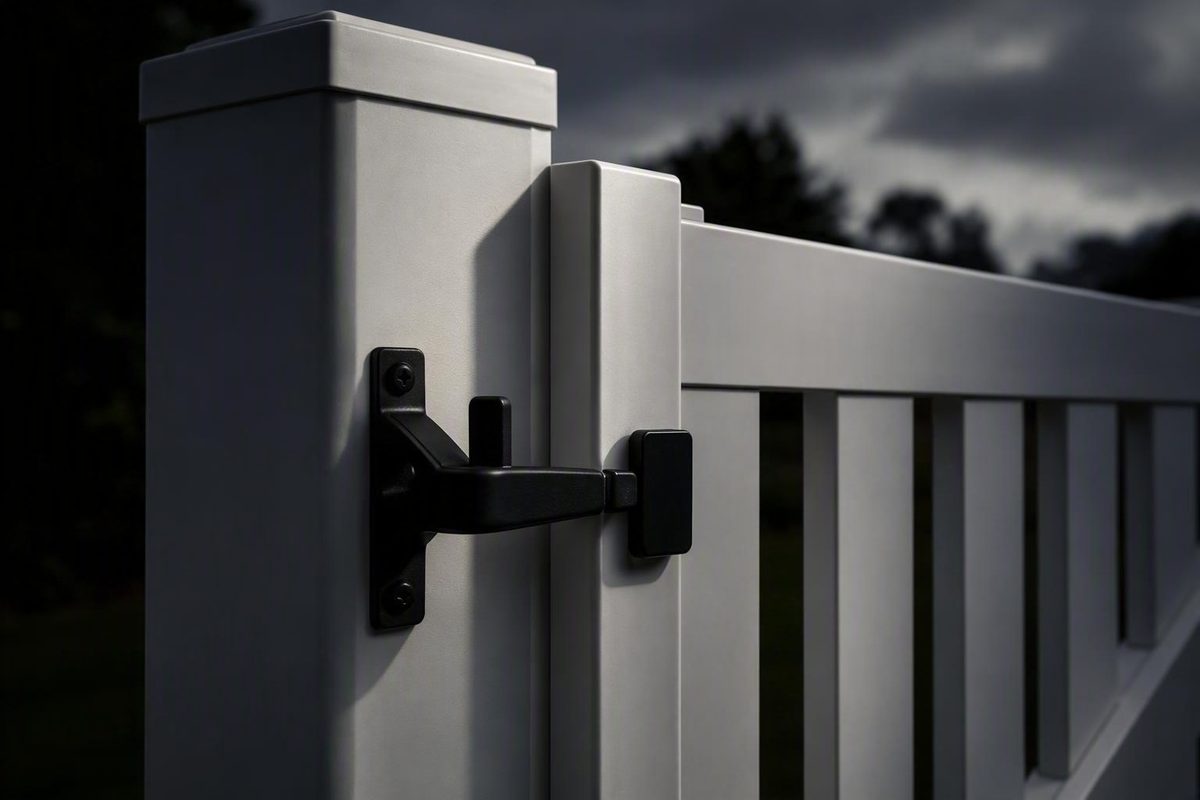
The right latch for a vinyl gate is the one that fits the gate’s mounting geometry first and meets its access or locking needs second. Measure the post, gate upright, closed-gate gap, striker position, mounting surfaces, and swing direction before comparing features. Treat “vinyl compatible” as a catalog category—not proof of fit—and do not drill until the exact model’s dimensions and instructions match your gate.
Start here: match the latch to your measurements and access needs
Record these six items before shopping:
- Latch-post dimensions: Measure the width and depth of the stationary post where the latch body or keeper will mount.
- Gate-upright dimensions: Measure the width and depth of the moving vertical member.
- Gate-to-post gap: Measure the clear gap while the gate rests naturally in its closed position. Do not push or lift it into alignment.
- Latch setback and striker position: Record the horizontal and vertical relationship between the intended latch-body and striker locations.
- Available mounting surfaces: Look for trim, routed rails, caps, hinges, handles, or uneven faces that could obstruct a bracket or fastener.
- Swing direction: Record whether the gate swings left or right and which side of the gate you are viewing.
Next, define what the latch must do. A garden gate may need closure only. Another gate may require a separate padlock, an integrated key cylinder, operation from both sides, or automatic engagement when it closes. These are separate functions, and each can change the hardware layout.
Retail catalogs sort gate hardware by criteria such as post size, frame size, gate style, material, finish, and locking feature. Hoover Fence, for example, provides post- and frame-size filters alongside one- and two-sided access, key-locking, pad-locking, and non-locking categories. Those filters illustrate why a broad “vinyl” label does not establish physical fit for a particular gate (Hoover Fence gate-latch catalog).
If a listing omits the required gap, bracket dimensions, fastener locations, or mounting instructions, stop before drilling. Find documentation for the exact model or ask the seller for it.
Choose the latch function: basic, padlockable, keyed, or magnetic
Use the gate’s everyday operating pattern to narrow the category.
| Latch type | Access method | Separate lock required | Two-sided operation |
|---|---|---|---|
| Basic or non-locking | Lever, ring, gravity, or manual catch | No | Model-dependent |
| Padlockable | Manual latch | Yes, for locking | Often limited; verify access side and shackle clearance |
| Integrated keyed | Built-in key cylinder | No | May be one-sided; verify cylinder location |
| Two-sided keyed | Keyed release from both sides | No | Yes, when expressly documented |
| Magnetic | Magnetic engagement and a separate release | Model-dependent | Model-dependent |
| Self-latching | Engages automatically at the striker | Model-dependent | Not implied by self-latching action |
For every type, verify handle reach, release side, striker alignment, gap tolerance, mounting dimensions, and the exact locking arrangement.
Self-latching describes automatic engagement. Keyed, padlockable, and two-sided describe security or access arrangements.
Retail listings show how these features can be combined. Direct Fence lists a post-mounted latch as horizontally adjustable and padlockable. Deck Expressions lists a polymer push-button latch as self-latching, keyed from both sides, and intended for posts and gate uprights at least 1 inch wide (two-sided polymer latch listing). Other retailer listings include magnetic, narrow-strike, and double-sided keyed configurations. These examples show different arrangements, not a quality ranking.
For any two-sided locking latch, consider how people are expected to enter and leave before buying. A retailer’s product description does not establish that the hardware is suitable for every location or use.
Fit guide: standard, extended, narrow-strike, and adjustable designs
Terms such as standard, extended, narrow-strike, wide-striker, and adjustable describe different mounting arrangements, but the supplied product listings do not support universal definitions or dimensions across brands.
Horizontal adjustment can help position the latch and striker. In every case, use the exact product drawing and listed dimensions rather than the category name.
| Documented retailer example | Listed fit detail | Possible shopping use | Still verify |
|---|---|---|---|
| Direct Fence post-mounted latch | Fits 4- and 5-inch vinyl posts (listing) | A gate using a documented 4- or 5-inch post | Upright width, gap, footprint |
| Jake Sales adjustable latch | Requires a 3/4- to 1-1/2-inch gate-to-post gap (listing) | A measured gap within that range | Variant, mounting faces, instructions |
| Keystone metal two-sided keyed latch | Supports a 1/2- to 1-3/4-inch gate gap (retailer listings) | A measured gap within that range | Post depth, key access, striker position |
| Two-side narrow-strike flange latch | Marketed for narrow gate frames | Limited striker-mounting width | Flange dimensions and clearances |
Jake Sales also states that its adjustable latch can be installed on a left- or right-swing gate and includes mounting hardware. Vinyl Solutions Unlimited lists the Keystone metal keyed latch with a template and instructions, while its narrow-strike listing does not establish complete dimensions for every gate.
Consider a gate with a measured 1-inch gap. That dimension falls within both the Jake Sales range of 3/4 to 1-1/2 inches and the Keystone range of 1/2 to 1-3/4 inches, according to their respective retailer listings above. Both therefore pass an initial gap check, but neither is automatically a fit. Post width, gate-upright width, striker geometry, swing direction, access side, and mounting instructions still have to agree.
Adjustment may make final positioning easier. However, the listings do not establish how much sag or post movement an adjustable latch can accommodate. Correct gate-alignment problems at their source rather than treating latch adjustment as a structural repair.
Materials and finishes: compare specifications without overpromising lifespan
Retail catalogs include latch hardware described as stainless steel, zinc-plated or powder-coated steel, nylon, polymer, aluminum, and zinc. Listed finishes include black, white, stainless steel, galvanized, chrome, and others (Hoover Fence catalog).
A material named in a title may describe only the body, bracket, or visible housing. It may not identify the spring, pivot pin, striker, cylinder, screws, or connecting rod. Where corrosion exposure matters, look for a component-by-component description rather than relying on one “stainless” or “polymer” label.
Powder coating, zinc plating, stainless hardware, and seller-reported salt-spray testing are useful specifications, but they do not prove that a complete assembly is rustproof or predict its service life at a particular property. Product listings may not identify every internal or supplied component.
For a wet, coastal, poolside, or deicing-salt location, verify:
- Latch body and bracket material
- Striker material
- Springs, pins, and cylinder components
- Supplied fasteners
- Finish or plating on edges and holes
- Latch-specific warranty terms
- Replacement-part availability
Choose from the documented component list and warranty rather than assuming one broad material category will always last longer.
What the latch costs—and what may be missing from the box
Because the supplied retailer evidence has no reliable common retrieval date, exact prices should be treated only as undated examples—not current quotes or a representative market average.
The listings show basic or padlockable examples from $21.99 to $40: Vinyl Solutions Unlimited lists individual latches at $21.99, $22.99, $25.99, and $28.99, while Direct Fence lists its post-mounted latch at $40. The same Vinyl Solutions Unlimited page lists magnetic or two-sided keyed options from $54.99 to $83.25 (vinyl-gate latch listings).
Specialty stainless-steel products can be listed above $100. Hoover Fence, for example, displayed a stainless-steel quick-catch latch at $146.88 to $184.80. These figures may change with inventory, variant, discounts, and seller updates.
Compare total project cost rather than latch price alone. Confirm whether the package includes:
- Latch body and striker
- Mounting screws
- Keys
- Push button or connecting rod
- Drilling template and instructions
- Handle or padlock
- Hinges
- Any support required by the gate system
Direct Fence’s $40 post-mounted listing included black self-tapping screws and described the latch as horizontally adjustable, padlockable, and compatible with 4- and 5-inch vinyl posts. Deck Expressions’ $59.99 polymer listing included a latch, striker, seven 1-inch screws, a push button, a push rod, and two keys (polymer latch package). Retailer catalogs also list combined hinge-and-latch kits.
Included hardware does not prove installation suitability. Confirm the package, color, model, price, instructions, and mounting requirements when ordering.
Installation-readiness checklist for a vinyl gate
Print or save this checklist before making holes:
- [ ] The gate closes squarely without being lifted, pulled, or forced.
- [ ] The latch post, gate upright, gap, and setback match the exact model.
- [ ] The striker can engage the latch without rubbing or binding.
- [ ] The swing direction and inside/outside access arrangement are correct.
- [ ] All required latch, striker, screw, key, rod, and button parts are present.
- [ ] The manufacturer’s instructions or drilling template are available.
- [ ] The gate’s construction and any required internal support have been identified.
- [ ] Hinges and posts hold the gate in consistent alignment.
- [ ] Key cylinders, handles, and padlock openings will remain reachable.
Determine whether the intended mounting area is hollow, reinforced, or backed by another structural component. A package containing self-tapping or self-drilling screws does not establish that those screws alone are suitable for every vinyl post or upright.
Correct significant hinge sag, a loose gate frame, or post movement before positioning the striker.
After installation, cycle the gate repeatedly without guiding it into the latch. Confirm that it engages from its natural resting position and releases from each intended access side. Retain the instructions, model information, spare keys, and purchase record for adjustment or replacement parts.
Pool gates and other safety-sensitive locations require a separate code check
A product name, retailer category, magnetic mechanism, or “pool gate” description does not establish compliance with a pool-barrier code.
Before buying for a pool barrier or another safety-sensitive location, check the current rules that apply to the property and compare them with the exact product documentation. If suitability is uncertain, ask the authority responsible for the property’s requirements before purchase or installation.
Do not infer that a keyed, magnetic, or self-latching product is child-safe or approved for a particular safety application merely from retailer wording. Two-sided locking also warrants a location-specific review of how the gate must be used.
Choose by fit before features: record the post, upright, gap, striker position, mounting surfaces, and swing direction; then select the required closure and access type. Buy only when the exact model documentation confirms the measurements, mounting requirements, and included parts.
Will a vinyl-gate latch fit a 4-inch or 5-inch post?
Some will. Direct Fence lists one post-mounted model for both 4- and 5-inch vinyl posts (product listing). Confirm the remaining gate and mounting dimensions before buying.
Can a vinyl-gate latch work on either a left- or right-swing gate?
Certain reversible or adjustable models can. Jake Sales states that its adjustable latch supports both left- and right-swing installation. Verify the exact variant and diagram because bracket orientation, striker placement, and access side can differ.
Are mounting screws normally included with a vinyl-gate latch?
Many listings include screws or mounting hardware, but not all listings establish the contents clearly. Check the exact package list and installation instructions rather than assuming that hardware is included or suitable.
Can a vinyl-gate latch lock or open from both sides?
Yes, when the exact model is designed for it. Retail examples include two-sided keyed latches and an adjustable latch marketed as lockable from both sides. A padlockable or one-sided keyed latch does not automatically provide two-sided operation.